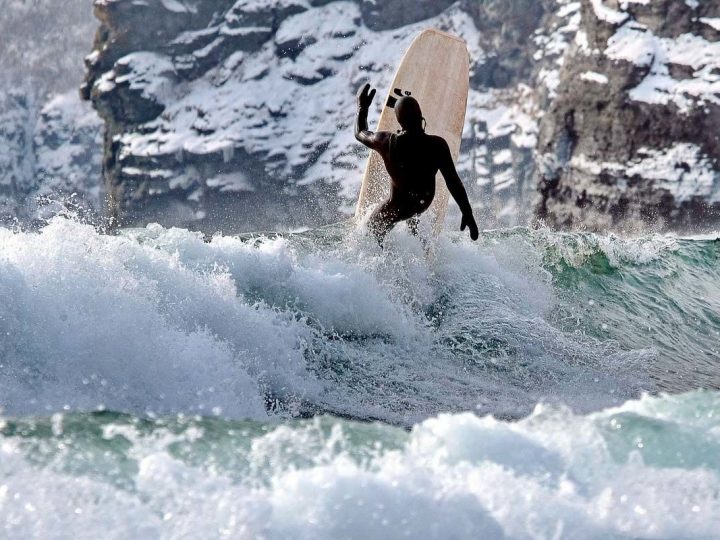
В конце 19 века коренные жители Гавайских островов стали возвращаться к истокам в новых условиях в составе США и серфинг, как часть коренной культуры, стал активнее практиковаться на лодках и досках. Повсеместно открывались новые отели, отдыхающим на островах богатым американцам стал интересен необычный вид водного спорта и они стали его осваивать.
Важную роль в популяризации серфинга за пределами исторической родины сыграли не только известные для каждого серфера люди 20 века – Александр Хьюм Форд, Дюк Каханамоку, Джордж Фрит, Джек Лондон, Марк Твен и Агата Кристи (о них речь пойдет в следующей части), но и малоизвестные авторы и художники века девятнадцатого. Обо всех этих людях пойдет речь в этой статье.
Содержание:
- Первые художественные изображения серфинга 18-19 века
- Первые упоминания о серфинге в прессе 19 века
- Первые упоминания в литературе 19 века
Первые художественные изображения серфинга
До 1900 года выходило множество книг с иллюстрациями серфинга, не ставших такими популярными, как книги известных писателей чуть позже. Выкладываем для вас эту интересную галерею с подписями, датами и местом их публикации.

Charles Gold: Catamaran surfer, Madras, India, 1800. (detail) The earliest known image of surf riding.
Charles Gold: Catamaran surfer, Madras, India, 1800. The earliest known image of surf riding.
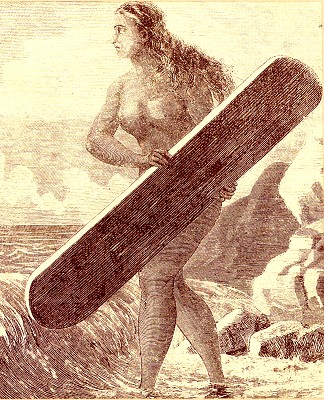
sHawaii1800_BpWahine_BishopM_NatH_p8
Wahine and surfboard, circa 1875. This important early board portrait image is only preceded by Pellion’s The Houses of Kraimokou, (circa 1819).
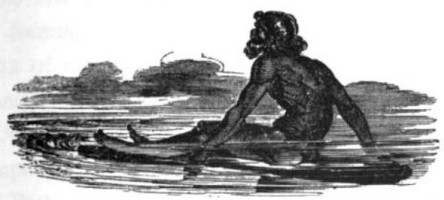
rbKing_Western_Intertropical_Australia_1827_Raft (1)
1818 Phillip Parker King: Raft rider, off Lewis Island, Northern Australia.
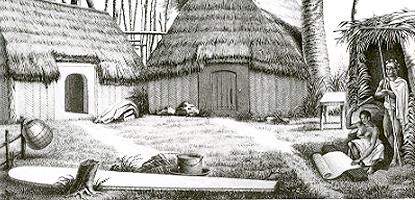
1819_Arago_Hawaii_Finney_Houston_p37
Jacques AragoorAlphonse Pellion: The Houses of Kraimokou, circa 1819. First image of an Olo board.
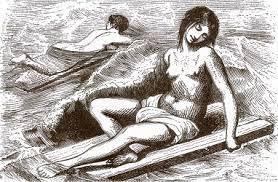
Isaac Taylor: Surf Swimmers, (Sandwich Islands), 1830. The earliest known image of Hawaiian surf riding.
Isaac Taylor: Surf Swimmers, (Sandwich Islands), 1830. The earliest known image of Hawaiian surf riding.
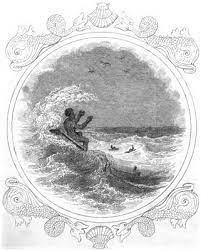
1831_Howard_Finney1996_Frontp
F. Howard: Sandwich Island Surf-riders, 1831. Often cited as “The first Western image of surf-riding.” Illustration from Ellis, Rev. William: Polynesian Researches: Hawaii. Fisher, Son and Jackson, London, 1831, frontpiece.
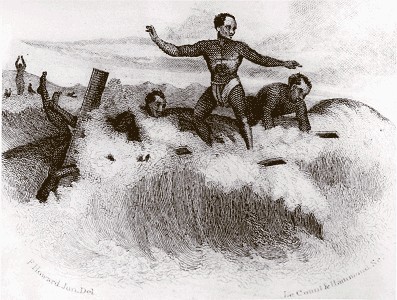
1841_Olmsted_Surf_Play_Leuras_p40
F. A. Olmsted: Sandwich Islanders Playing in the Surf, 1841.First image of surf riding by the same author and artist.Lithograph by Endicott, New York.
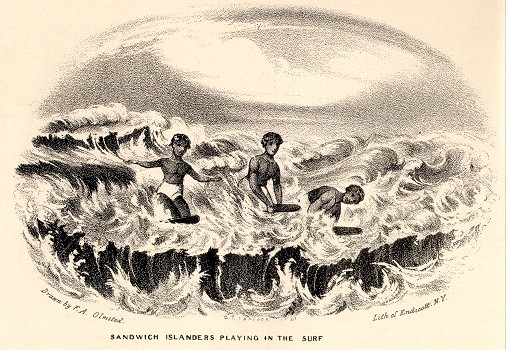
1850c_Hilo_Tin_Severson_Leuras_p48_detail
Hawaiian Surfing, Hilo Bay, Hawaii, circa 1850. Mr. and Mrs. Don Severson Collection.
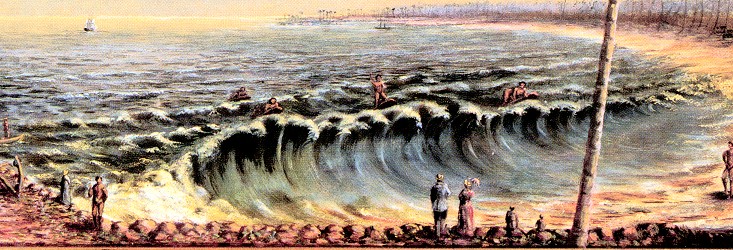
rbCheever_Life_Sandwich_Is_1851_p68f
Hawaiian Sport of Surf Playing, 1851. First surf riding illustration published in a magazine. Published in Cheever, Rev. Henry T. : “The Sandwich Islands Today” The International Monthly Magazine of Literature, Science and Art. Volume IV, Number III, October 1851. Stringer and Townsend, New York. and Cheever, Rev. Henry T.: Life in the Sandwich Islands.
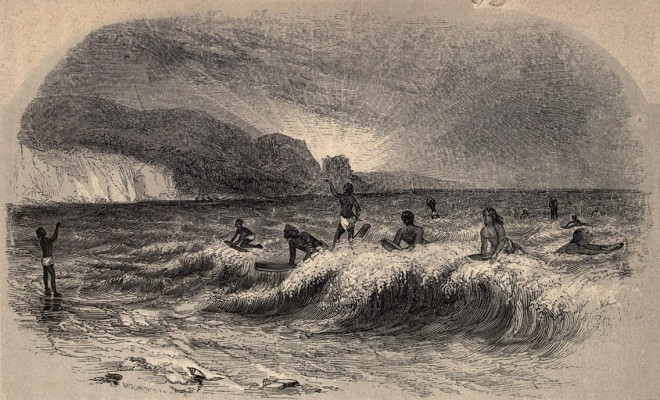
1855_Sawkins_Lahaina_Thoms_p5
James Gay Sawkins : Surfboard, a bathing scene, Lahaina, circa 1855. Water colour, National Library of Australia.
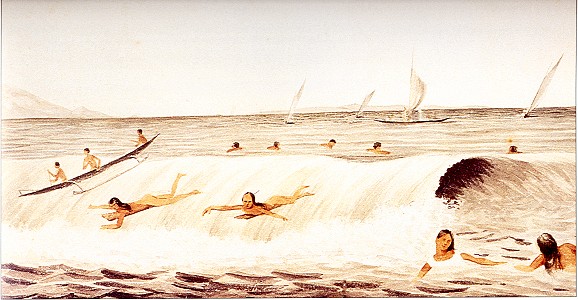
1866_Surf_Swimming_DelaVaga_p5
Surf swimming at Hawaii, Sandwich Islands, 1866.Most likely a copy of Harden S. Melville’s Surf Swimming off the Coast of Hawaii, 1863,above.
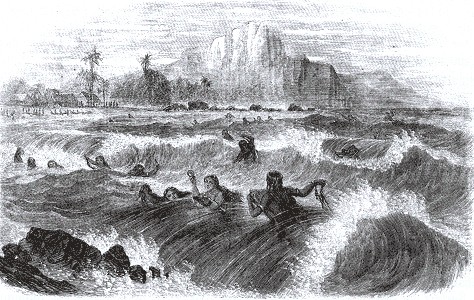
1872_Twain_Success_2ooYSL_p29
Surf-bathing Success, 1872.One of two illustrations to accompany Mark Twain’s account of surf riding in Hawai’i.Twain, Mark: Roughing It.
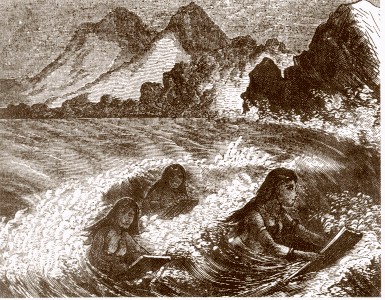
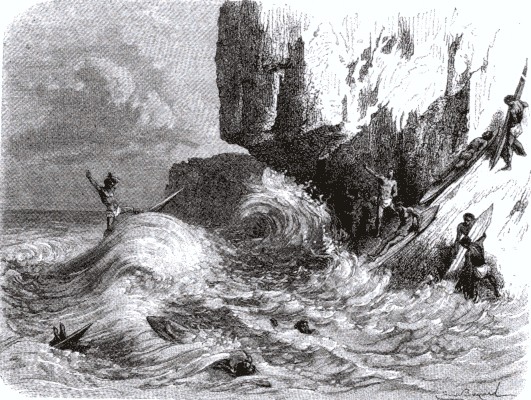
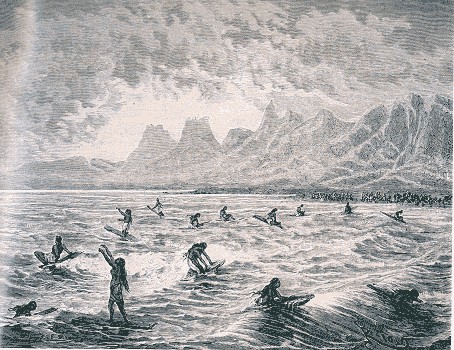
Pacific Rural Press, Volume 5, Number 13, 29 March 1873
Pacific Rural Press, Volume 5, Number 13, 29 March 1873
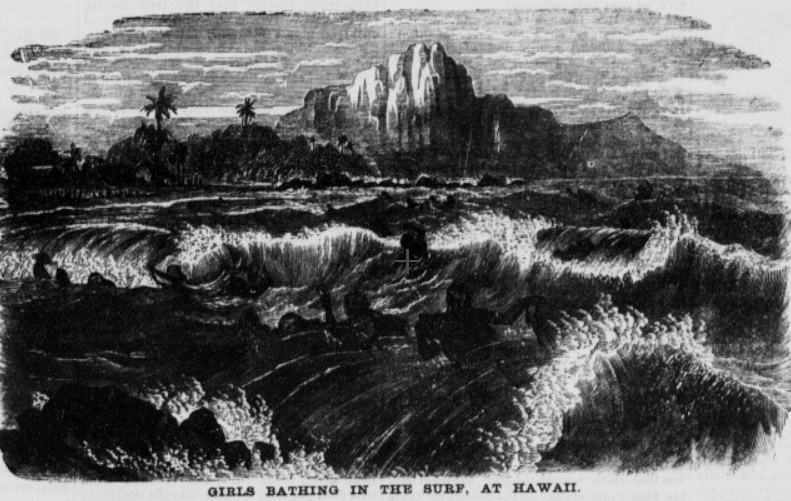
1874_McKay_Nat_Hist_p30
Wallis McKay: Surf-swimmers, 1870. A highly detailed image denoting riding positions, stance, duck-diving, waves in sets, off-shore winds and significant wave height.This is very similar in composition and style to Wallis McKay (1873), see below. Either McKay was responsible for this illustration, or this artist was influenced her work.
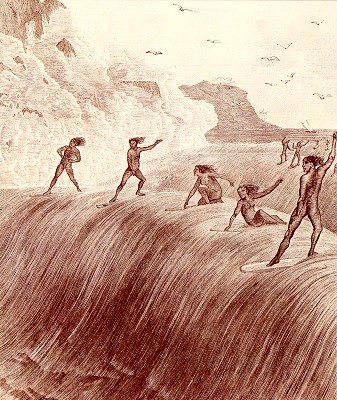
rbBallantyne_Man_Ocean_1874_Ch3_Sth_Sea_Canoe
R. Richardson: South Sea Islanders in Canoe.Engraving: W. Jackson.
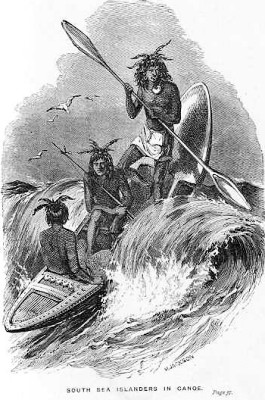
rbBookwalter_California_Sandwich_1874_p185
Clarke: Surf-bathing, 1874.Published inBookwalter, John Wesley:Canyon and Crater; Republic Printing Company,Springfield, Ohio, 1874.
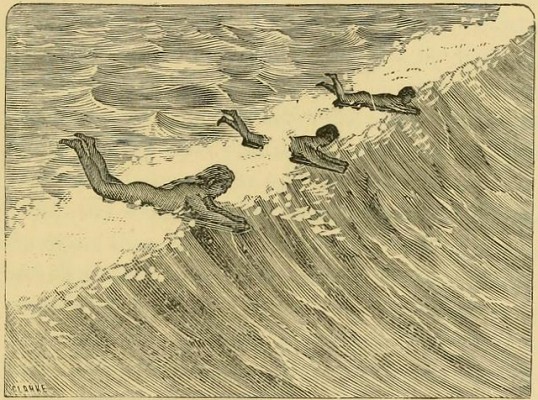
1875_Charlton_Newport_DelaVaga_p22
Jay Charlton: Natives Bathing In The Surf Near ‘Newport’ Three Miles From Honolulu, Towards Diamond Head, 1875. Printed with the article “King Kalakaua at Home” Leslie’s Illustrated Weekly, 23 January 1875.
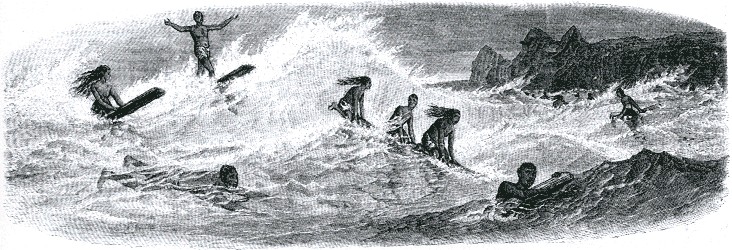
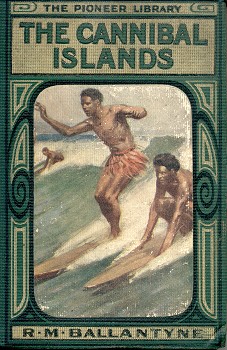
rbBallantyne_Cannibal_Islands_1880jpg
R.M. Ballantyne: The Natives Playing in the Water, 1880.Cover paste down and frontpiece toBallantyne, R.M.:The Cannibal Islands – Captain Cook’s Adventures in the South Seas.Nisbet and Co. Ltd., 22 Berners Street, London, circa 1880.
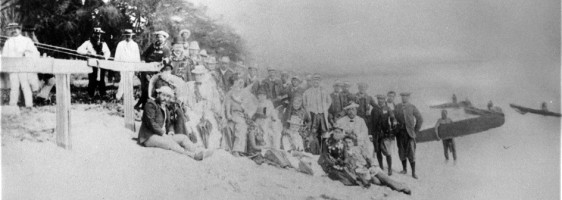
1887_Kalakaua_Dickerson_Haw_Arch_PP-96-14-012 (1)
King Kalakaua, Commodore and Mrs. John S. Dickerson, others, and surfboard rider, Waikiki, 1887
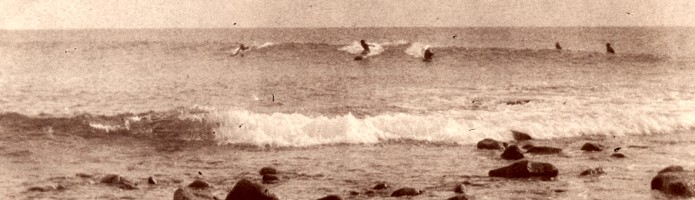
1888_Hilo_surfing_Knox_p32
First printed in Nordhoff, Charles: Hawaii Dei.Harper’s New Monthly Magazine, August 1873. Accredited as”Woodblock by Commander William Bainbridge Hoff(of the flagship California).”
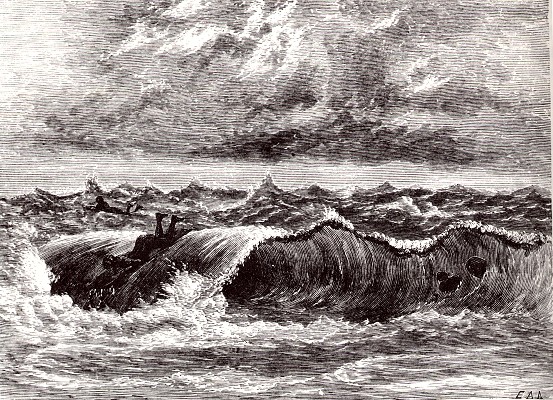
rbSwinton_Geography_1881_p105
The illustration appeared in Swinton, William: Grammar School Geography, Ivison, Blakeman, Taylor, and Company, New York, 1881 It is possibly the geography book illustration recalled by John R. Musick on observing the surfboard riders at Kailua, Hawaii, in 1898, see below.. Perhaps borrowing from Musick, in 1908 Alexander Hume Ford wrote of a similar geography book inspiring his schoolboy dreams of surf riding in his article, Riding Breakers. Ford would virtually replicate the scene, including the grass huts, with the establishment of the Outrigger Canoe Club on Waikiki Beach in 1908.
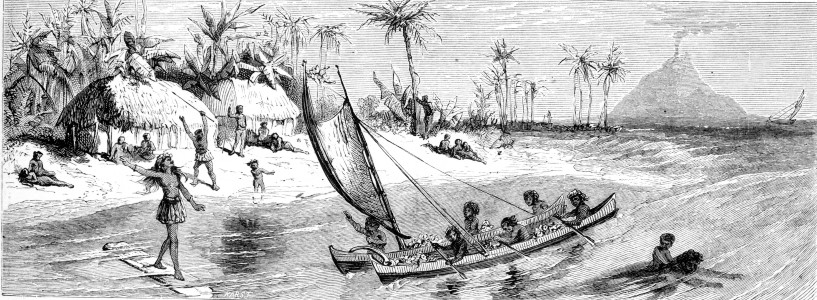
rbGill_Jottings_Pacific_1885_p10
A Coral Island in the South Pacific, 1885. While not showing surf riding, this is a very dramatic illustration of large waves breaking on a coral reef. Illustration from: Gill, W. Wyatt: Jottings from the Pacific The Religious Tract Society, [London], 1885.
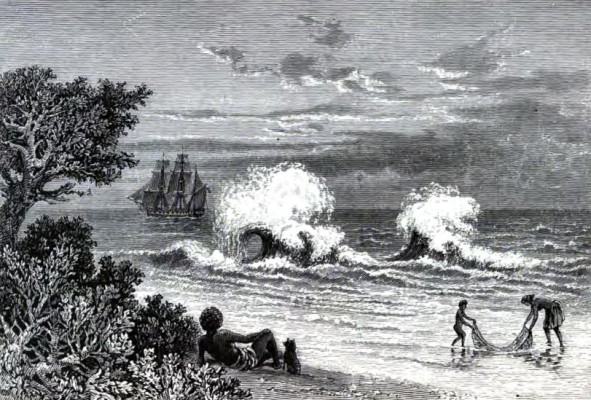
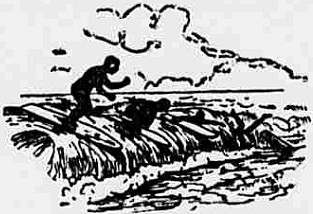
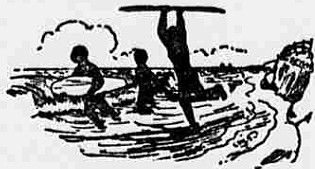
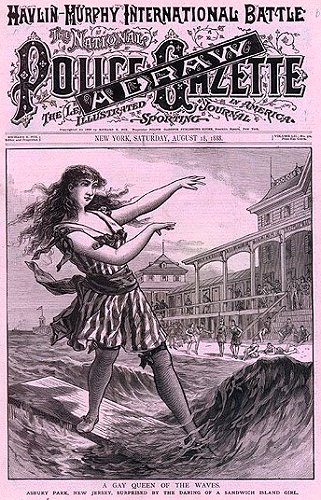
1888_SIG_Police_Gazette_August_18
A Gay Queen Of The Waves, 1888. Published to illustrate an article, Sandwich Island Girl, by a newspaper renowned for manufacturing content. Also note the similarity to the female surfboard rider in Karst: Scene in Polynesia (1881). Front cover of The National Police Gazette August 18, 1888.
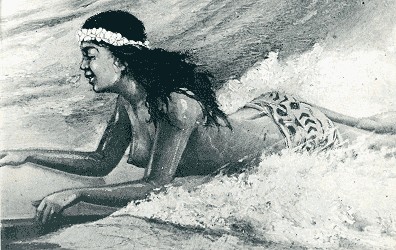
1890c_Wahine_Riding_MarganFinney_p25
Wahine wave-riding, circa 1890. This image, its dating speculation, is only know to appear in Margan and Finney: Pictorial History (1971).
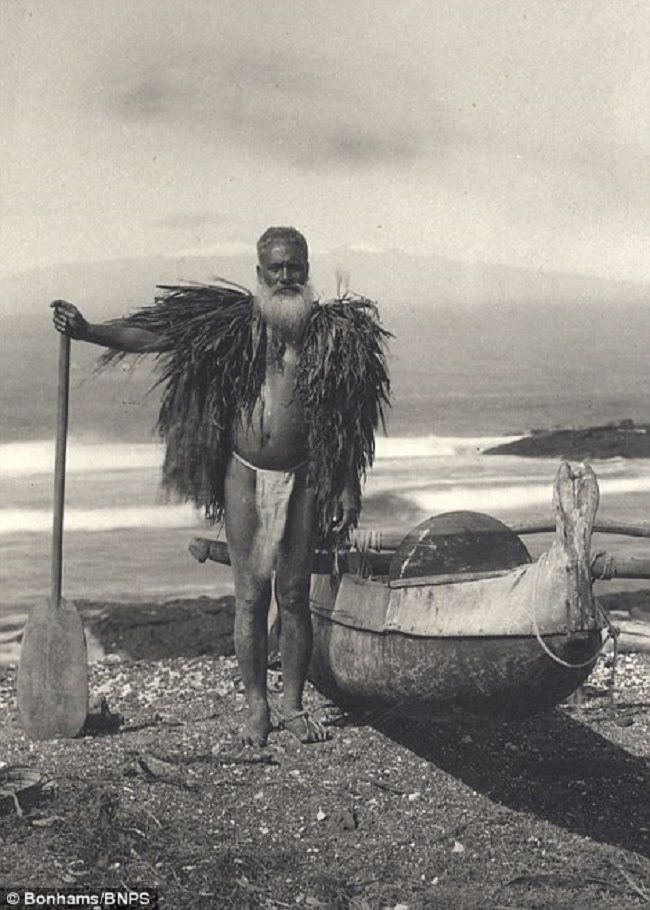
English: Hawaiian fisherman in a malo and ‘ahu lā‘ī, Mauna Kea in background; Hawai‘i. ca. 1890s.
English: Hawaiian fisherman in a malo and ‘ahu lā‘ī, Mauna Kea in background; Hawai‘i. ca. 1890s.
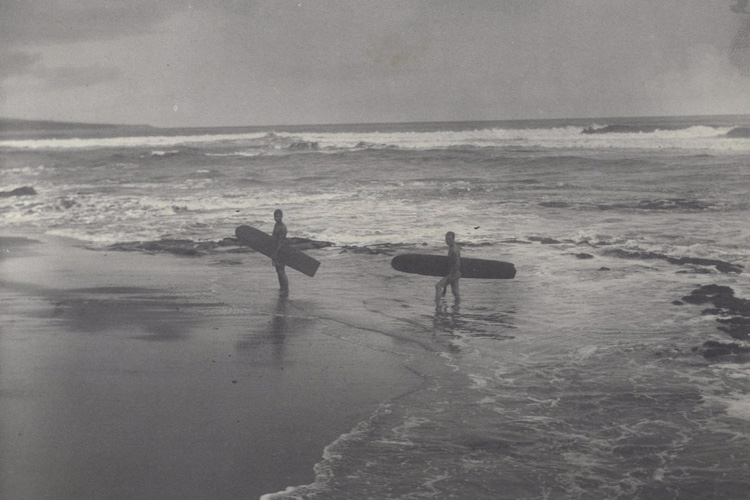
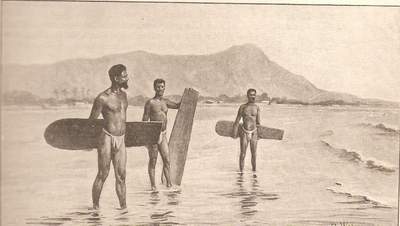
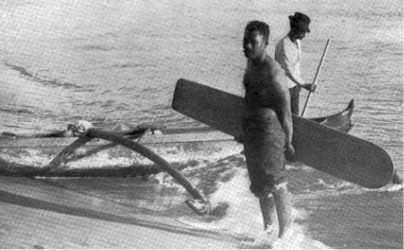
oldestsurfphoto
Historians believe they have found the oldest surf photo ever. It was taken in the early 1890s in Hawaii. Herbert Smith, an amateur photographer born in Manchester, shot two Polynesian natives carrying surfboards on a sandy beach at Hilo Bay, on the Big Island of Hawaii. According to the specialists, the snap is more than 120 years old and was captured three decades before surfing became a proper tourist attraction in Waikiki Beach, Oahu.
rbWhitney_Guide_Hawaii_1890_bc_c
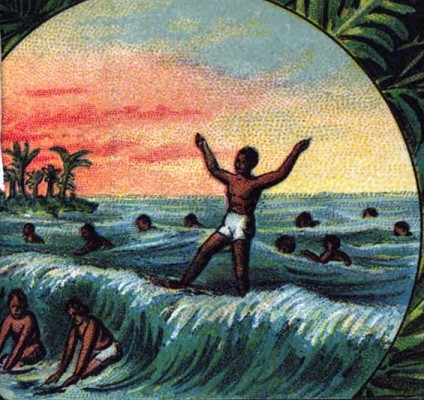
Oceanic Steamship Company: Surf Riding, Hawaii, 1890.Detail from a colour advertisement for J. D. Spreckles and Co. and the Oceanic Steamship Company.Whitney, Henry M. (editor) . The Tourists’ Guide through the Hawaiian Islands, The Hawaiian Gazette Co., Honolulu,1890.
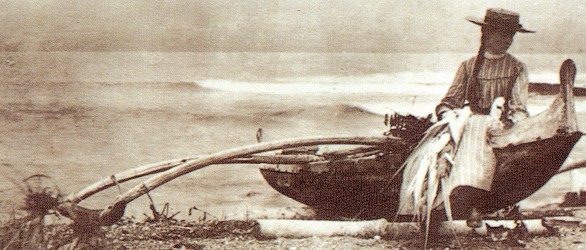
sHawaii1890_Hilo_Canoe_Holmes_p77
Canoe at Hilo Bay, Hawai’i circa 1890. Photograph Charles Furneaux, Bishop Museum.
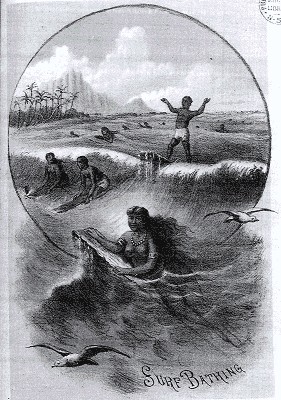
1895_Surf_Bathing_Stoddard_p35
Schmit Litho Co., S.F.: Hawaiian Surf-Bathing, circa 1890.Printed inStoddard, William Charles : A Trip to Hawaii.Oceanic Steamship Company, San Francisco, 1895, page 35.
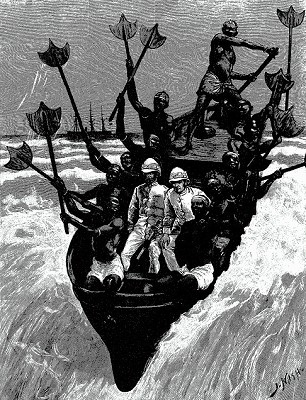
SB1891_Graphic_Accra_08_15_Nash
Joseph Nash – Fred W. J. Airey:Landing in a Surf boat at Accra, 1891.Published in The GraphicLondon, August 15, 1891.
rbLaFarge_Sketchbook_1891_n11p58V
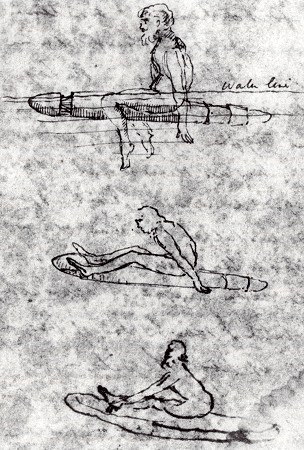
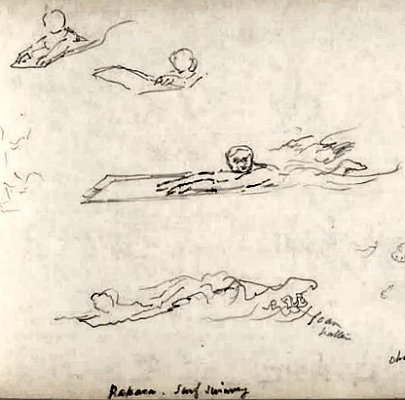
John La Farge: Papara – Surf swimming, 1891.La Farge wrote of surfboard riding at Papara, Tahiti, earlier described by Daniel Wheeler in 1835.These sketches of prone surfboard riders were included in La Farge, John: South Seas Sketchbooks 1890-1891.
Sea Sledging, 1891.In the text the surfboard is called a “sea sledge,” and this crude representation has been amalgamated from several earlier illustrations.Printed inMather, Helen:One Summer in Hawaii.
Sea Sledging, 1891. In the text the surfboard is called a “sea sledge,” and this crude representation has been amalgamated from several earlier illustrations.Printed inMather, Helen:One Summer in Hawaii.
rN_1894_03_24_Evening_News_p3
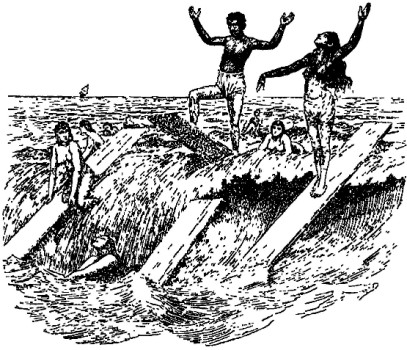
Kelea, the Surf Rider of Maui, 1894.Illustration accompanying:Hawaiian Folk LoreEvening News.Sydney, 24 March, 1894, page 3.
rbThrum_Annual_1896_p111 (1)
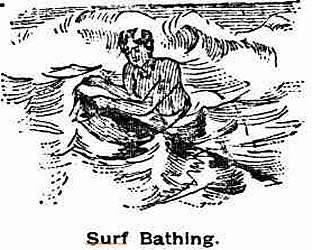
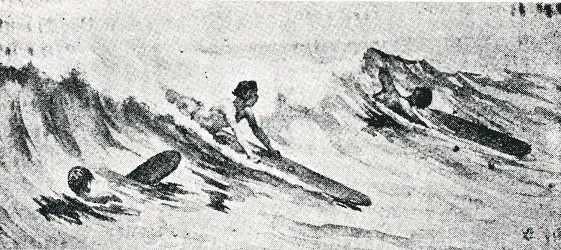
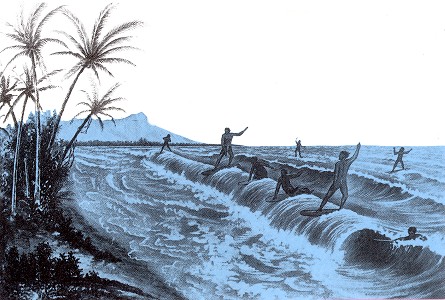
Expert Positions, 1896.Second of two illustrations published inThrum, Thomas G. (editor): Thrum ‘s Hawaiian Annual of 1896.Honolulu, 1896.
1896_Thrum_Annual_Klein1965_p28 (1)
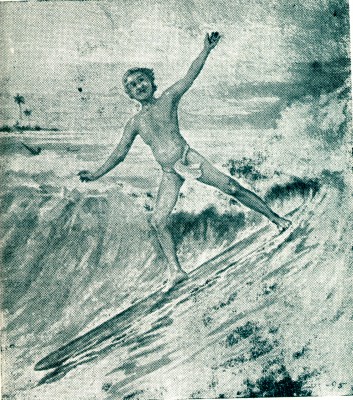
Surf-riding, 1896. Header to the article Hawaiian Surf-riding.One of two illustrations, and a photograph of canoe surfing at Waikiki published inThrum, Thomas G. (editor): Thrum ‘s Hawaiian Annual of 1896.Honolulu, 1896.
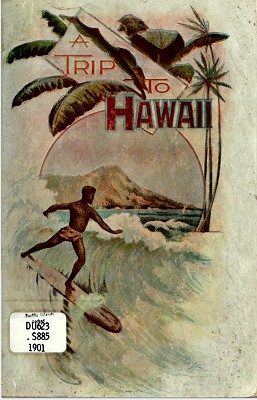
rbStoddard_Trip_Hawaii_1901
A Trip to Hawaii, 1897.Cover forStoddard, Charles Warren: A Trip to Hawaii.Oceanic Steamship Co., San Francisco, 1897. The frontpiece of the 1901 edition included a photograph by Frank Davey: Native with Surf Board, Waikiki Beach, circa 1898.
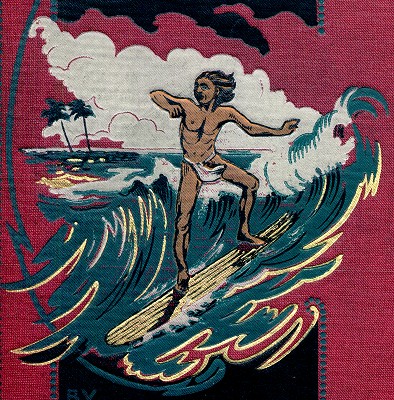
rbMusick_Hawaii_1898_x
Phillip E. Flintoff: Surf Rider, 1898.Cover [detail] ofMusick, John R..:Hawaii – Our New Possessions.Funk and Wagnalls, New York, 1898.
rj1898_La_Nature_n1330_Nov_Weisser_b
Charles Weisser: Surfers, Waikiki, 1898.Printed inLa Nature, Number 1330, November 26th,1898.
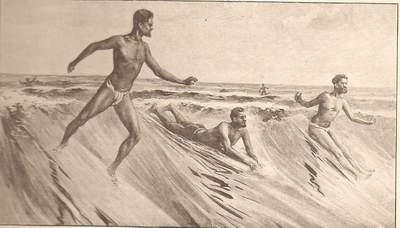
rj1898_La_Nature_n1330_Nov_Weisser_a
Charles Weisser: Surf Riding, Waikiki, 1898.Printed inLa Nature.
rj1899_American_Anthro_v1n2p213
British Museum: Surf-board of hard, blackened wood; length 71 inches, 1899.Printed inCulin, Stewart: Hawaiian GamesAmerican AnthropologistPutman, New York, April 1899.

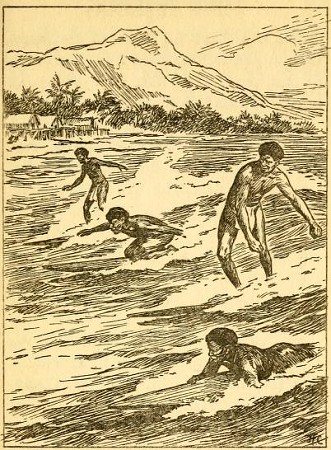
rbHall_James_Chalmers_1910_p21
John F. Campbell: The native surf-riders [Nuie].Although the illustration accompanies text describing surfriding in Nuie in 1867, it was almost certainly drawn from an early Hawaiian photograph, with what is clearly Diamond Head in the background.Printed inHall, A. Gratten: James ChalmersGeorge Dorian Company, New York, [1910].
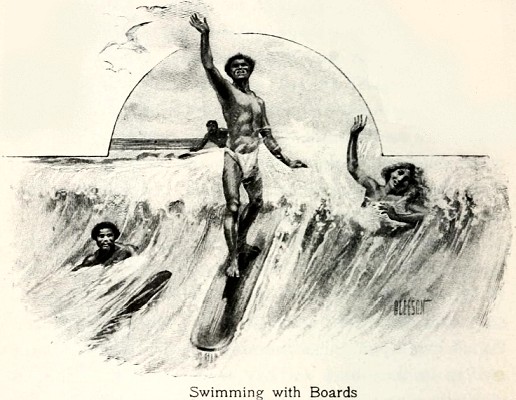
rbKrout_Alice_Hawaiian_Is_1900_p48
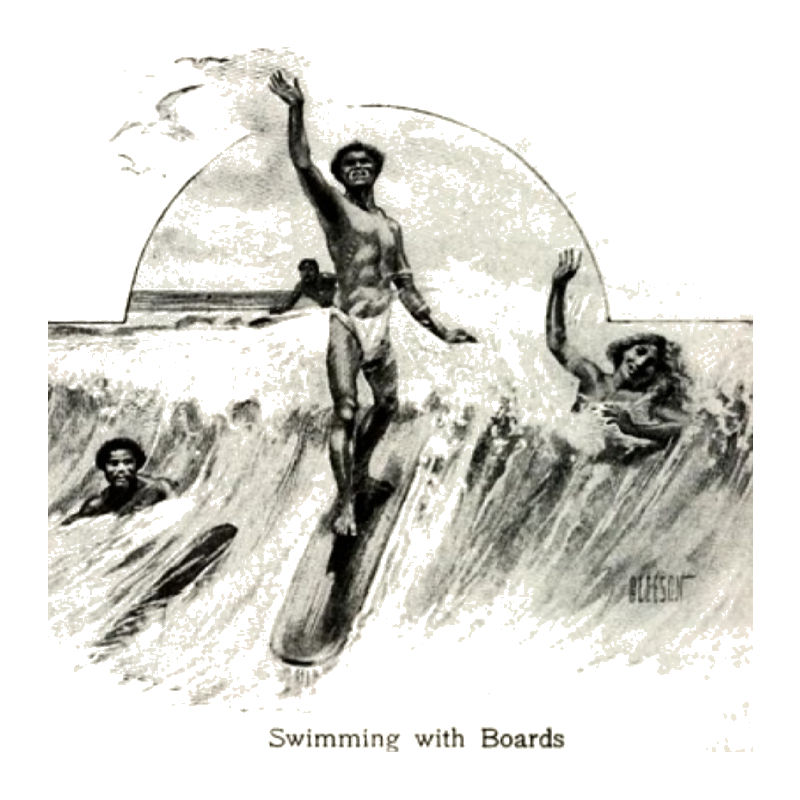
Gleeson: Swimming with Boards, 1900.Printed inKrout, Mary H.: Alice’s Visit to the Hawaiian Islands.American Book Company, New York, 1900.
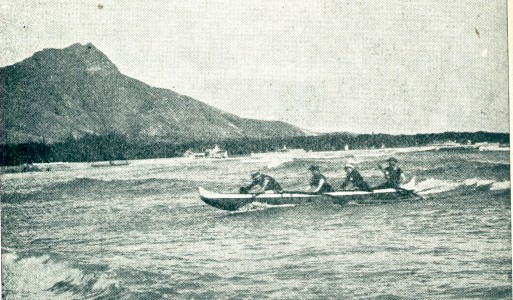
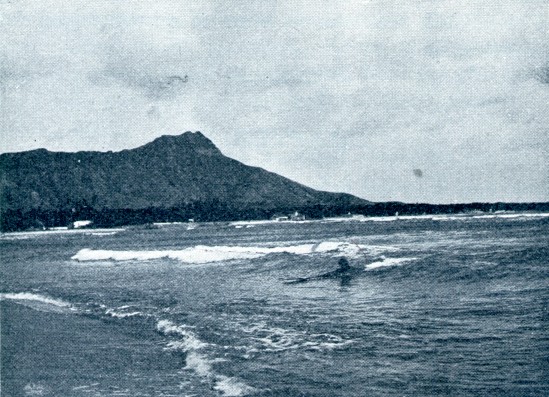
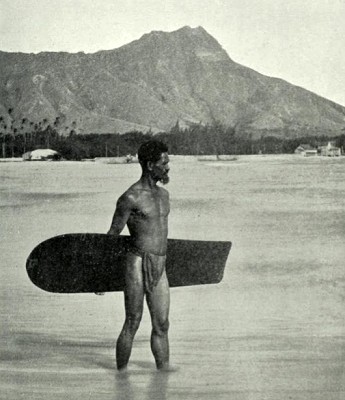
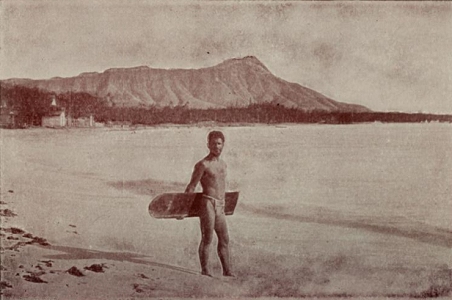
rbOlivares_Islands_Camera_Pencil_1899_p426b (1)
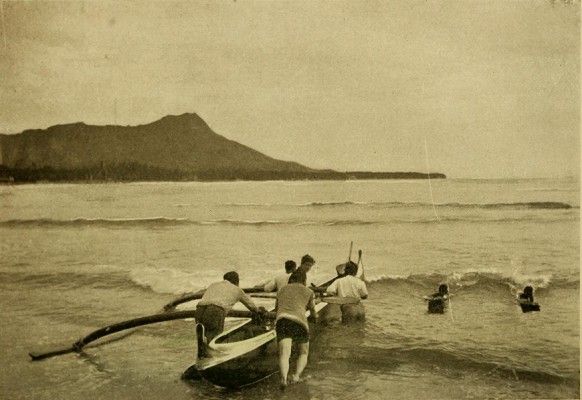
Walter B. Townsend : A Native and his Surfboard, 1899
Серфинг в прессе 19 века
Благодаря архивам, нашлось множество упоминаний о серфинге в прессе 19 века. Удалось выяснить, что серфинг хоть и находился в упадке с 1800 года, но был частью развлекательных соревнований в США и на Гавайях – в итоге его даже сделали коммерческим и серфинг стал частью услуг для отдыхающих богатых людей. В прессе он часто упоминался и описывался журналистами. Примечательно, что серфинг упоминается в прессе Ост-Индии (на тот момент колонии Британской империи) и Австралии задолго до Дюка Каханамоку, хотя, как принято считать, именно он открыл серфинг для Австралии.
Из заметок в прессе можно сделать вывод, что несмотря на всю опасность воды, многие американские и европейские моряки не умели плавать, и для многих было настоящим откровением то, как взаимодействовали с океаном туземцы. Многим морякам принципы серфинга, задержки дыхания и плавания спасли жизнь! Были написаны правила поведения на воде, вероятно – первые в мире.
Ознакомимся с хронологическими заметками о серфинге в прессе 19 века. Здесь не все заметки, которые удалось найти, а лишь наиболее содержательные на языке оригинала.
Connecticut Courier
Bridgeport, Wednesday, 18 September 1822
“Both sexes are surprisingly dexterous in swimming, and so exceedingly fond of water as very frequently to continue in it from morning till night.
One method they have to amuse themselves is called ha-a-nah-roo, swimming with the surf on surf-boards.
These surf-boards are from 6 to 18 or 20 feet in length and from 10 to 20 or 24 inches in width and from two thirds of the way forward, back a little slanted, the fore end rounded, the hind one square ; the sides somewhat oval, and the edges rounded.
They are made of very light wood and neatly polished.
With these boards the natives run an the highest and most terrific surf for many rods with the most astonishing swiftness, steering the board in what direction they please with their hands and feet.
Great numbers may be seen when the surf is augmented to its greatest height is passing and re passing each other with the swiftness of a blrd flying in the air and being as very expert in managing their boards, it is very seldom any one is injured ; though there has been instances where the body has been cut in two in the middle, and where arms have been cut off by the sharp edge of the surf-board, the persons being unable to get out of its way, or those on the board were not able to keep it in its proper direction.
Setting out from the shore, they dive under several of the first wares letting them roll over them, rising successively beyond each wave till they have arrived sufficiently far out into the sea.
Having arrived at the smooth water they recline themselves upon their board, watching a favorable opportunity, they place themselves on the top of the largest surge, and giving their board a small inclination and at the same time using both hands as paddles, they are carried or driven along before the wave with rapidity towards the shore.
And having arrived near the shore, they make a short tern/turn (?), dive under the surf still keeping hold of the board with one hand, then arise at the top of the water and return again to sea.
Should they be separated from their board it would chance to be thrown against the rocks and dashed to pieces, or should they, through miscalculation, approach too near the rocks with which the shore is lined, if they did not in an instant leave the board and dive under the water they would be driven against them and destroyed.
The unparalleled courage and address with which they perform these manoeuvres are truly astonishing.
They will often dive to the bottom where the water is ten or fifteen fathoms deep and bring up things of several pounds weight.
In this manner they dive and obtain several kinds of shell, and other fish, and even the shark does not always elude the grasp of these expert divers, but are sometimes taken by a rope with a slip-knot put over the tail!”
Серфинг на катамаранах (каноэ с аутригером) упоминается в индийской прессе аж в 1838 году!
The Colonist
Sydney, Wednesday 14 March 1838
“VESSELS approaching the-shore at Madras in the East Indies, often find a great difficulty in going into port or landing their cargoes, and passengers, inconsequence of the shallows and the raiging surf which prevail on the coast.
To assist in these purposes, and to act in some measure as life-preservers, there are a number of adventurous natives, who for hire sail through the surf upon things called catamarans, and are exceedingly useful in their perilous profession.
Captain Hall thus describes this class of men, and their fagile machines:-
“These primitive little life-preservers, the catamarans, which are a sort of satellites attending upon the passage-boat at Madras, consists of two or-three logs of light wood fastened together; and are capable of supporting several persons.
In general, however, there is but one man upon each, though on many there are two.
Although the professed purpose of these rafts is pick up the passengers of such boats as may be unfortunate enough to get upset in the surf; new comers from Europe are by no means comforted in their alarm on passing through the foam, to be assured that, in the possible event of their boat being capsized, the catamaran men may probablysucceed in picking them up befored the sharks can find time to nip off their legs!
It is very interesting to watch the progress of those: honest catamaran-fellows, who, live al imost entirely in the surf, and who, independently of their chief purpose of attending the masullah boats, are much employed as messengers to the ships, in the roads,: even in the worst weather.
Strange as it may seem, they contrive, in all seasons, to carry off letters quite dry, though, in getting across the surf; they may be overwhelmed a dozen times.
I remember one day being sent with a note for tihe commandinig officer of the flag-ship, which Sir Samuel Hood was very desirous should be sent on board ; but as the weather was too, tempestuous to allow even a masullah boat to pass the surf, I was obliged to give it to a catamaran man.
The poor fellow drew off his head a small skull-cup made apparently of some kind of skin, or oil-cloth, or bladder, and haviing deposited his dispatches therein, proceeded to execute his task.
We really thought, at first, that our messenger must have been drowned even in crossing the innerbar, for we well nigh lost sight of him in the hissing yeast of the waves in which he and his catamaran appeared only at invervals; tossing about like a cork in a pot of’boiling water.
But by far the most difficult part of his task remained after hehad reached the comparatively smooth space betweenr the two lines of surf, where we could observe him paddling to and fro as if in search of an opening in the moving wall of water raging between him and the roadstead.
In fact, he was watching for a favourable moment, when after the dashing of some high wave, he might hope to make good his transit in safety.
After allowing a great many seas to break before he attempted to cross the outer bar, at length seized the proper moment, and, turning his little bark to seaward, paddled out as fast as he could.
Just as the gallant fellow, however, reached the shallowest part of the bar, and we fancied him safely across, a huge wave, which had risen with unusual quickness, elevated its foaming crest, right before. him, curling upwards many feet higher than his shoulders.
In a moment he cast away his paddle, and leaping on his feet, he stood erect on his catamaran, watching with a bold front the advancing bank of water.
He kept his position, quite undaunted, till the steep face of the breaker came within a couple of yardsof him, and then leaping head foremost, he pierced the wave in a horizontial direction, with the agility and confidence of a dolphin.
We had scarcely lostsight of his feet, as he shot through the heart of the wave, when such a dash took place as must have crushed him to pieces had he stuck by his catamaran, which was whisked instantly afterwards by a kind of somerset, completely out of the water, by its rebounding off the sand-bank.
On casting oureyes beyond the surf, we felt much relieved by seeing our ship wrecked friiend merrily dancing on the waves at the back of the surf, leaping in all directions, first for his paddle, and then for his catamaran.
Having recovered his oar, he next swam, as he best could, through the broken surf, to his raft, mounted it like a hero, and once more addressed himself to his task.
By this time, as the current always runs fast along the shore, he had drifted several hundred yards northward farther from his point.
At the second attempt to penetrate the surf, he seemed to have made a small misdalculation, for the sea broke so very nearly over him, before he had time to quit his catamaran and dive into still water, that we thought he must certainly have been drowned.
Not a wit, however, did he appear to have suffered, for we soon saw him again swimming to his rude vessel.
Many times in succession was he thus washed off and sent whirling towards the beach, and as often obliged to dive head foremost through the waves.
But at last, after very nearly an hour of incessant struggling, and the loss of more than a mile of distance, he succeeded, for the first time, in reaching the back of the surf, without having parted company either with his paddle or with his catamaran.
After this it became all plain sailing; he soon paddled off to the Roads, and placed the admiral’s letter in the first lieutenant’s hands as dry as if it had been borne in a dispatch-box across the court-yard of the Admiralty, in the careful custody of my worthy friend Mr. Nutland.
I remember, one day, when on board the Minden, receiving a note from the shore by a catamaran-lad, whom I told to wait for an answer.
Upon this he asked for a rope, with which, as soon as it was given him, he made his little vessel fast, and lay down to sleep in the full blaze of a July sun.
One of his arms and one of his feet hung into the water, though a dozen sharks had been seen cruising round the ship.
A tacit contract, indeed, appears to exist between the sharks and these people, for I never saw, nor can I remember ever having heard of any injury done by one to the other.
By the time my answer was written, the sun had dried, up the spray on the poor fellow’s body, leaving such a coating of salt, that he looked as if he had been dusted with flour.
A few fanamns- a small copper coin was all his charge, and three or four broken biscuits in addition, sent him away the happiest of mortals.”
The Sydney Morning Herald
2 December 1854
“Surf-bathing is an exciting sport to the swimmer at the Sandwich Islands, and a cause for excitement and astonishment on the part of an unaccustomed spectator.
The swimmers start out from the shore taking with them their surf-boards.
These boards are of dimensions suited to the muscular strength and capacity of the swimmers.
As they proceed seaward, they dive like ducks underneath the heavy rollers, and come up on the other side.
This course is pursued until the outermost roller is reached, sometimes nearly a mile from the shore.
The higher the roller the more exciting and grand is the sport.
Placing themselves on these boards, the bathers gradually approach the inward current of the roller as it sweeps over the reef, and, lying on the chest, striding, kneeling, or standing up on the board, they are borne on the foaming crest of the mighty wave with the speed of the
swiftest race-horse toward the shore, where a spectator looks to see them dashed into pieces or maimed for life.
By a dexterous movement, however, they slip off their boards into the water, grasp them in their hands, dive beneath the yet foaming and thundering surge, and go out seaward to repeat the sport.
This they do for hours in succession, until a traveller is almost led to suppose they are amphibious…”
Polynesian
Honolulu, April 17, 1858
“In DeBow’s Review for February, 1858, is an article upon ” Physical Education at the South,” written apropos of the erection of a southern
University, in which the writer shows that ” gymnastic exercises are called for by social morality, health and mental energy and urges their introduction at every school and college throughout the land.
We copy the concluding remarks of the article :
…
We put our foot on the wrestling-match and the surf board, on the spear exercise and the foot-race, because they might prolong the conversion of the people ; we stripped them of tho exercises and amusements that had formed the warrior race of the -heathen times and ignoring or refusing to furnish them with equally healthy and less doubtful occupation, we virtually drove them, through ennui and as a pis aller, to idleness and its prolific offspring of vices.
In order to brace the mind, we emasculated the muscles, and both already bear the premonitory symptoms of a galloping consumption, to avert which requires instant and energetic remedies.
To know and acknowledge an error is the first step to retrieve it.”
The Courier
Hobart, 25 June 1858
“Coming home one beautiful evening, I met some girls going down to the jetty to see fish which had been caught this calm day ; it was a pretty scene indeed in the brief twilight, the gay looking fish lying on the stones, the people standing about in groups, the water, where the great waves were not rolling furiously in, coloured by the glowing sky.
Some of my companions longed to jump in.
“What, into those great breakers ?”
“That’s the fun” whispered a young girl by my side.
At Pitcairn’s, it seems, ‘the fun’ was to swim out to sea pushing a surf-board before you, and then to come gaily back with it, on the top of a huge roller.
“You can swim,” asked a delicate young mother of one as we stood together; and when I owned my ignorance, the compassionate, half-contemptuous tone of her reply was very funny.
Men, women, and children here take to the water like so many ducks ; the girls think it a great pity that I who am “such a seafaring lady,” do not know how, and offer to teach me.
“You should soon learn from me,” said one, a noble-looking creature, reported, I could believe justly, to be the best swimmer of the party.
Every family had some fish apportioned out to them ; and one, most magnificent, beauteous to behold, was presented to me ; they called it nenetoe, and said that they had had the same at Pitcairn’s; it looked of the mullet kind.”
Polynesian
Honolulu, May 26, 1860
“On Monday last, the good people of Honolulu went to work to enjoy themselves in that determined and emphatic manner which they know so well how to display when they set about it…
The Canoe Race. No sooner was the boat race over than the canoes, six in number, started to run over the same course as the boats in the previous race.
This was a new feature in the spirts of the day, and, in fact, in Hawaiian sports of any kind since the times when the canoe and the surf-board were household words in Hawaii nei, and synonyms with strength and litheness.
The prize run for was a purse of $50, which was won by a canoe owned by the King and pulled by five fishermen, some of whom might have handled the paddle in the days of Kamehameha the Great.”
The Hawaiian Gazette
Honolulu, April 29, 1868
“On Thursday last, April 2nd, as I was riding from Makuu to Hilo, and was in Panaewa woods, about 3 1/2 to 4 miles from the latter place, another shock of earthquake occurred at 3:45 P.M., by my watch, (some minutes after 4 by Hilo watches). This was the heaviest shock we had yet experienced…
At Punaluu, at the moment of the shock, it seemed as if an immense quantity of lava had been discharged into the sea some distance from the shore, for almost instantly a terrible commotion arose, the water boiling and tossing furiously.
Shortly afterwards, a tremendous wave was sweeping up on the shore, and when it receded, there was nothing left of Punaluu! Every house, the big stone church, even tbe cocoanut trees all but two were washed away. The num ber of lives lost is not yet ascertained.
All who were out fishing at the time perished, and many of those ashore.
A big chasm opened, running from the sea up into the mountain, down which it is said lava, mud, trees, ferns and rocks were rushing out into the sea.
The same wave that swept away Punaluu, also destroyed the villages of Ninole, Kawaa and Honuapo.
Not a house remains to mark the site of these places, except at Honuapo, where a small “hale halawa” on the brow of the hill, above the village, still stood on Friday last.
The large cocoannt grove at Honuapo, was washed away, as well as that at Punaluu.
A part of the big pali at Honuapo, on tbe road to Waiohinu, had tumbled into the sea, and people coming from thence are now obliged to take the mountain road through Hillea-uka.
I have just been told an incident that occurred at Ninole, during the inundation of that place.
At the time of the shock on Thursday, a man named Holoua, and his wife, ran out of the house and started for the hills above, but remembering the money he had in the house, the man left his wife and returned to bring it away.
Just as he had entered the house the sea broke on the shore, and, enveloping the building, first washed it several yards inland, and then, as the wave receded, swept it off to sea, with him in it.
Being a powerful man, and one of the most expert swimmers in that region, he succeeded in wrenching off a board or a rafter, and with this as a papa hee-nalu, (surf board), he boldly struck out for the shore, and landed safely with the return wave.
When we consider the prodigious height of the breaker on which he rode to the shore, (50, perhaps 60, feet), the feat seems almost incredible, were it not that he is now alive to attest it, as well as the people on the hillside who saw him.”
Pacific Rural Press
San Francisco, Volume 5, Number 13, 29 March 1873
“At Hawaii, Sandwich Islands, a favorite amusement of the natives, and foreigners who have attained the art, is swimming in the surf and diving beneath its foaming crests as they successively chase each other to the shore.
Our illustration depicts a merry group of native girls each with their surf-board on which they rest, dive or propel themselves along with inimitable grace, ease and safety.
A writer in the Illustrated Press says of the scene:
Hoomauna and all the rest of them are off for the beach now —they say the surf in good to-day for bathing.
Kapello has gone, and beckons us.
We are good swimmers, and why not, with the modest though narrow tapa that hinders nought in action or figure, around the middle of each of us?
A merry, lively crowd.
Noise of surf and laughter, action, motion, grace.
The breakers are certainly stiff; they knock you over again, without the least ado, until you learn to bestow yourself properly- as the natives do.
You quickly learn to dive under each one as it comes along, and to catch your breath in time to be sharp “end on” for the next.
That trick learned, and you presently begin to laugh at the terrors of Neptune yourself.
You venture out; you are all right.
Why should anybody get drowned in the breakers?
Hoomauna comes sailing by on her surfboard at railroad speed.
You try it again and again, but the breaker refuses to pick you up.
You get tossed every time.
There is an art in it more difficult to acquire than skating.
In sheer animal spirits you strike out for the farthest line of breakers beyond the outermost swimmers.
One of the natives beckons you back, but you do not understand what she says or means.
Kapello enlightens you after you have dressed.
“You ought not to have gone out there —it is deeper, and the sharks come in as far as that.”
Memphis Daily Appeal
Memphis, April 20, 1873
“To the beach by all means!” cried and to the beach we hastened, where indeed, we found a heap of cast-off raiment, and a hundred foot-prints in the sand.
What would Robinson Crusoe have said to that, I wonder?
Across the level water heads, hands, and shoulders, and sometimes half-bodies, were floating about, like the amphibia.
We were at once greeted with a shout of welcome, which came faintly to us above the roar of the surf, as it broke heavilv on the reef, a half mile out from shore.
It was drawing to the hour when the fishers came to land, and we had not long to wait before, one after another, they came out of the sea like so many mermen and mermaids.
They were refreshingly innocent of etiquette, at least of our translation of it; and, with a freedom that was amusing as well as a little embarrassing, I was deliberately fingered, fondled, and fussed with by every dusky soul in turn.
“At last,” thought I, “fate has led me beyond the pale of civilization; for this begins to look like the genuine article.”
With uncommon slowness, the mermaids donned more or less of their appare!, a few preferring to carry tneir robes over their arms, for the air was delicious, and robes of sea-weed are accounted full dress in that delectable latitude.
Down on the sand the mermen heaped their scaly spoils- fish of all shapes and sizes, fish of every color; some of them throwing somersaults in the sand, like young athletes; some of them making wry faces, in tneir last agony; some of them lying still and clammy, with big round eyes like smoked-pearl vest buttons set in the middle, of their cheeks- all of them smelling fish-like, and none of them looking very tempting.
Small boys laid hold on small fry, bit their heads off and held their silver-coated morsels between their teeth, like animated sticks of candy.
There was a Fridayish and Lent-like atmosphere hovering over the spot, and I turned away to watch some lads who were riding surf-boards not far distant- agile, narrow-hipped youths, with tremendous biceps and proud, impudent heads set on broad shoulders, like young gods.
These were the flower and chivaly of the Mena blood, and they swam like young porpoises, every one of them.”
The Hawaiian Gazette
Honolulu, December 2, 1874
“In consequence of his delicate state of health Mr. Lambert, the eldest son of an English gentleman residing ot Coqnimbo in Chile, was invited by his friend Capt. Cator, R. N. to accompany him in his cruise to the Hawaiian Islands, in the hope that the invigorating sea breezes might restore him to his former strength and vigor.
When the “Scout” carried Professor Forbes and his party to Kailua, Mr. Lambert was asked by Professor Forbes, who had become much attached to him, to remain there until the return of the vessel from Hilo.
In the interval, however, he had benefited so much from his stay at Kailua that he determined to prolong his visit until the Professor had finished his work there.
The party were accustomed to bathe every morning in the waters of the Bay.
On Friday morning a little before 8 a.m., Professor Forbes and Mr. Lambert went to bathe as usual.
During three days previously a Kona had been blowing into the bay, and having on Thursday seen the natives using the surf-board, Mr. Forbes and his friend thought of trying their hands at it.
They were furnished by the Hon. Simon Kaai, Sheriff and Representative of the District, with surf-boards, he not considering that
there was any danger in so doing.
Professor Forbes entered the water first.
When it was up to his chest, being about thirty yards from the shore, he began to look out for a good wave to try to ride in upon. Not having been successful and happening to look round he found that he was a hundred and fifty yards from the shore, having been carried out by the under current.
He did not however at that time apprehend any danger.
A small native boy, an adopted son or Simon Kaai, now shouted to him, gesticulating and pointing to Mr. Lambert, who was about fifty yards nearer to the shore than himself.
He saw that Mr. Lambert had let go of his surf-board, and was in difficulty.
He then swam with all his strength towards Mr. Lambert, making, however, but little progress against tbe current.
Mr. Lambert wasdrifted towards him.
He was feebly striking out, every wave submerging him.
When about ten yards from him, the Professor shouted to him to keep up five seconds longer.
When he approached him, Mr. Lambert made no attempt to clutch Professor Forbes, as many would have done in similar circumstances, nor did he during the whole time that he was being supported, yield to the temptation.
Professor Forbes now held him up with the assistance of the native boy above mentioned.
It appeared to him that to launch a canoe in the surf then raging (for the sea had increased with the wind since they had entered the water), was a sheer impossibility.
It therefore never ocurred to him to shout for a boat, especially as the natives soon crowded on the shore perceiving their danger. While therefore with his right hand Mr. Forbes held Mr. Lambert under the left arm-pit, he struck out bard for the shore.
He made however no head way, but was drifted farther out, and it then occurred to him that there was no prospect of either of them being saved, and he resolved to hold up his friend until they should both go down together.
The surf was at this time dashing against the rocks at their side so that landing seemed impossible.
There was, it appears, a channel there known to the natives, but of which he, the Professor, was ignorant.
So he continued to strike out for the shore.
In the course of time, Mr. Weeks, the carpenter, and a native came out, and they held Mr. Lambert up between them.
Mr. Weeks, however, being subject to asthma, was soon exhausted and left.
Mr. Forbes again took his place.
The other native was also going off, but owing to the urgent remonstrances of Professor Forbes, remained; even then he would not lend a hand in helping to support poor Mr. Lambert.
They now saw that the people on shore were attempting to launch a canoe.
Ten minutes after Professor Forbes became absolutely exhausted ; his arms lost their power, and it was only with the greatest difficulty that he was able to hold on to Mr. Lambert, every wave engulphing them both.
He had now been dead some minutes.
Professor Forbes was in the position of clutching Mr. Lambert’s arm, and raising his head out of the water, then obliged to let him down a little, and using his last strength to keep afloat enough to get breath occasionally, when a native called Kaea (who with the best swimmer had been inland, but rushed down to the shore on seeing tbe canoe brought out) whom the waves bad hitherto hid from his sight, appeared.
He relieved the Professor of the dead body of bis friend to save whose life he had made almost superhuman efforts and with his
great strength raised him out of tbe water.
The canoe, which took twenty mintues to come out, then reached them, although a holewas broken in it while being launched.
The Professor with the dead body of his friend was put into it, and reached tbe shore in safety.
Mr. Lambert’s body was taken to a house and laid on his back with his bead on a pillow, his jaws though slightly open were firmly locked, and it was found Impossible to get his tongue out.
Both the plans publithed by tbe Royal Humane Society of London were tried in vain.
Hot water was applied to his feet, his limbs were rubbed by the native women to excite circulation, but all to no purpose, and brandy was poured down his throat.
The body was then taken to the house in which Professor Forbes and the party were residing, and carefully laid out on a bed.
Mr. Barnacle went to Kona to see tne English clergyman, the Rev. Mr. Davies, and Mr. Weeks went for a coffin.
Great credit is due to Simon Kaai for his attempts to aid Professor Forbes and his friend, he (Simon Kaai) stated that he was much flurried, and that was why he did not think of a canoe sooner.
Thanks also are due to Mr. Bergman, a German resident here, for coming off in the canoe, and likewise to the stepmother of Simon Kaai for the same service.
Mr. Lambert met his end, as all who knew him must have felt that he would, with fortitude and resignation, it is believed that he died without pain; and the calmness of his expression showed that he died in peace.
Mr. Lambert’s early and untimely death is deeply and deservedly mourned by Capt. Cator and the Officers of H.B.M.S. Scout, and by all who knew him.
How little they all thought that the soil of Hawaii was to give him a grave!
The conduct of Professor Forbes, in whose arms Mr. Lambert drew his last breath, and who, with unequalled courage and devotion, risked and would have sacrificed his life to save that of his friend, is beyond all praise.
On the 21st the body ol Mr. Lambert was conveyed to Honoull, by native bearers under the charge of Mr. Kaai, and followed by Professor Forbes, who was obliged to be carried In a wagon, and by Mr.Barnacle.
There, in the little English Church Yard belonging tn the mission, with his country’s flag for a pall a fitting canopy for one who had met his end with the courage of in English gentleman, the mortal remains of Charles Lambert found their last resting place.
Until a stone can be sent out from England, the spot will be marked by an oaken cross made on board H.B.M.S. Scout by the direction of Captain Cator, and conveyed to Kona by Lieut. Clutterbuck last Monday.”
The Hawaiian Gazette
Honolulu, June 16, 1875
“Miss Adelaide Miller, the Hawaiian songstress, was the beroluc, a short time prior to her departure for San Francisco, of an adventure, perhaps, unlike any recorded in the wildest production of fancy, certainly nothing of equal romance has been made public.
Miss Miller was on a visit to some friends at Waikiki, a celebrated watering place near Honolulu, and also noted as the summer residence of the Hawaiian Kings.
It is a great place for surf bathing – almost every hour of the day during the season shoals of dusky figures being visible balutnic surfing the breakers.
The waters near the shore are considered safe, but outside oh the reel are tabooed, on account of the shark, which are found in immense numbers.
Woe to the daring swimmer that veulures that far.
Once beyond the reef he may as well make his will in favor of the nearest Bats, for his fate is as certain as the deplellou of a friendless toper’s exchequer by the voracious sharks of a police court.
One day Miss Miller was enjoying a surf bath with a number of her companions.
Like most of the islanders, she is amphibious, as much at home in water as upon land, swims in fact like a fish, and has a national reputation as a diver.
While so engaged, one girl proposed they should swim out to the reef.
The suggestion was not followed, fear of the monsters there abounding being the excuse.
This did not intimidate the girl who made tbe proposition.
She resolved to go thither herself, and finally bantered her companions into following her example.
As they approached tbe reef a canoe passed them, the natives calling, ” Mano ! Mano!” (shark! shark!) also urging them to hasten to the canoe for safety.
But, before the terrified girls could move one way or the other, a huge blue shark surged in among them, and, rising to the surface, lifted Miss Miller out of the water.
In her terror she grasped one of the shark’s upper lips.
This proceeding, as well as the burden upon its back seemed to terrify the monster, for it darted off at a speed that would easily outstrip the fastest ship, keeping however, upon tbe surface of the water, it kept along at this pace for about sixty yards, still bearing tbe Hawaiian maid upon its back, when it suddenly plunged downward, forcing the fair rider to let go ber hold, and leaving her unscathed after her perilous adventure.
She was soon picked up by the canoe, and, with her companions, returned In safety to Waikiki.
This adventure raised Miss Miller very highly in the estimation of her country people, by the bulk of whom the shark is held sacred, and still worshipped.
Even after a century of Christianity, this superstition prevails.
The Kanakas will not kill a shark except in self-defense, nor will they eat its flesh, though this is estimated s delicacy among most of the South Sea Islanders.
The fact that a Hawaiian had ridden a this so sacred (and, we may add, voracious), was indeed a subject for panegyric, though we question whether the highest eulogist would induce the sweet-voiced Maulan to again cavort upon the back of an azure-sklnued “mano.”
[The above is a fair specimen of a sensational reporter’s efforts to manufacture news.
Miss Miller doubtless related the story of the old native Hawaiian woman, who, some twelve years ago, rode across Wailua Bay on the back of a shark, as published in the P. C. A., at the date of the occurrence of this remarkable feat, which is believed to have been a fact, as there were several eyewitnesses of it.
The reporter has made Miss M. the hero of a story, which is being copied far and wide in American papers.”
The Hawaiian Gazette
Honolulu, June 13, 1877
“A large crowd went down to the beach to witness the ancient sport of surf-riding, but the Committee of Arrangements, however efficient in other respects, had failed to provide a high surf, consequently this part of the programme fell through, and all that was seen it was three or four score of juvenile aboriginals splashing about in the blue waters.
Chronicling America.”
The Pacific Commercial Advertiser
Honolulu, June 16, 1877
“But the “He’e nalu,” or surf riding, did not come off, for the reason that Father Neptune was unpropitious, and failed to furnish the requisite billows.”
The Hawaiian Gazette
Honolulu, June 20, 1877
“The above day was celebrated on Monday, June 11th, with a lively eclat.
The sports were altogether native, and illustrated in a striking manner to the observation of foreigners, the ancient skill and prowess of Hawaiians.
The situation and all the surroundings of this place are most favorable for the display and observation of gladitorial action.
A smooth and pleasant, yet gentle, banked up beach enables spectators to stand on the very brink of a grand surf-bounding tide, and on this occasion all the people of the ancient Hawaiian capital were there to witness, as foremost sports, a match of Hawaiian swimmers.
Four stout and well-framed men, showing their glossy brown bodies and the swell and fold of well-wrought sinews, stood up in a line with girded loins, like the ” mamalahoa” or special warriors of the Conquerer, and, at a signal, they dashed into the surf, and swam towards the “Nettie Merril,” that lay about a quarter of a mile offshore.
The four heads kept about an even line till they rounded the schooner’s stern, but as one bushy head came foremost out from under the Nettie’s bow, and was recognized by the throng of people as a Lahaina favorite, then the shouts ran along the shore and again as he came along almost neck and neck with a stout contestant, and the other two at his very heels, the outcries of friends and of an excited multitude drowned the roar of the now surging tide.
Now, louder and londer was the human roar as the foremost men, whose straining stare was now plainly to be seen on the shore, came in on the great rollers hand over hand, and as Paeola the favorite struck the sand hardly an arm’s length beyond his stout competitor, there went up a shout from tbe multitude load and prolonged that must have waked the memories of ancient contests on Lahaina’s shore.
The foot races, of both men and boys, were spirited and well contested, and awakened the highest enthusiasm.
The climbing of the lofty flagstaff was a stirring illustration of Hawaiian daring.
And the donkey and bag races, with all their comical mishaps and incidents, convulsed a well amused multitude with roars of laughter.
But the surf riding, the pre-eminent Hawaiian sport, attracted an earnest attention, as the dignified Governor Moehonua had his chair planted, like King Canute, in order to observe more closely by the sea marge, where the far lapping tide came to wet his feet.
Poepoe, the champion surf rider of Hawaii, took part in this contest, and there was a murmur among the spectators as this splendid athlete appeared on the beach with his board that the judge of the games might as well give him the prize at once.
But there was another, and very special matter of interest in this contest; a woman was to contend with men in this daring and dangerous pastime.
Though past her youth, yet this woman was of a comely form, which was but slightly concealed by the scant pa-u.
Her long flowing hair, and well rounded limbs glistened pleasingly through tbe green translucent white crested combers, through which she lightly made her way seaward, along with three stalwart male companions, till they reached tbe outerline of surf swell.
This surf is grand at times at Lahaina ; and the old gods wanted the old capital to have a treat this day.
The towering, combing waves rushed and thundered like an avalanche upon the beach.
There were alternations of greater and lesser waves.
Now those bold navigators on their tiny craft, are waiting for a great swell.
Here it comes, – upward, the swelling long liquid ridge arises.
It towers aloft and rushes onward to engulf the shore.
And onward came the children of old ocean, – coming, – sliding, and dancing on her crests.
Poepoe with outstretched arms like an ancient warrior about to hurl a spear, comes erect on his swift flying keel ; but where is Nakooko, the woman?
– Keeping her tiny craft well aslant the insurging tide, she shoots like a flying fish through the whitening foam, and as though Thetis would favor her daughter, she jostles the champion on his wonted plank of victory, and so the flowing hair and the rounded form came in foremost amid the out-cries of a delighted multitude glad that the woman had won.”
Colonies And India
London, October 4, 1879
“Madras itself is not a particularly interesting place, yet there are many things worth seeing in that flat and level city; though we observe that the description of them does not occupy quite twenty pages of the Handbook.
As for our own impressions, we thought that the exciting work of landing through the surf- riding on the crest of a gigantic wave and then being swiftly whisked ashore by strong and swarthy arms was the best thing about Madras, except indeed the performance of the same operation when we took our departure.
How we envied the independence and pluck of the amphibious natives dancing over the dangerous surf on their tiny catamarans.”
The Riverine Grazier
Hay, NSW, Wednesday 4 January 1882
“- Mr Conway very kindly offered to get up some surf-bathing at a short notice, and the offer of one dollar brought out half-a-dozen surf-riders instantly.
These, poor fellows jumped into the water, and swam out through the breakers about three-quarters of a mile from shore – just outside the furthest rollers – taking their surf-boards with them.
How they manage this is a mystery to me.
They use their hands and legs in swimming out seawards, like other people : and unless they stick the surf boards on to their chests with patent mucilage, or carry them in their teeth, I cannot tell how they do get them out.
They appear to lie on the boards on their faces, and somehow they do get oiutside the breakers, boards and all, and there they balance themselves in the water and wait for the big roller to come along.
When they see it coming they quickly swim to just in front of the curling top of the breaker just as it begins to form itself.
Their object thenceforward is to keep exactly in that position.
They start lying upon their board at full length; face downwards, and by paddling rapidly with their hands they can keep just in the place necessary for their safe and rapid journey.
Well, after Mr Kanaka has fairly started on this rapid journey, he has to look out sharp that his board does not turn under him, or that the comber does not overtake him.
Should either of these accidents happen, the surf rider disappears in the twinkling of an eye, and is rolled over and over like a log.
Should he keep his place all right, he is rushed along at a speed of at least forty or fifty miles per hour towards the shore, where he lands on water knee-deep, having been carried with this great velocity riding on a plank half-an inch thick, lying almost entirely on the surface of the watrr – about three-fourths of a mile – in less than one minute. I timed this feat several times.
The swimmer’s sometimes wait a long time for a good big roller.
Half-an-hour is not too long.
The surf was high on the occasion, and there were plenty of upsets, but finally all got safely ashore, and some, went back again three times.
Altogether surf-bathing struck me as being- about the most wonderful thing l was likely to see in the islands.”
The Pacific Commercial Advertiser
Honolulu, October 21, 1884
“We have been permitted to publish the following interesting report made to the Minister of Foreign Affairs by Mrs. Beckley, on her return from a holiday trip to Molokai:
“Your Excellency,
I obtained during my recent vacation on Molokai the following articles for the Museum:
An old surfboard has been promised me from Lahaina.
All the above things were given to me by people who would not sell them, being old family possessions.”
The Sun
New York, August 28, 1887
“We have just returned from a feast given by the King in honor of a company of Masons numbering 100 that came here not long ago from California.
The feast was what the natives called a luau
The road to the King’s country residence, where the luau was given, was so full of carriages us to remind one of the picture of Englishmen going to the Epsom races
The King’s ground are at Waikiki, a distance of three miles or so out of town along the beach.
When we reached the place we found a lot of seats on the wide lawn under the trees and a great many people occupying them.
The native band was furnishing very good music indeed.
Their selections were chiefly from “Erminie”, the “Black Hussar” and “Amorita.”
When the King made his appearance the band struck up the national hymn.
He was dressed in a white flannel suit, white canvass slippers, a hat made out of a pumpkin vine, and a le of yellow blossom about his neck.
Le means necklace.
The people all doffed their hats to him as he came near.
He walked in among them and shook hands here and there cordially, and then invited everybody to go down to the beach and see a swimming exhibition.
He led the way to the beach himself thus:
He is about six feet tall, has broad shoulders and a really fine bearing and an intellectual countenance.
As we neared the beach we caught sight of the native swimmers.
When they saw the King and his company approach they ran into the surf carrying boards shaped like coffin lids.
Here is what we saw:
As soon as they had pasted out beyond the breaker into smooth water they mounted the boards by a sudden jump, and back they came riding on the curl of the breaker this fashion:
When one fell off as sometimes happened the rest laughed heartily at him.
The King being present, not many fell off. After looking at the swimmers for a while the King invited his guests over to his house.”
The Daily Bulletin
Honolulu, May 27, 1889
“The surf at Waikiki ran exceptionally high yesterday, probably on account of the southerly wind.
Long Branch bath-house was well patronized as was also the toboggan slide,
Twenty or more native youngsters, on surfboards, rode the huge breakers handsomely, making an interesting picture.”
Los Angeles Daily Herald
August 18, 1889
“A. H. Smith, formerly of the Sandwich Islands, now of Pomona, has organized a “Surf Board Club” at the later town, and is having a number of the Hawaiian surf boats made to use among the breakers at Santa Monica.
Mr. and Mrs Smith went down to Santa Monica yesterday to make a first trial.”
The Daily Bulletin
Honolulu January 25, 1890
“During the high surf of last week, several of our native men gave an exhibition of their skill, in riding the wild surf horse.
They started from the point off Waianuenue street and made a landing on the sands near Richardson’s store.
They did fairly well; but the present generation have not the skill and daring of the old times.
Even it is rare to see a first class surfboard.”
Star
Canterbury, New Zealand, Issue 7044, 22 December 1890
“Christchurch Swimming Club.
Two hours’ amusement was afforded at the West Christchurch school baths on the occasion of the annual display given by the members of the Club.
Among the spectators were a number of ladies.
The arrangements were excellently carried out by the Committee under Captain A. Francis.
The programme began with a display of springboard diving, in which the antics of Mr G. Jackson caused much merriment.
The tub race in heats was won by H. Laurenson, most of the competitors coming to grief in their attempts to navigate their unwieldy craft.
A series of fifty yards scratch races resulted in. a victory for J. Crummie, and the Sub-Captain W. R. Sneddon won the 25yds electric dash.
D. H. Cashbolt won the 50yds steeplechase, Crummie and Jewisa won the pick-a-back race, and Merrie the 50yds back race.
The leapfrog race, African surf-board race, rescue from drowning, all served to show the proficiency of the members.
Mr W. R. Sneddon won considerable applause by plunging 49ft 2in.
The match at water polo between teams from the rival Clubs, East and West Christchurch brought the programme to a close.
This resulted in a win for the Christchurch Club by two goals to one. Cheers being given for the Christchurch Club the proceedings terminated.”
The Roanoke Times
Roanoke, Virginia, October 7, 1891
“A curious pastime which is somewhat in vogue among the natives of the Hawaiian islands, and was more popular formerly than now, is surf-riding.
In the opinion of a contributor to the Journal of American Folk Lore the difficulty of the accomplishment has been exaggerated.
He describes it thus:
Six stalwart men assembled on the beach of a small cove, bearing with them their precious surf-boards.
These boards, in Hawaiian, “wave-sliding boards” are made from the wood of the bread-fruit tree.
They are eight or nine feet long, fifteen or twenty inches wide, rather thin, rounded at each end, and carefully smoothed.
They are sometimes stained black, are frequently rubbed with cocoanut oil, and are preserved with great care, sometimes wrapped in cloths.
Children use smaller boards.
Plunging through the nearer surf the natives reach the outer line of breakers, and watching their opportunity they lay flat upon the board.
The more expert among them kneeled.
Just as a high billow was about to break over them they pushed landward in front of the combers.
The waves rushing in were apparently always on the point of submerging the rider; but unless some mishap occurred, they drove him forward with rapidity upon the beach or into shallow water.
In a high surf it is an exciting sport, and demands skill and experience.
A few days later I was initiated into the mysteries of surf-riding by my host, who is himself quite expert.
I learned the principle, and believe that practice only is needed to gain a measure of skill.
For persons accustomed to bathing in surf the process is far less difficult than is usually represented.”
The Hawaiian Gazette.
Honolulu, November 10, 1891
“A voyage of 28 days from the Golden Gate brings one to Honolulu, the Hawaiian capital.
Rather slow traveling that in these days of steam.
It is a city of thirty thousand inhabitants, fifteen thousand Islanders, five thousand Caucasian and ten thousand Chinese.”
Then follows a glowing description of a city gorgeous with flowers its atmosphere “perfumed with the fragrance of eternal summer.”
After this preface the main subject of the article is broached in the statement that the natives who are said to be a Malayan race are of a light yellow color.
Elsewhere in the article their complexion is described as olive and again the girls are spoken of admiringly as orange colored nymphs.
Then “stroll out in the forests on a Sunday morning and listen to the nature choirs singing in their chapels amid the roar of the surf” if you wish to have a “rare pleasure.
Rare the combination would certainly be on the Hawaiian Islands.
The Hawaiian girl is a famous swimmer that is not news to any of us but we learn now that she is also a born navigator
The snowy sail of her canoe may be seen any day as it rides the “great breakers” of the stormy channels that separate the islands
When not surf bathing or sailing her canoe or taking moonlight horse back rides in her white riding habit if she is not practicing one of the peculiarly graceful dances of the country you may find her sitting on her coral block reading the latest “sea story” or posing over a religious book or possibly the weekly news papers for she is fond of reading.”
The Daily Picayune
New Orleans , Sunday 7 August 1892
“It was far from the strife and weary longings that throb in the pulses of life, that I found the living represents* tire* of this little romance I had been spending two weeks abut off from the world in the little city of Hilo, on the Island of Hawaii,
There were few visitors in this place, but one was a multitude in himself, an Englishman, splendidly formed, with an open, honest face, and soft blue eyes.
Even the lulling air of the tropics could not subdue his animal spirits.
He was traveling purely for pleasure.
“Ladies, ladies,” he cried, “this will never do.
How many have we here? One, two, three, four five; three ladies and two gentlemen and a little half of a woman asleep in that big bamboo chair.”
“Not at all,” cried I, “who could sleep when you’re about to tease?”
“Well, suppose we two wide-awakes stir those sleepy people into life, I have engaged a small craft to sail us along the coast of Hawaii to-morrow, and we will get back in time to see the natives in their great sports on tho beach; and in two days more we will start for our journey to the volcano.”
I fell asleep that night dreaming of the delights before us.
Early the next morning we were up and down by the crude landing, the surf was dashing in with immense force; a small boat with two natives awaited us.
This was to convoy us over the breakers to the little steamer outside.
We had to jump from the dock, as the waves washed the boat up to us.
After much laughing, chaffing and cowardice we were all safely in and with screams and shouts sprang over the breakers.
It was delightfully exhilarating, and I was sorry when we were on a larger vessel.
We drifted along until our every sense was subdued by the beauty before us, even our volatile boat was silent.
The coast of Hawaii is conceded to be the most beautiful on earth.
Up out of the blue sea rose the lofty banks, some two or three hundred feet high, soft, green and velvety, dotted here and there with scarlet, purple and yellow flowers, deep gulches indented the coast, in which the sea rushed breaking over this wilderness of beauty, leaving the whole shimmering or sparkling in the bright sunlight myriads of gems.
The entire coast is covered with a silver fringe, formed by thousands of waterfalls that flow over its banks into tbe sea; it is impossible to count them.
The effect is most charming.
The tall coooanut trees stand like lonely sentinels, seemingly tipping the blue sky.
If Hawaii dazzled our eyes in the blazing sunlight, when that sun faded and left lior subdued the effect was by far more entrancing.
With a sigh of regret we returned, soon sailing into the bay at Hiio.
Along the shore were several hundred natives, shouting, encoring and enjoying in their gay and careless way the sport of surf board riding.
After we landed we joined in the crowd, and became as excited and noisy as the others.
It was a strange aud picturesque scene.
The women robed in their “holokuas,” or gowns, of brightest hues, covered with wreaths, or “leis” of flowers; bare were their feet. It was delightful to see their innocent abandon, to listen to their musical tongue, and the infection from their gay laughter was most contagious.
The men were covered with pale green mele vines, and around their hats bright feathers, or wreaths of shells, or flowers.
Looking out, to sea over the high breakers could be seen a number of bobbing black heads.
The surf-board is a plank shaped something like a coffin lid, about thee foot broad, from six to nine long, well oiled and well cared for.
The men, dressed only in “malos” (a loin cloth), carrying their boards under their arms, waded out from some jagged rocks that projected out into the sea, then swam out a half-mile from shore.
They throw themselves face downward on their boards, then they rode in majestically on the curl of the wave at the speed of forty miles an hour.
The more expert knelt and one man stood erect like a “god of the sea,” and, waving his hands, uttered exultant cries.
“Break, break on through the coming years.
Break at the foot of thy crags
But the grace of a day that is dead, will never come back to me.”
At the dawn of day we reached the hotel, and felt fainting with fatigue upon our couches.
We were revived with tea, and our kindly native women never eeaeed for hours to bring us back to life with their famous “lomi-lomi.”
Sitting around the fire our landlord told us the legend of Pele, which runs, as nearly as I can remember it, thus:
Many years age a king of the islands possessed a lovely daughter, called Pele.
On the island was bom a girl, named Aloha, which means “all love, all good, all welcome.”
The good king adopted Aloha, and she and Pele grew up loving each other fondly.
Pele was fair, Aloha was dark.
At last they grew to womanhood, and Pele, who lived in Honolulu (a native of Oabu), became the betrothed of the crown prince of Hawaii.
The wedding day came, and beautiful Pele clad in royal robes, went forth to meet the prince.
She reclined in a chariot of flowers, grasses, shells and sweet herbs followed by her subjects, in their native dress of grass skirts and wreaths of flowers, bearing gifts of fowl and fish, shrubs and sandal wood.
Fifty timoahad the multitude cheered and the women arouKftoout ttis Woad, manly shoulders ^tt2qXr bright-‘leis,” arid tho men gave, boardrd “mele” vines. But from out this with a tnde his proudly flashing eye ^com.oetU the form of his beloved young juanel^K^^iiRinft, and his child, theirs.” *. forward, and with smiles oonsonaut if.^nds, with teudor grace placed of England \r the gifts that had went uuheede,w04 Up0U h\m, Labaina are those who o.^ woro ft I0be of trayed tbo folliot, loosoly to hor foot. Her of lifo without Hying’ hair touohod thoin them lurked the latent savagery that is hidden beneath a veneer of gentleness in all Hawaiians; her smile showed teeth of pearl, her lips, full and blood red, contrasted well with her bronze hue, her nostrils dilated, her breast heaved with pride and joy, her tiny, shapely feet were bare.
She was barely 17.
She would throw her arms around her Lunalila, and, in the soft Iove tones of Hawaii, thank him.
The cry arose: “Lunalila will ride once more.”
He kissed sweet Lahaina and bounded into the waves
Back he came, with arms folded across his breast, his shapely head thrown proudly up.
In bringing horses ashore on these crude coasts they are made to swim behind a small boat.
One animal became terrified, broke away and dashed the kingly athlete from his course; before be could recover himself he was thrown with great force upon the sharpest ledge of the rocks projecting into the water.
There was a low moan and Lahaina threw her child upon the sands and sprang into the sea,
The weird wail of the Hawaiians began and mirth was turned to sorrow,
Out she swam, her beautiful hair covering her like a pall.
She gained his board, and climbing on the rocks drew him to her, placed him on the board and eamo in to shore; there they sang and wailed, she spoke to him, whispered into his ear, raised his arms around her neck-no answer.
Lunalila was dead.
They carried him to his little home made of grass and palm loaves.
Left alone she prayed to the great Goddess Pele for mercy.
“Thou art angered, but then wilt be appeased? I will give thee all, but give me back brave Lunalila,”
Shs covered him with vines, grasses and flowers, and closing the door,gently took her child in her arms, and stealing out into the moonlight, she said; “Friends, guard your beloved until I return.
I go to pray to Pele.
When I come again Lunallla will awake to life, love and Lahaina.”
Then her young form was lost in the jungle of tropical foliage.
We were deeply awed by this sad event, and I fell to wondering what Lahaina could do to appease the anger of the Goddess Pele which was in reality tbe burning volcano of Kilauea, worshipped by the natives as a deity.
We decided to set out at once for the volcano, and if possible overtake the heart-broken little wife.
We left Hilo at 0 a.m. on horseback for our ride of thirty miles through dense foliage and ever blistering folds of lava to reach the Volcano House.
The beauty of the first flfteen miles was bewildering.
We cut our way through tangled flowers, shrubs, tropical fruits, – exquiiite ferns and palms and cool brooks, our horses plunging in and swimming across; overhead miniature waterfalls and a multi-flora of perfumes, delightful to our every sense.
Our young Englishman was singing to us in a most charming way.
We jogged along, our guides trotting behind on foot.
We emerged from this earthly paradise to find ourselves climbing over ridges and gulobes of lava that had flowed over the country since ten years ago.
We tried walking, soon tired of that; we rode man-fashion.
Our horses fell upon their knees and slipped.
We heard that we would soon reach tho Half-way House.
I felt that rest was at hand.
What was our anguish only to find a tattered grass hut, where we rested five minutes.
The sweet songs of our young friend had died into deep groans.
Up came a storm, down came a rain.
We were drenched
It was growing late, darkness was overtaking us.
Suddenly a oh an go earns over tbe world, a mist gathered before me, tbe world was on fire, aud standing out like a phantom in the red glow stood tbe Volcano House, the house that knows not sunlight or moonlight, but ever stands in tbe fiery glow of Kilauoa.
It was a long, low, log house.
We were taken from our horses and helped into the parlor, chilled, numb and sore.
A warm fire glowed in a large, open grate.
A kindly native woman put us to bed, gave us a good supper and then began that celebrated “lomi-lomi” (what we call massage).
We rested there that night and the next day, going into the volcano by night.
This trip can only be made on foot, and is the most trying and dangerous that can be imagined.
We put on our heavy boots with rubber soles, abort dresses, heavy Buckshire gloves, and staff in hand followed the guide.
Some fifty yards from the hotel we came to a steep wall, and after climbing down almost perpendicularly for one hour and a half we reached the lowest level of the crater.
Then came the long tramp of three miles that cover a sea of fire beneath.
Lava formed into every conceivable shape, deep gaps would appear, and then the cry from the guide: “Look out for the cracks.”
Down we would fall, scorching our limbs.”
Star
Canterbury, New Zealand, Issue 7443, 12 December 1892
“The Christchurch. Amateur Swimming Club held its thirteenth annual exhibition of aquatic sports in the West Christchurch School bath on Saturday afternoon, under very favourable circumstances.
The weather was fine, and the attendance was very good.
The bath was in excellent order, but the water was rather cold for some of the swimmers.
The following are details of the various events:
Spring Board Diving and Procession.- About twenty members took part in this event, and some very neat swimming and diving were shown by them.
Acrobatic Feats- T. H. Harker, A. H. Jewiss and P. Williams performed some very difficult but exceedingly graceful acrobatic feats, including a double somersault off the spring board.
Surf-board Race- D. H. Cashbolt 1, E. Sneddon 2, G. Gray and A. H. White also started.
Won by a yard.
Tub Race— A. P. Blanchard and G. Wark were the only starters, and the latter’s tub sank shortly after the start.”
The Salt Lake Herald.
August 6, 1893
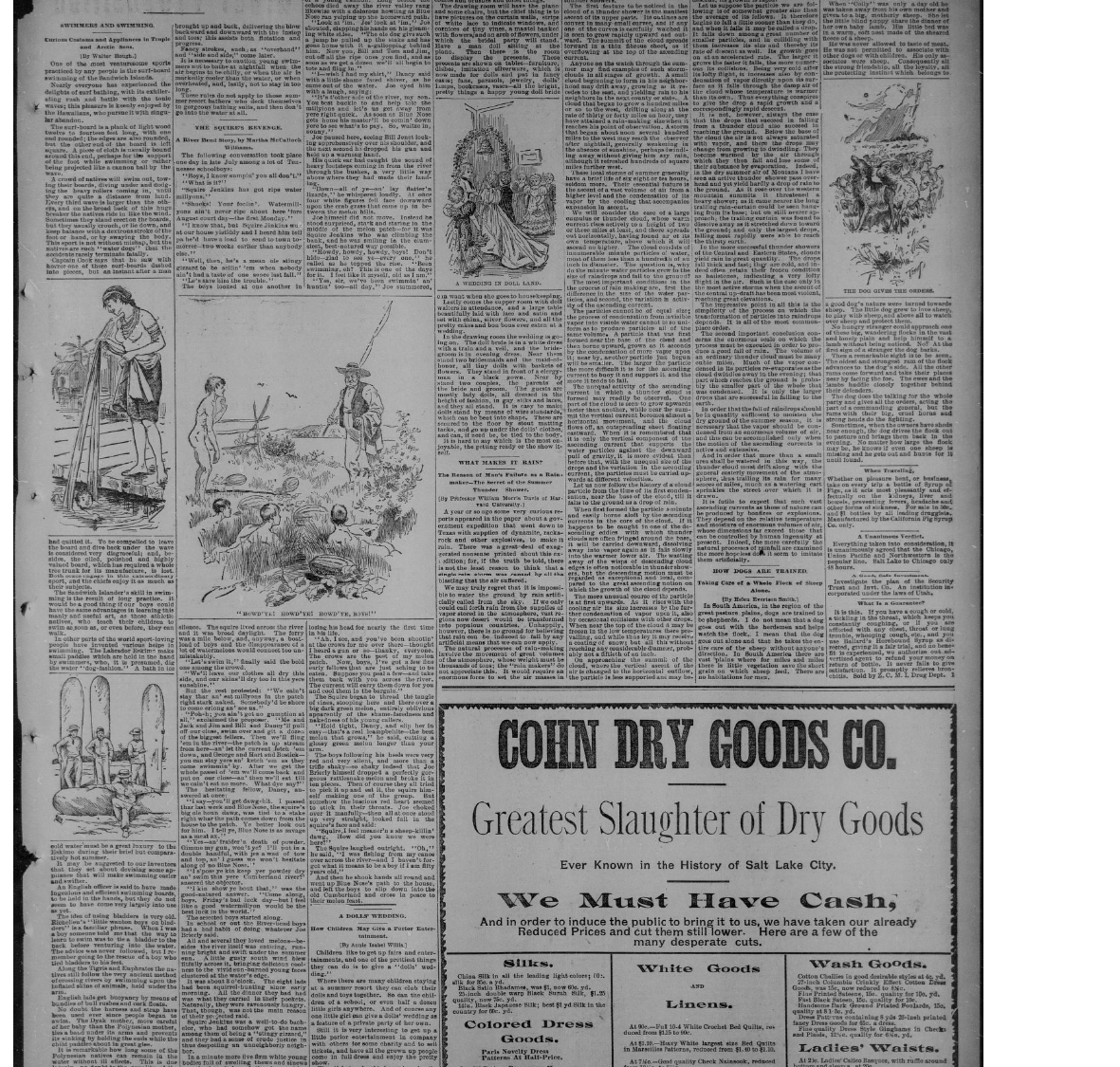
“One of the most venturesome sports practised by any people is the surf board swimming of the Sandwich Islands.
Nearly everyone has experienced the delights of surf bathing, with its exhilarating rush and battle with the tonic waves; this pleasure is is keenly enjoyed by the Hawaiians who pursue it with singular abandon.
The surf board is a plank of light wool twelve to fourteen feet long, with one end rounded ; the edges are also rounded, but the other end of the board is left square.
A piece of cloth is usually bound around this end perhaps for the support of the foot while swimming or rather being projected like a cannon ball by the wave.
A crowd of natives will swim out towing their boards diving under and dodging the heavy rollers coming in until they are quite a distance from land.
Every third wave is larger than the others and on the broad back of this huge breaker the natives ride in like the wind.
Sometimes they stand erect on the boards but they usually crouch or lie down and keep balance with dextrous stroke of the foot or hand or by swaying the body.
This sport is not without mishap but the natives are such water dogs that the accidents rarely terminate fatally.
Captain Cook says that he saw with horror one of these surfboards dashed into pieces but an instant after a man had quitted it.
To be compelled to leave the board and dive back under the wave is considered very disgraceful and besides the oiled, polished and highly valued board which has required a whole tree trunk for its manufacture is lost.
Both sexes engage in this extraordinary sport and the chiefs enjoy it as much as their subjects.
The Sandwich Islanders skill in swimming is the result of long practice.
It would be a good thing if our boys could have the same advantages in learning this manly and useful art as these athletic natives who teach their children to swim as soon as or even before they can walk.
In other parts of the world sport loving people have invented various helps in swimming.
The Labrador Eskimo make small paddles which are held in the hand by swimmers who it is presumed dig the water dog fashion.
A bath in ice cold water must be a great luxury to the Eskimo during their brief but comparatively hot summer.
It may be suggested to our inventors that they set about devising some appliance that will make swimming easier and swifter.
An English officer is said to have made ingenious and efficient swimming boards to be held in the hands but they do not seem to have come very largely into use as yet.
The idea of using bladders is very old.
Richelieus little wanton boys on bladders is a familiar phrase.
When I was a boy someone told me that the way to learn to swim was to tie a bladder to the back before venturing into the water.
The advice was never followed but I remember going to the rescue of a boy who tied bladders to his feet
Along the Tigris and Euphrates the natives still follow the very ancient method crossing rivers by swimming upon the inflated skins of animals held under the arm.
English lads get buoyancy by means of bundles of bull rushes and cork floats.
No doubt the harness and strap have been used ever since people began to swim.
The Dyak mother, more careful of her baby than the Polynesian mother, ties a band under its arms and prevents its sinking by holding the ends while the child paddles about in great glee.
It is remarkable how long some of the Polynesian natives can remain in the water without ill effects.
This is due largely no doubt to the equality of the temperature of the air and water.
The oiling of the body with cocoanut oil may have something to do with it.
In long distance swimming great feats have been performed.
I doubt however if any modern Leander of the sporting world would care to undertake a twelve mile swim as did an Eskimo I call to mind who leaped from a ship wild with desire to return to his native paradise of desolation.
The best way to learn to swim is to practice floating first, keeping the lungs inflated holding the head back allowing the water to fill the ears and then striking the open palms against the water and experimenting on the push it gives.
After a little while one gains confidence from the floating of the body and can strike out.
I found it much easier to learn to swim by using short clawing strokes which help flotation and progress at the same time.
This was called swimming dog fashion
After this dog paddle stroke is learned it is easy to make the full arm strokes by bringing the hands together with the arms straight forward then separating the hands rapidly curving the hands under and bringing them to the first position with the least resistance possible.
At the same time the feet are brought up and back delivering the blow backward and downward with the instep and toes; this assists both flotation and progress.
Fancy strokes such as overhand and side and side come later.
It is necessary to caution young swimmers not to bathe at nightfall when the air begins to be chilly or when the air is markedly cooler than the water or when overheated and lastly not to stay in too long.
These rules do not apply to those summer resort bathers who deck themselves in gorgeous bathing suits and then don’t go into the water at all.”
San Diego Union
San Diego, 29 September, 1893
“On Monday next there will be a grand labor day picnic given at Pacific Beach under the auspices of the various labor organizations of San Diego.
The programme will be quite an elaborate and interesting one. The opening addresses will be delivered by George H. Spears, the popular president of the Federated Traders.
Speeches will be made by Martin Doyle and John L. Dryden. There will be a number of games and racing for both sexes and all ages.
These wil be followed by a splendid exhibition illustrating surf-riding by George McCullough. This is an exciting scene rarely witnessed outside the Sandwich Islands.
Music and dancing will contine all day, and a pleasant time may be expected.”
Ka Nupepa Kuokoa (Hawaiian language newspaper)
Honolulu, 30 September 1893
“Here I am in San Diego in good health.
Note the manner of my residence beyond this letter.
The nature of those above is that they are my employers. My work is that of a fisherman at $25 dollars a month, [but] my pay for surfing is $10 for each day.
It may be true that I’m the most unskilled of surfers there (Hawaii), but I’m the number one surfer here in California.
This is a fine land where all are equal.
I am just like all the others who are staying in this hotel. I met my employers in Honolulu, where Johnson was the previous owner of the Hotel Hawaii.
I won’t tell you the tale of my wanderings that led me here now. That will come later. Because I assume you’d all wonder if I didn’t write, I am sending this letter to you.
I think I’ll stay here through this winter, and then next spring, I’ll wander on to the east to New York. I appreciate this place more than our own in regard to the protection of personal rights of the people. Even the birds are protected by law here, which is the ultimate.
Whereas I can no longer write this letter properly because of the amount of Caucasian people here, I shall close with regards to you and the family.”
The Hawaiian Star
Honolulu, November 23, 1893
“Amoung the natives who will go to the Midwinter fair at San Fancisco under management to the Exhibition Company is James Apu, now in Honolulu from Kauai, who is the champion diver and surf rider of that island.
Many stories of the remarkable feats performed by this man in the water are related.
It is said that he is so expert at diving that he can stay underwater for four minutes at a time and meanwhile catch fish with a spear
and net which he uses while on his submarine visit.
He has no fear of sharks and will take to the water at any time and under any circumstances.
While on board one of the island steamers a little while ago off Diamond Head Apu got fish hungry and jumped overboard, caught
some and returned to the steamer in a few minutes.
In 1884, while at Molokai in a small schooner with three or four other natives, after discussing several bottles of gin the others left Apu on shore and sailed for Maui.
Apu threw off his clothes, tired them in a bundle on his head and swam after the schooner, which he soon caught up with.
The others would not let him in, so he struck out for himself and swam the entire distance, reaching the Maui shore some time
before the others.
The distance is over eight miles and the current swift and dangerous.
Apu will give surf riding exhibitions at the Cliff House on his arrival at San Francisco, and the board which he will use is now to be seen at T.W. Hobron’s office.
This one has been made to order of redwood, which Apu says is preferable to koa, being so much lighter.
It will be painted black, that color being most obnoxious to sharks.
This surf board is 12 feet long, and when performing Apu stands errect on it and goes through a variety of wonderful feats in
balancing, etc.
Apu will give a private exhibition of his powers in surf riding, diving and fishing within three or four days for the edification of a few members of the company.”
The Sun
New York, December 31, 1893
“A House Party in a Famous Suburb of Honolulu – Some of the Social Diversions of the Modern Hawaiian Aristocracy – Poi, Women, and Song, and Dips in the Warm Waters of the South Seas.
Once man who has been twice around the world and is now slowly drifting around on his third tour said to me that he thought life afforded more pleasure in the Sandwich Islands than anywhere else on the globe.
A few miles from the town of Honolulu, reached by a drive bordered with parks and gardens of luxuriant tropical plants and trees, with now and then a cocoanut grove, or an open space through which, on one side the smiling South Sea reached away forever, or, on the other, the dark green mountains rested the eyes and cooled the air, is a suburb called Waikiki.Well, at Waikiki many wealthy people have homes, some on the very edge of the water, which are neither “summer” homes nor “winter” homes, to be closea and deserted half the year.
Their owners have homes in town, but keep the Waikiki places open always, to be occupied by any members of the family or all the family, as the fancy dictates: for a single meal, a night, a week, month, or continuously.
It must have been at Waikiki that the globe trotter referred to lived his South Sea idyl.
One of the most charming places on the beach at Waikiki is owned by a Honolulu merchant whom I had the singular good fortune to meet pleasantly in this country and then to accompany on the steamer from San Francisco to Honolulu.
In that way I became his guest at Walkiki.
He had a beautiful home in the town, but nearly every evenlng drove to the beach.
But, and this is a peculiarity of Hawaiian temperament, he never knew whether he was going to the beach or not until he got into his buggy to do so.
Once during Kalakaua’s reign I breakfasted at his Waikiki place with a party which included my merchant friend, an ex-Governor of Virginia, an English tourist, and Claus Spreckles.
After breakfast we went out intoa beautiful cocoanut grove, where Kalakaua ordered one of his most expert cllmbers to go up a tree and send down some nuts.
By the time the climber had descended, and the King had given an order for some surf riders to take their surf boards to the beach and give an exhibition of surf riding, all the Kanakas were in a delirium of excitement, their own expressions of this emotion constantly adding to It.
The lanai was, I would think, a hundred feet from where the baby surf broke after rolling in over the inside coral reef, the big surf breaking on the outside coral reef.
I don’t know what the temperature was of air or water.
I don’t think any one ever uses thermometers or things like that there.
You know that the air is balmy and soft, and that you are perfectly happy lying in the hammock in pajamas, or lying on the white beach sand in your wet bathing dress and that to be in the water is a luxury.
The native servants might not be accounted very good servants in the estimation of a New York housekeeper.
It takes two or three to do what one Chinese or Japanese will and there are plenty of the latter, if you prefer.
But the natives can do so many things outside of household work which the Chinese and Japs cannot.
I remember one night we were lounging on the lanai with a big moon swinging over us, the baby surf purring at our feet, the big surf sending in a faint, drowsy boom from the outside reef and a groupof natives just beyond the lanai rail softly singing and laughing.
We had all been silent for a long time when our host lazily called one of the servants and gave him some instructions that caused
the wildest delight.
The natives ran out a canoe, and three of them, absolutely nude, embarked.
One paddled, one held a torch, one carried a spear.
They silently moved out beyond the line of inside surf, and there the man with the paddle held the canoe still.
The torch bearer and spearsman stood up.
For several minutes they were as motionless as bronze statues, and at handsome, too, the torch bearer holding his flaming light over his head, the spearsman standing with muscles tense, poised for a stroke.
Suddenly there was a quick, dexterous plungeof the spear and a royal kumu, that big golden fish of these waters, captive.
The men in the canoe announced their prize, and their comrades on the beach danced exultantly.
We had that kumu for breakfast, and the natives seasoned their poi with a little devil fish one of the fishermen caught with his hands and calmly killed by biting the back of its head as it wound its tentacles around his arm.
I saw a Kanaka woman do that once, and her expression was just the same as an American seamstress wears when she bites her thread.
But what I wat going to say is that, while the natives may not makes good house servants as some others, they do something in
compensation.
The picture of those men in that canoe that night might even compensate for the lack of pictures painted on canvas.
Next the ocean was the fancy of the younger members ot the party, and soon from the different cottages came the bathers dressed for the surf bathlng by moonlight in thetiouth sea, where the water affects the whole body as a glass of fine wine sometimes does the palate, as something imparting more than a physical luxury almost, and where the companionship is fitted for just that kind of bathing, is a diversion that can be safely recommended between dancing and supper on an evening in Waikiki.
It is a significant fact that Honolulu was the first community in the world to make practical use of the telephone.
Modern science advances very slowly in Honolulu generally, but when that community heard of the telephone it arose as one man and said, “Now, here is something worth talking about and through.
They stilt tat raw flh jind use
thslr lingers for that purpose, but they use more telephones in proportion to population than New York does.
After learning by telephone that no ship had como in, and excusing himself from his office on the ground that he had something “very important to attend to at the beach,” our host would join us in that occupation nowhere else to artistically perfected doing nothing.”
The Herald
Los Angeles, February 16, 1894
“Amoung the natives who will go to the Midwinter fair at San Fancisco is James Apu, now in Honolulu from Kauai, who is the
champion diver and surf rider of that island.
Many stories of the remarkable feats performed by this man in the water are related.
It is said that he is so expert at diving that he can stay underwater for four minutes at a time and meanwhile catch fish with a spear
and net which he uses while on his submarine visit.
He has no fear of sharks and will take to the water at any time and under any circumstances.
While on board one of the island steamers a little while ago off Diamond Head Apu got fish hungry and jumped overboard, caught
some and returned to the steamer in a few minutes.
In 1881, while at Molokai in a small schooner with three or four other natives, after discussing several bottles of gin the others left
Apu on shore and sailed for Maui.
Apo threw off his clothes, tired them in a bundle on his head and swam after the schooner, which he soon caught up with.
The others would not let him in, so he struck out for himself and swam the entire distance, reaching the Maui shore some time
before the others.
The distance is over eight miles and the current swift and dangerous.
Apu will give surf riding exhibitions on his arrival at San Francisco, and the board which he will use has been made to order of
redwood, which Apu says is preferable to koa, being so much lighter.
It will be painted black, that color being most obnoxious to sharks.
This surf board is 12 feet long, and when performing Apu stands errect on it and goes through a variety of wonderful feats in
balancing, etc – Hawaiian Star.”
Maryborough Chronicle, Wide Bay and Burnett Advertiser
Queensland, 28 April 1894
“The natives of the Sandwich Islands take first rank in this respect.
They are almost amphibious, living quite as much in the water as on the land, and are adept at swimming and playing in the water almost from boyhood.
Lady Brassey has described their wonderful swimming powers.
She says:
“All the kings and chiefs have been special adepts in the invigorating pastime of surf swimming, and all the present king’s sisters are considered first-rate hands at it.
The performers begin by swimming out into the bay, and diving under the huge Pacific rollers, pushing their surf-boards — flat pieces of wood, about 4ft. long by 2ft. wide, pointed at each end, edgewise before them
For the return journey, they select a large wave ; and then, either sitting, kneeling, or standing on their boards, rush in shorewards with the speed of a race-horse, on the curling crest, enveloped in foam and spray, and holding on, as it were, by the milk-white manes of their furious coursers.”
This is a most enjoyable amusement, but only those who have tried it know that its performance is only possible to expert and fearless
swimmers.
The majority of the children in the Sandwich Islands are expert swimmers before they are able to walk.”
The Pacific Commercial Advertiser
Honolulu, June 10, 1895
“Canoe surf-riding was indulged in near Anyway baths by some two dozen ladies and gentlemen yesterday.
The dexterity with which the canoes were managed was a matter of favorable comment.
Several snapshots of the riders were taken by amateur photographers.”
The Herald
Los Angeles, July 7, 1895
“This week was marked by more activity than has characterized any of the preceding weeks of the season.
Every day there were fresh arrivals of visitors, who have come to spend a few days, weeks or months at what is unquestionably one of the finest beach resorts in the world, so far as natural advantages are concerned.
The number of people who indulge in the health-giving exercise of surf bathing is steadily increasing, the daily plungers including not only men, but women and even very small children.
At the present rate of increase the season is likely to be one the liveliest ever known here, so far as beach enjoyments go.
Hotel Redondo has been the scene of more then usual activity during the past week.
Beginning with last Sunday when the Santa Fe railway deposited over 4000 visitors to this favorite beach, the capacity of this great caravansary was tested to its utmost.
Levy, the great cornist. and the royal Hawaiian band were the special features on this occasion.
Again on the Fourth both railways carried crowds to the sea. and once more was the hotel full to the brim.
Another crowd is expected tomorrow and preparations have been made to accommodate all.
The Santa Fe will run. trains every hour commencing at 8 a.m. until 2 p.m. from the city, and the Redondo railway will have a similar schedule.
All told there will be about twenty-five trains to Redondo.
Last Sunday’s musical programme will be duplicated.
The Hawaiian band will make their last appearance in California prior to their departure for Manhattan Beach.
They will be stationed on the piazza of the Hotel Redondo, on which seats will be placed sufficient to accommodate a thousand or more people, while throughout the spacious grounds benches and settees will be arranged.
The programme will begin at 11a.m. and continue until noon, during which time various native songs will be rendered by the islanders.
During the dinner hour the hotel orchestra, the famous Ribagllati quintette, will discourse their choicest Spanish and Guatemalan airs.
At _ o’clock on the hotel veranda Levy, the world renowned, will render his favorite melodies that have made him famous.
In addition to this charming musical entertainment there will be high diving, surf riding by the Hawaiians and later in the ony “a balloon ascension.
Altogether Redondo proposes being right in it.”
The Dawn – A Journal For Women
Sydney, Saturday 1 February 1896
“A curious pastime which is somewhat in vogue among the natives of the Hawaiian Islands, and was more popular formerly than now, is surf-riding.
It is described thus:-Six stalwart men assembled on the beach of a small cove, bearing on them their precious surf-boards.
These boards- in Hawaiian, “wave-sliding boards” -are made from the wood of the bread-fruit tree.
They are eight or ten feet long, fifteen or twenty inches wide, rather thin, rounded at each end, and carefully smoothed.
They are sometimes stained black are frequently rubbed with cocoanut oil, and are preserved with great care, sometimes wrapped in cloths.
Children use smaller boards.
Plunging through the nearer surf, the natives reach the outer line of breakers, and watching their opportunity they lay flat upon the board.
The more expert among them kneeled.
Just as a high billow was about to break over them they pushed landward in front of the combers.
Apparently, the waves rushing in were always on the point of submerging the rider ; but unless some mishap occured, they drove him forward with rapidity upon the beach, or into shallow water.
In a high surf it is exciting sport, and demands skill and experience.
A few days later I was initiated into the mysteries of surf-riding by my host, who is quite an expert.
I learned the the principle, and believe that practice only is needed to gain a measure of skill.
For persons accustomed to bathing in surf, the process is less difficult than is usually represented.”
Evening News
Sydney, Saturday 14 March 1896
“The average native inhabitant of what is properly Polynesia, i.e., that is that vast collection of grouped and isolated is lands extending front about latitude 170deg east to longitude 130 deg west, and reaching from the Equator to about 28 deg south — spends nearly a third of his existence upon the water.
Especially is this this case with those people inhabitating the low, sandy atolls of the Paumotu, Ellice, Kingsmill, Gilbert, and Union; Groups; for they have not the fertile soil and luxuriant vegetation of the higher, volcanic, order of islands, and in consequence their food supply comes largely from, the lagoons and reefs of their island homes.
That such a people should be skilled fishermen, daring voyagers, and addicted to spend much of their time in apuatic pastime is not, therefore, in be wondered at.
They are literally able to swim as soon as they can walk, and lose all dread of the sea ere they are old enough to know that the feats they perform in the water would fill even the most powerful and ‘cracked-up’ European professional swimmer or diver with astonishment and envy.
As divers they are, perhaps, unsurpassed by any other race in the world; and even although among the degenerate breed of Fijians and Samoans that the present-day traveller will see at Suva and Apia he will witness some good diving he wants to go further afield among the pearl-divers of Manhike and Penrhyn’s Island to form an. adequate idea of the extraordinary powers of the Polynesian to work under, water. But, the average native loves to play on the water much better than he likes to labor under it, and it is such a pastime as that of surf-swimming that he fills the white be holder with astonishment at the daring nature of the exhibition and with admiration for the skill and grace of his seemingly involuntary flight upon the crest of the thundreing surges.
Of all the national games or sports that take up so large a snare of the time of the South Sea Islander surf-swimming is the most favored, and practised, particularly by the young people of both senses.
By the Samoan it is called ‘faa’se’e,.’ by the Tahitians and other people of the Society and Austral Islands either ‘horue’ or ‘faahe’e,’ and by the people of ths Elliee Islands ‘fakaheke.’
Sometimes the whole of the inhabitants of a village, young and old alike, develop a sudden craze for the sport, in the same. manner that the Samoans of late years have taken to playing cricket, and a most extraordinary and amusing spectacle is presented.
Many years ago ths writer, when living on one of the Micronesian is lands, was asked by a number of Polynesian natives in his employ, to give them a few hours’ leave to ‘fakaheke,’ and, this being granted, some five or six young men at once dashed out into the surf, and began the sport.
Their example was contagious, and in less than three minutes the village was deserted, except by aged and inferior people.
These, however, crept out upon the beach and watched the fun with the greatest interest.
Among them was an old man of at last 70, who was suffering from an ophthalmic complaint, and who could not even see the performances of those enjoying themselves in the surf.
But, like an old troop horse, whose blood tingles in his veins at the sound of the bugle, old Pakia’s spirit awoke, and he earnestly besought the writer to lend him ‘a large flat board,’ so that he might join in the pastime.
A piece of a deal packing case brought forth his warmest thanks, and in a few minutes the old fellow was swimming out, jeebly but gallantly to join the merry crowd of surf-riders.
A roar of approval went up as they caught sight of the old man, and some young lads and girls at once went to his assistance.
They soon reached the edge of the reef, near where the surf curled over ere it broke; and then with loud shouts of laughter the poor old fellow was placed upon his surf board, and, at a fitting moment, let go in, front of a huge seething roller.
But, old and blind as he was, he came in like an arrow from a bow, and with a feeble cry of triumph let him self slide off the board ere it touched the beach.
Again and again was this performance repeated amidst loud plaudits and shrieks of laughter from his companions; and certainly the ancient person did present a very amusing sight as time after time he flew before the roaring surf, his scant white locks trailing behind him like the frayed out end of a Manilla hawser, and his features expressive of the most sublime enjoyment.
The most favored spots for this exciting pastime — the tobogganing of the sea, it may be termed — are the passages leading through the inner lagoon reefs, or, if there is not too angry a surf, the entrance to a bay or harbor on the outer reef.
Here, at high tide, the long unbroken ocean billows roll in in unbroken majesty till they are barred by the walls or reef, over which they curl and break, and then dash madly shoreward in a long line of seething foam.
Those who are the most experienced at ‘fakar-heke’ disdain to use the surf board, and, spring ing in front of a sea, by a curious method of holllowing in the back and depressing the head and neck, they fly in before the rolling surge at an amazing speed.
Sometimes both hands will be held outspread before them; at others the right hand only, while the left strikes the water a series of quick strokes so as to keep the swimmer well in front of the propelling surge.
With, the board, however, even an European novice can soon attain the art in a few lessons, provided he has confidence in himself and is a good swimmer.
If he has not the latter qualification he had best not attempt it — he would be drowned to a certainty if unaccompanied by natives.
On some of the Ellice Islands the swimmers will go quite half a mile from the beach, and, braving the danger from sharks, watch for an incoming wave as it thunders over the reef.
Then, forming in line, each person rests his or her stomach upon the board, grasping the upper edge with both hands, and with a cry of triumph they are off, and tearing at a mad rate of speed shoreward.
Straight as a bullet they go, steering themselves by their feet and an imperceptible movement of the back and shouders; for the slightest deviation from a straight course would result in a capsize and being left behind in an instant.
As the beach is neared they slip off the aboard, which, however, is retained in the hand. ‘
Then turning seaward again they dive under the advancing surges that roll down upon them, and swimming between the lulls reach their start ing point again.
Others there are, however, who are so skilled by long practice that, instead of rushing before the, sea in a prone position, they sit upon the board, holding themselves in position by grasping the sides.
This is a method much in practice among some of the women and girls, and to see perhaps from ten to fifty of them mounted on the top of a curling sea, and enveloped in spray as they rush shoreward with the speed of a por poise in pursuit of its prey, is an exhilarating and interesting sight.
Their loud cries of delight and encouragement to each other, the thunder of the surf as it breaks upon its coral barrier, and the shrieks of laughter that ensue when some luckless one overbalanpes or misguides her self among the hissing foam lend an additional zest of enjoyment to the scene.
It is but seldom that surf swimmers are attacked by sharks.
This no doubt results from the clamor that prevails during the continuance of the sport.
Only one instance has come under the writer’s knowledge, when, in 1874, a fine handsome young native while enjoying himself with a number of others at ‘faa’se’e’ on the island of Apolima, was seized by a shark.
He, with three others, was spinning shorewards, when just before they reached the beach he was seen to disappear, to rise again in a moment or two with his right arm gone close to the shoulder.
At the island of Tematagi, in the Paumotuan Archipelago, however, some three years ago. eight young children were attacked by four or five sharks while surf swimming in very shallow water, on tne outer reef.
Before canoes could be launched to go their assistance, five of the unfortunate, children had been taken, and one of the survivors badly bitten in her side.
This is the only real and, fortunately, infrequent danger that may be dreaded by the surf swimmer.
As for being drowned, no one has ever heard of such a fate befalling a Polynesian; at the pastime.”
The Hawaiian Gazette
Honolulu, July 28, 1896
“Kalahele, the ablest surfrider on Molokai, is still living in Halawa Valley and at the very advanced age of over seventy years.
He has told the writer how he acquired dexterity in that branch of acquatic sports now almost unknown to the rising generation of Hawaiians.
It was a craze (almost as that prevailing among tennis players) among, the youth of those days.
Practice makes perfect, he says, and only in that way did he learn to perform feats of standing in various attitudes on a surf-board while being borne on the top of the waves at a break-neck speed.
He is old now and lacks strength and agility, but performing feats on a surfboard he could never forget.
Halawa folks who have seen him giving exhibitions in his balmy days all say that Kala hale did perform most wonderful and graceful feats.”
The Independent
Honolulu, May 10, 1897
“A number of Hawilians living near the beach at Waikiki and owning canoes have forged a hui for the purpose of giving tourists and others a chance to enjoy a surf ride.
The men who will paddle the canoe are expert surf riders and any one who can swim and is not afraid of a dipping in the briny deep can lately risk the experience of the peculiar sensation which a surf ride causes.
Mr W. W. Dimond, who is one of our most celebrated canoe steerers has kindly agreed to act as manager of the Hui Pakaka Nalu.
Canoes can be obtained at all the bathing resorts at Waikiki manned by “professionals.”
All the timid little girls and the bold mashers want to do is dig $1.00 an hour for the pleasure of riding on the surf and it is safe to predict that even the elderly “new woman” and the scientific “profession”, will take a chance of riding on the foam crested waves of the Pacific ocean under the guidance of the expert boat steerers.
And what tales will be unfolded when our tourists after their experience on the surf meet at the fireside in New England.
We wish the Hui Pakaka Nalu all possible success and many bright dollar.”
The Hawaiian Star
Honolulu, May 19, 1897
“When W. W. Dimond made it possible for tourists and resident of the city to enjoy the pleasures of surf riding by organizing a company which obtained a number of first class canoes and employed experienced native canoeists, he did a thing lor which he should receive the thanks as well as the support of the entire community.
It is the ambition of every enterprising city in the United States to make a faavorable impression on all visitors.
The public spirit is beginning to dominate in Honolulu.
That the sea surrounding the city affords the finest bathing in the whole Pacific, all tourists who come here frankly admit.
The surf riding that can be had here has enraptured many people who have lived along the Pacific Coast all their lives.
They have never enjoyed such a treat in any other land.
While people have been surf riding in Honolulu for years, the sport has been confined to favored ones.
Tourists were taken out to ride the waves only when they were invited by someone who owned a canoe.
Even many townspeople have never, enjoyed the sport because they nor their friends did not own canoes.
Mr. Dimond had been urged by.many, people to take the step he did.
He has arranged everything for the convenience of patrons.
The telephone can be used to engage canoes which can be had on a few. moments’ notice.
The canoes are sent to any place on the beach.
It is surprising the patronage that has been accorded to him since its formation, a week or so ago.
During the afternoons on week days a half a dozen canoes may be seen out in the surf, and on Sundays there is twice that number out.
Some of these are private canoes.
The best surf is opposite Haniwai or Wright’s Villa.
Mr. Dimond, who, is an expert canoeist and without doubt, one of the best steersman among the haole men, says that the most timid ladies need have no fear for their safety.
It is very rarely that a canoe is capsized, and then the natives can rescue every occupant with ease.
In fact, many of them are strong enough to place the canoe lit position again while in the water.”
The Sun
New York June 11, 1897
“An added attraction has been created for visitors at our lovely Waikiki Beach.
A number of expert native canoe men have been organized into a company for the purpose of treating the visitors to the sport of wave sliding, which is midway between surf riding and snow-hill coasting.
A light canoe and an expert paddler are furnished, who will take his passenger out through a passage to the outer surf, where the incoming billows begin to comb over.
Selecting a high wave just on the point of breaking, he lets it rise under the stern of the canoe, at the same moment paddling vigorously, so as to keep from being dropped behind the wave, but balancing the canoe on the exact point on the front of the combing wave where it will be Impelled forward at highest speed.
A swift rush of a fourth of a mile to the beach may thus be made in a few moments, with the tossing comb of the wave overhanging the stern.
The charge for this sport is $1 an hour, time enough for several repetitions of the ride.
Very rarely might one get upset by a careless stroke on the paddle.
But the Kanakas are like fish in the water, and never let any one drown.
The canoes are hollowed from single logs, beautifully modelled and smoothed, with a light outrigger.
This sport Is very popular.
The practice of surf riding has become nearly obsolete in these islands.
The natives came to prefer horses to surf boards, and now are taking to bicycles.
Up to fifty years ago, before horse became cheap, one could find no beach with outer surf near a village where at any time many might not be seen at this play, of both sexes and all ages.
With the long, thin board of rounded ends under the arm, they breasted the waves to the outer surf, diving momently under each great breaker as it smote down upon them, and so evading its crushing blow.
When outside, watching for a wave at the first moment of its combing, the rider mounts his board, lying face downward on the front of the billow, and with a few sharp thrusts of hands and feet gets in motion on the mighty comber, which shoots him forward to the shore.
It was a very lively, and to a stranger an exciting, spectacle to see the riders thus come flying in on the high green fronts of the great combers, with the water spurting aside from the fronts of their boards as from the stern of a swift ship.
After the first start, which had to be made in a recumbent posture, so as to ply hand and foot in the water. it was usual for all practised operators to rise into at least a crouching posture on hands and knees on the boards.
The more skilled would rise to an erect posture, standing on the board as they shot forward, guiding it unerringly by automatic muscular action, like a practised cyclist, with his arms locked.
This ”hui nalu,” or wave sliding, was the favorite sport of royal princes as well as of the common people.
In the entrance of the Bishop Museum are two immense planks, carefully shaped to thin edges, which were the favorite surf boards of the royal chiefs at Lahaina fifty years ago.
They are made of the cork-Iike willwili (weely weely) wood, very rarely found of such a size.
Their royal riders were men and women of great stature. like all the chiefs, and averaged 300 pounds apiece.”
The Pacific Commercial Advertiser
Honolulu, July 2, 1898
“Burton Holmes and his motion picture man, Mr. De Pue, are already hard at work on material for the illustrated lecture on the Islands, which will Be the leader with the company next year.
The first of the new series of motion pictures will show that popular sport, surf riding in canoes.
Six parties will he shown and some well known people of this community may at some future time practically see themselves indulging in the grand pastime of making express time on the crest of a Waikiki wave.
These motion pictures are made at the rate of eighteen to the second and the instrument for making the impressions or negatives was kept quite busy for some time on Thursday afternoon.
In the embarkation are shown the Princess Kaiulani, Marshal Brown and Mrs. Brown, E. It. Adams, Mrs. J A. Oilman, Miss Parker and others equally prominent in the Islands.
Both Mr. De Pue and Mr. Holmes believe that a thorough success was made with the films and the machine.
Every precaution was put forth against failure.
The negatives made here will be prepared in the States for use in projecting on the screen.
There will .be several hundred views.
The first picture taken by Mr. Holmes for coloring by the artist who has given so much life to his Yellowstone Park and other pictures, was very appropriately of that pleasant institution the luau.
It will show the feast and decorations in detail, the native musicians, the lanai and the guests.
Mr. Brown, manager for Mr. Holmes, is delighted with this first of the series of big colored pictures.
In a day or two the artist party will visit Ewa and will there secure views of the sugar mill in full operation and of field hands at work.
The Japanese cane cutters have heard of this and it is said they will throw activity into the scenes that will surprise the most experienced luna.
One thing in the Holmes illustrated lecture that will advertise Honolulu pretty well for several years will- be scenes from the dinner hour of visiting Boys in Blue.
These will show the crowds and the surroundings fully.
One of the companies of the First Regiment, N. G. H., will figure in the lecture and the military men abroad can have the chance of passing upon the efficiency of the local force.
Capt. Zeigler, F Company, will provide an artillery drill for Mr. De Pue in front of the camera that makes the negatives for the moving pictures.
There will be a number of Honolulu street and water front scenes.
On the other Islands Mr. De Pue will find as material for motion pictures the handling of live stock, sugar and other freight at unfavorable landings by the native boat crews.
For the large colored pictures to be used in the lecture proper, Mr. Holmes will select views on all the Islands.
He will spend some time at Kiiauea, will visit Molokai, will visit Iao valley, Hanalei, Hakala and many other historic and scenic spots.”
Saint Paul, July 30, 1898
HAWAIIAN DANCES
“He will find little of the beautiful surf board riding, where lithe men and women launched themselves on long, thin boards into the flying surf till their brown bodies shone like bronzes.
The pretty and cleanly grass-braided huts have given way to houses made of prosaic Seattle pine and fir.
American whaleboats have crowded the graceful canoes from the beaches.
And the truth and power of the hula-hula dance is gone.”
Kansas City Journal
August 10, 1898
“To experience the true poetry of motion one must try surf riding.
There is something about going thirty miles an hour on the crest of a white-foamed breaker, ever yawnirg and surging to overwhelm and give you a battle for your life, but
tver, by the impotent e ot its own wrath.
tirring ou on in exhilaration and safety that makes the blood tingle and raises the mere pleasure of p.isitil existence! to the
nlane of intellectual ccstas.
There is all in it that there is in coasting or tobogganing or shooting the chutes and a great deal more besides, something so subtle that it can only be felt, not described, and
ct it i- to rtal, eo powerful, so embracing that it takes hold of ven the most unpoetlcal nature, facinates and enthralls it.
The natlve Hawaiian, in all his conquests in an environment which did not offer many material aids to advancement, proved his possession of high intellectual qualities and capacity for attainment in no more conclusive manner than when he read In the rolling surf this natures secret of motive power.
Since the waters were gathered together and called sea the surf has been rolling in in long breakers upon ever shore the ocean waves.
But it was the Hawaiian alone of all the sons of earth and sea who discovered its subtle power and the subtle power to control and utilize it.
The art of surf riding is indigenous to the Hawaiian islands.
To see a frail outrigger canoe, itself a monument to the patience and skill which hollowed and shaped it with rude tools from the trunk of a koa tree, glide with almost the swiftness and grace of an eagle in flight before a whlte-crested breaker, without tremor or a jir from the argr waters behind it, is.i -Uht worth a long journey to see.
To be in the canoe, to experienee that annihilation of time and space, to be always about to be overwhelmed, but nlvvas escaping, is a sensation worth a life’s ambition to feel.
But just a little more vivid, just a little more exhilarating. Just a little more in-ten-e
than surf-canoe riding is surf-board riding. Which of the two pastimes is the earlier in conception and the older in practice it is impossible to say.
Tradition is silent on the subject, and both antedate history.
There Is reason to believe that the surf board, being the simpler implement, came before the canoe.
However that may be, the conditions which admit or surf-board riding are rarer than those of surf canoeing, and though the two have been known and dee-enbed -inco
Captain Cook discovered these islands, it is onlv- within the last few weeks that actual pictures of surf-board riding by instantaneous photography, showing it as it is and correcting erroneous impressions regarding it, as the same means corrected the traditional impressions of the horses movements in running, have been procured.
The conditions of surf-boat riding; require a long panel beach, gently and evenly sloping for a long distance into the sea, without rocks or depressions, so that the surf will roll in long sweeping breakers with a uniform speed from the time they form till they waste and spend themselves on the shore.
Surf canoeing doe not require nearly such uniform nor perfect conditions, because in the canoe the speed can be accelerated or diminished by the use of paddles to keep in exactly the right position with relation to the rolling breaker to get its forward motion.
For ear, past there” has been no place. HnIulu where the condition were right for surf-board riding, and it became almost a lost art. Up to a few months ago there was onlv one native known in Honolulu who could ride the surf board standing upon it. But within the last tw … formed off the WaikikI beach right in front of the suburban residence of Colonel George W. Macfarlane. which gives the perfect conditions. Surf-board riding has in conseejuenee been revived. ha In fact, become a fad. and a large number of people, both the a t natuts- hae become expert In The surf board is five or six feet long and rrom twelve to sixteen Inches wide near the forward end. drawn to a rounded point in front and tapering slightly aft. In general outlne It resembles a eoffln lid It it perfect! tlat on the upper side, but eleep – uneier side. To ride it the rider goes out as far as he can in the water on the shelv ing bearh: then, facing the hore. holds the board up in front of him. point upmost, the bottom or under side resting on his middle. Just as the rolling motion of an aelvancing breaker reaches him he gives a spring up ward and forward bringing the board tlat upon the water with rather more than half hi- bod upon it. The springing movement gives a forward motion to himself and the
board, which he aelels to bv- kicking against tho rolling wall of water behind him until his speed is jx ictly that of the breaker. 1 rom that point on. when the rider has acquired the art. the rolling motion of the surf carries him until it lands him high and eir on the shore There are three points in particular to be observed in surfboard riding. To spring at the right moment, to acquire the exact speed and direction of the breaker, and to keep both sides of the
board level.
If one side gets a little deeper in the water than the other it drags, changes the direction and the breaker is lost.
From this point the next stage in progression in the art is to be able to rest one’s elbows on the board and one’s face in one’s hands.
To ride standing on the board, the rider gradually moves his body forward on it. then rises to his knees, and finally to his feet, always keeping the edges of the board perfectly level.
As the breakers roll in at about thirty miles an hour and the rider cannot go out into the water much deeper than up to his waist, because otherwise he cannot make the necessary initial spring, it can be seen that to ride standing requires not only great dexterity, but perfect conditions.
But the triumph is worth the effort.
Skillful riders can ride in conditions not perfect by being able to adjust their speed to the vnring speed of the breaker by using their hand as a paddle when they feel they are going slower than the breaker, or as a drag when they feel they are going faster.
Surf canoeing is exactly the same In principle, but the novice can enjoy it by going out with an experienced canoeist.”
The Salt Lake Herald
August 11, 1898
“The Hawaiian islands sometimes called Sandwich islands lie in the Pacific ocean at a point about where a line through Cuba and central Mexico extended westerly would meet a line through western Alaska extended southerly
The Hawaiians are famous swimmers and divers.
Many of the boys earn a living off the coast by watching for travelers and inducing them to toss coins into the water that they may dive for them.
As soon as the coin touches the water the boys go down like turtles under the surface and presently come up with the coin held high up in his hand He then puts the coin in his mouth and awaits expectantly another chance to dive.
At Waikiki a fashionable seaside resort the natives do some marvelous diving and surf swimming.
Aquatic sports were once practiced by all the natives young and old and is to these exercises that the women owe their beautiful forms
Now swimming is not so popular but many of the natives still retain their skill
Surf swimming has made the Hawaiians famous.
The swimmers each take a surf board and strike out from shore diving under the huge waves until they are several thousand feet out
Then every man mounts his board and either he lies stretched full length along it or he keels or even stands erect on it.
The incoming swell washes him swiftly toward shore.
When he is near the beach he dives from his board then recovers and swims out again to re peat the performance.”
The Sun
New York, August 14, 1898
“Of all that Honolulu showed the soldiers two things stand out particularly, surf riding and the hula dance.
Surf riding is a sport for kings: as for the dance well, when you have seen it you will know .whether you want to see it again or not.
Surf riding is one of the great sports of all the South Sea Islands.
The natives are experts both with boards and in canoes.
White men become expert with canoes, but rarely with boards. The canoes are dug out of big logs.
They are very deep and narrow and seats are stepped near the gunwale so that they would tip over at a glance if it were not for the enormous outriggers they carry.
Across the gunwales are lashed two short sticks, one fore and one aft, which extend about eight feet-out on the port side and curve down to the water, where they are fastened to a four inch log of an extremely buoyant native wood.
Getting swamped is mighty dangerous business, for the surf booms in so rapidly and heavily that it is an impossibility to bail out the canoe and it must be taken to the beach, a task of great proportions in a heavy sea and one that demands that the men with the canoe shall be good swimmers.
The canoes almost never upset, but unless a comber is handled well it is likely to break over the canoe and fill it with wator, and then there is trouble.
The canoe is manned usually by two big husky Kanakas, who can fairly smell a big breaker long before it lifts its head above the sea.
Some of the white men who were born in Honolulu are nearly as expert as the Kanakas.
I went out with Billy Dimond, who has spent nearly his whole life in Honolulu, and as Tao-hai, one of his Kanakas, says, is a “ver good man.”
We paddled along the beach to a place where the surf was running high about as it booms in along the Jersey coast under a fresh breeze.
Then out to sea we went until we were beyond the line of the breakers.
There we lay, watchlng the sea. which was so quiet that I could hardly distinguish the long, regular heave of the Pacific swell.
Suddenly Mr. Dlmond began to shout to his two men in Kanaka.
Instantly a feeling of wild confusion and excitement pervaded the canoe.
The Kanakas and Mr. Dimond drove home the broad paddles and shouted in the Hawaiian language.
The other passengers and myself paddled on as hard as we could and shouted too – anything that came into our heads – we couldn’t help it.
Straight toward shore we drove the big canoe, almost lifting it out of the water.
The long, broad-bladed paddles whipped through the water, and the shouting was like that when the cowboys repulse the Indians at a Buffalo Bill performance.
Three other canoes were out near us.
They were working for the same breaker we were trying to catch, and all were yelling ss hard as they were paddling.
In one of them Lieut. Sidney A. Cloman, Fifteenth Infantry, the Commissary of this expedition, was having his first experience in surf riding.
He, too, was the guest of Mr. Dlmond and old Tao-hai was in charge of his canoe.
The whole outfit of us were in bathing suits, with pajama coats to prevent the sun from burning, and a conglomeration of skull caps, toques, and straw hats for head gear.
The Kanakas wore bright yellow sweaters and gaudy bandanna handkerchiefs tied on their heads as turbans.
The canoes were bright yellow, the color of the sweaters, trimmed with a black line at the gunwales.
The day was bright and fair, with the usual storm over Punchbowl, the mountain back of Honolulu, and little clouds breaking away from it occasionally and drifting down toward Diamond Head.
ON THE CREST OF A WAVE.
All abreast the four canoes shot in toward the beach. The paddles ripped the clear, blue water. The spray dashed over the bows. Everybody yelled. No one looked behind, but all knew that the big, rolling sea was overtaking us. If we did not have sufficient way on the canoe the comber would go by us and we should be left the objects of derision of all the yelling crews that caught us.
How we yelled a mixture of Kanaka and English, everybody shouting at full lung power, the Kanaka exclamations coming wlth sharp, explosive force that contrasted with the slower English like the crack of six-pounders with the roar of guns. On we go, and there’s hardly time to notice that we are just a little ahead of the other three canoes when “There she comes!” shouts Mr. Dimond.
There is a sudden lifting of the stem of the canoe, an instant response in the yells of the crew, a lightning increase in speed, and we’ve caught the roller.
The others have caught it also, and all four abreast we dash ahead.
Now paddles are at rest, and down the inshore side of the roller we slide, always just ahead of and just under the curling crest that breaks into foam almost under the sharp stern of the canoe.
The speed is tremendous. It seems as if we were outrunning the Empire State Express. Lucanias and great Kaisers never dreamed of such speed. From the sharp cut water of the canoe the foam flies in two lines back up to the crest of the roller. The spray dashes over us in streams. And all the time everybody yells. It is like the performance of an amateur fire department trying to scare out a fire by noise. It is half a mile to the beach, but there Is hardly time to catch sight of that gorgeous rainbow under the black cloud that hangs over Diamond Head, we are in so quickly. Not yet though, not yet. There is a little back swell caused by the beating back of the big surf from the bench. The watchful Mr. Dlmond at the helm catches sight of it, and his shouting takes the form of directions to his Kanakas.
The puddles that have been dripping little silver balls into the foam, leap forward again.
There is a sudden spurt by the canoe in response.
Two or three seconds it lasts, hardly long enough to shout “Well, ke hao” and we’re over it.
That long-drawn wolf howl from the next canoe is Cloman, voicing his satisfaction that Tao-hai has caught the swell too.
The others are managed well and no one has been left behind.
Now the four still abreast drive straight at the beach.
We are on the left flank.
Cloman and Tao-hai are next, the others beyond.
Mr. Dlmond shouts to Tao-hai ond gets a staccato response.
Wo are not twenty yards apart and almost on the beach.
Down goes Mr. Dimond’s paddle to port, hard held against the rushing sea.
Tao-hai follows.
Off to port we swing and slide by the beach in line, in half a foot of water.
Skillfully managed were the other canoes also.
At the instant that we swung to port they swung to starboard, and now, all head back toward the reef where the breakers start, we are standing up in the canoes, drenched with the salt spray, but yelling like Indians with the pure joy of it.
A sport for kings, but one that few kings know, and most of those the world regards uncivilized.
De Quincoy found tho glory of motion on top of a six-horse coach.
Others have caught the same spiritual intoxication in the wild, free forward sweep of a fast locomotive.
De Quincoy mused from the top of his coach that the heart of man was the all-compelling power of his glory.
It is the heart of native that knows the surf and drives the surf rider’s canoe.
A MOMENT FULL OF EXCITEMENT.
Out beyond the reef again, waiting for an other swell.
Down through tho glass-clear water we see the coral growing at the bottom.
Mr. Dimond speaks to one of his Kannkas.
Over the big fellow goes, yellow sweator, red bandanna and all.
The little column of bubbles that followed his descent has all disappeared, and down at the bottom we see him tugging at a coral bunch. Presently up he comes with a beautiful great piece of coral and a broad smile on his face.
We take the coral from him and he goes down for another piece.
Starfish, crabs, tiny lobsters, and dozons of small bright-colored flsh, in appearance much like fresh-water sunflsh, have made their homes in the folds of the coral, and now they crawl and flop about the bottom of the canoe.
The Kanaka comes in with the second bunch of coral, and Is about to dive again when Mr. Dimond shouts to him in apparent excitement.
A seaward look shows no appearanoe of a swell to me, but in climbs the Kanaka with all haste, and at the paddles we go, might and main.
The other canoes lying further inshore take the warning and dart away.
We are going now at racing speed and just in time.
The swell behind us has developed into a giant.
Just as it begins to break we catch it and away we swash for the beach.
It is the first race over agaln, but this fellow is bigger.
The bow of the canoe dips under water.
Instant shouts from Mr. Dimond and the Kanakas and all three paddles are jammed into the water, holding hard, to stop the tremendous headway.
The moment’s check serves the purpose.
The long stem of the canoe rides on top again, and on we go.
Now Mr. Dimond shows us a trick that requires consummate skill and judgment.
We are shouting a derisive challange to Cloman in the othor canoe, when Mr. Dimond driven down his paddle broad across the course.
Sharp off to port swings the canoe on the very top of the giant roller.
The foam breaks all about us and gallons of it come aboard.
The Kanakas laugh and shout, but the passengers hold their breath.
The outrlgger rides free of the water and we are broad away on top of the wave, rolling beachward beam on.
Still Mr. Dlmond holds his paddle hard to port.
Presently the canoe answers.
The outrigger drops into tho sea again, the roller passes out from under us and leaves us headed out to sea.
Somewhere out of sight, on the other side of the swell, rlso the shouts of Cloman and Tao-hai, fooled for a moment into thinking we have lost the comber.
“That is what we would have to do.” says Mr. Dimond quietly, “if we saw a swamped canoe just ahead of us.”
It was marvellously done: even the Kanakas were moved to praise the skill of their master.
Now back outside again for a swim in the Pacific beyond any reef.
What a beautiful picture Honolulu is from here.
Nestllng down in the foreground in front of a semicircle of mountains.
Diamond Head at the right, just at the end of Waikiki, the beautiful beach rises bluff and rugged almost out of the sea.
Beyond it in the centre is Punchbowl, covered on its smoother slopes with cultivated fields, cut by sharp-edged gorges, and crowned eternally
with ever-shifting yet always remaining clouds, and to the left at the sea’s edge the Pali, with the dreadful cliff over which Kamahameha drove his victims when he conquered Oahu.
All the hundred shades of green show in the foliage which hides the buildings of the city, specked with yellow and white and blue and purple and violet and lilac where the flowering trees show through.
And over all a myriad of flags, always the Stars and Stripes with two exceptions, where over the public buildings float the cross and bars of Hawaii.
Along the beach swarms of soldiers, the water full of them, surf-rldlnir onnrwn ham .r,ri
m.i u. tuoiu, outrigger canoes here and there, the white sails of a few small yachts dotting tho bay, and over all the bright sunshine, with that persistent rainbow hanging over Diamond nead, one end In the sea and the other just at the foot of Punchbowl.
THE HULA-HULA.
Now, the swim over, one more roller, and then back along the beach to the cottage.
One plunge in the deep pool where the coral has been blasted out, a cold fresh-water shower, and “Here’s your drink, sir.” a long, slender glass, with ice in it, and Scotch and soda.
Then the last exhibition by the Kanakas.”
Daily Press
Newport News, Virginia, September 4, 1898
“The South Sea mother has very little use to worry when her baby has reached the reptilian or crawling stage.
In her house there are no stairs for the aventuresome infant to tumble down, if he crawls to the edge of the house he can crawl out of doors without harm, for there is no break in the level.
If he goes on a creeping exploration of the path there are no animals or wheels to bring bruises and bumps and even worse haps.
Happy, indeed, is the hardy crawler when he covers the narrow distance from his home to the beach, for there is a bank of soft,
warm sand to play in.
The next stage is to crawl from the soft warmth of the supporting sand into the yielding warmth of the still water.
Nature intended the human form to float, and, knowing no better, the wee Kanaka lets nature have her way.
The same motions which propel the crawling baby on shore turn him into the swimming baby in the sea.
From swimming baby to swimming man or woman there is no alteration of style.
There is the overhand stroke, no breast stroke. nothing but the crawling motion with which ivory four-limbed animal swims, it is nothing but the dog paddle, which civilized swimmers deride; but. laughed at as the stroke may be, it serves the turn of the strongest and longest swimmers in the world.
No one. no matter how good his stroke may be in theory and in swimminig-school practice, no one but a South Sea Islander would start out hopefully on a swim over twenty miles of ocean between two islands.
Scores of instances are known in which the Kanaka has covered that distance, starting with a cocoanut slung about the neck as a natural combination of haversack and canteen, food and drink in the same parcel.
It is only such confident swimmers who may venture on the thrilling sport of surf riding.
The Samoans ride the surf in canoes.
It can he done only in a lagoon which has a wide reef passage to the sea, and is possible only when a heavy sea on the ocean is setting right into the mouth of the pass.
When that happens old and young get out the canoes and lie just under the reef until a monster wave is seen approaching.
There is a hurry to get into position on the forward slope of the wave, and the paddies dig like mad to keep that place until the breaking wave lands the canoes on the beach.
If a man is slow with his paddle, the crest of the wave passes under him and he loses the thrilling rush shoreward.
If he makes a slip in steering, the canoe is upset and there is a chance that the outrigger will break his head by way of reminder that surf riding is an art.
Those who make the ride are entitled to the wild cries of delight with which they signalize the feat.
The great Hawaiian beaches seldom are protected by a barrier reef; therefore the surf riding is not to be done there in canoes.
Each swimmer has a stout board, longer than himself by two or three feet and about two feet broad.
With this he swims seaward; diving under the incoming wave, until he realizes the place where the rollers begin to form.
Here he watches the sea, lying upon his board.
When the largest roller begins to swell into shape he endeavors to paddle his board backward with his hands into the face of the forming comber.
If he times it just right, the wave picks him up and shoots him like an arrow to the beach, where the board, expertly handled, lands just even with the very last bubbles at the edge of the dry sands.
Surf riding after the Hawaiian fashion is extremely simple when performed with pen and ink, but the swimmer who tries it at Waikiki when there is any sort of sea tumbling in from the south is either overwhelmed in the roller or parts company with his board to learn the adamantine solidity of beach sand when a would be surf rider essays to plough it up with any portion of his anatomy.
Necessarily, the art cannot be learned in still water; therefore the learner must take chances on coming to grief under servere conditions.
The whole knack of it lies in a double distribution of the weight of the body on the surf-board.
It is essential to keep the board truly at right angles with the swelling face of the wave and to have its stern slightly elevated in order to keep always ahead of the wave.
The latter feat is accomplished partly by the exquisite moulding of the board to suit the owner and partly by adjusting his own position on the board to secure the right balance.
The former or steering disposition is effected by rolling to one side of the board or the other.
A few of the most expert Hawaiian surf riders are able to make the ride when standing on the board, but this is very dangerous and infrequent.”
The Hawaiian Gazette
Honolulu, November 1, 1898
“The Republican leaders in the State of New York felt that Colonel Roosevelt would venture to make very indiscreet remarks if he stumped the State after his nomination. Now comes Roosevelt with the feather of victory at San Juan in his hat, standing on the surfboard of a nomination, that is
poised on the crest of a tidal wave, and there is nothing to do for the men who work the “masheen” but to get into the tree-tops, and watch, with tearful eye, the magnificent movement of the wave, as it rises above the horizonon and lands the surf rider on shore in the governor’s chair.
The watcher in the tree tops feel that the Colonel is altogether too mean not to offer them standing room on the surfboard.
As it is, they will be forced to descend after the wave has receded, and after collecting the damaged parts of the “masheen,” take serious measures to circumvent the daring surf rider and Rough Rider.”
The Hawaiian Gazette
Honolulu, March 10, 1899
“Following is a translation of the statement of the Hawaiian concerned in the caneoing mishap of Saturday last:
On Saturday afternoon last I was called by the white man in charge of the Hawaiian Hotel at Waikiki, to take a party out surf-riding in a canoe.
The party consisted of two men, one lady and a young girl of 12 or 13 years of age.
The surf was quite heavy and the wind blowing quite strong no myself and a helper, one Kumukahi, took the inside line of breakers where the surf was only moderately high.
One of the men, the largest sized one, said that he wanted to take the larger breakers outside, but I objected because they were too large and from the further fact that there were women in the canoe, for I did not think it prudent to take the heavy breaker, fearing a “swamp” might result.
The large man insisted upon going out further and I did so.
On account of the strong wind blowing I found it difficult to turn the canoe around shoreward, and the breaker taking us before we were pointed right, threw be canoe sideways, burying the outrigger down and striking the reef, which immediately broke the outrigger short off when the canoe at once turned over.
This all took place on the ahua (shoal) where it was not over 4 1/2 to 5 feet deep, and not 25 feet deep as stated by the gentleman in the newspaper interview.
If the water had been 25 feet deep at that point how was it possible for the outrigger to strike bottom, and those who are familiar with canoeing in the surf know that an outrigger could not break off excepting from striking against the bottom.
Immediately upon capsizing the young girl was taken hold off and was borne to the shore by my helpmate, Kumukahi, while I remained to bring in the men.
I then set to work to right the canoe, but the party were frightened that I could not get them to let go of it, although I told them that they could touch bottom, an it was not over their heads.
I don’t know how the gentleman could make the statement that it was 25 feet deep.
It was dead low tide at this time (half past 3 pm) as can be seen by reference to the tide records, and was not high water, as stated by him in the interview.
He further stated that he was informed that I am not a competent man in the managing of a canoe in the surf, and seeks to detract from my reputation as an expert in this business.
I will leave it to such well known authorites in Marshall Brown, Leslie Scott, Ed Macfarlane, Willie Dimond and others who know what my capabilities are in the management of a canoe in the surf.
As to the accident being nearly a fatal one, is all nonsense.
I repeat that the water was not over 4 to 5 feet deep were the canoe capsized can be proved at any period of low tide at that point.
I think injustice to myself and the other natives who are employed in this line of business, that you should publish my side of this story, for if the report of surf-riding is proclaimed as dangerous to life, it will be very damaging to us who are dependent in a great measure on this sport for a living.”
The Scranton Tribune
Scranton, Pennsylvania, July 29, 1899
“To experience the true poety of motion one must try surf riding.
There is something about going thirty miles an hour on the crest of a white-foamed breaker, ever yawning and surging to overwhelm you and give you a battle for your life, but ever, by the impotence of its own wrath, carrying you on in exhilaration and safety that makes the blood tingle and raises the mere pleasure of physical existence to the plane of intellectual ecstasy.
There is all in it that there is in coasting or tobogganing or shooting the chutes and a great deal more besides; something so subtle that it can only felt, not described, and yet it is so real, so powerful, so embracing that it takes hold of even the most unpoetical nature, fascinates and enthralls it.
The native Hawaiian, in all his conquests in an environmet which did not offer many material aids to advancement, proved his possession of high intellectual qualities and capacity for attainment in no more conclusive manner than when he read in the rolling surf this nature’s secret of motive power.
Since the waters were gathered together and called sea the surf has been rolling in in long breakers upon every shore the ocean waves.
But it was the Hawaiian alone of all the sons of earth and sea who discovered its subtle power and the subtle power to control and utilize it.
The art of surf riding is indigenous to the Hawaiian Islands.
To see a frail outrigger canoe, itself a monument to the patience and skill which hollowed and shaped it with rude tools from the trunk of a koa tree, glide with almost the swiftness and grace of an eagle in flight before a white-crested breaker, without a tremor or a jar from the angry waters behind it, is a sight worth a long journey to see.
To be in the canoe, to experience the annihilation of time and space, to be always escaping, is a sensation worth a life’s ambition to feel.
But just a little more vivid, just a little more exhilarating, just a little more intense than surf-canoe riding is surf-board riding.
Which of the two pastimes is the earlier in conception and the older in practice it is impossible to say.
Tradition is silent on the subject and both ante-date history.
There is reason to believe that the surf-board, being the simpler implement, came before the canoe.
However that may be, the conditions which admit of surf-board riding are rarer than those of surf canoeing, and though the two have been known and described since Captain Cook discovered these islands, it is only within the last few weeks that actual pictures of surf-board riding by instantaneous photography, showing it as it is and correcting erroneous impressions regarding it, as the same means corrected the traditional impressions of the horse’s movements in running, have been procured.
The conditions of surf-board riding require a long, sandy beach, gently and evenly sloping for a long distance into the sea, without rocks or depressions, so that the surf will roll in long, sweeping breakers with a uniform speed from the time they form till they waste and spend themselves on the shore.
Surf-canoeing does not require nearly such uniform nor perfect conditions, because in the canoe the speed can be accelerated or diminished by the use of paddles to keep in exactly the right position with relation to the rolling breaker to get Its forward motion.
For years past there has been no place near Honolulu where the conditions were right for surf-board riding, and It became almost a lost art.
Up to a few months ago there was only one native known In Honolulu who could ride the surf board standlng upon it.
But within the last two or three months a sand spit has formed off the Wakikiki beach right in front of the suburban residence of Colonel George W. Macfarlane, which gives the perfect conditions.
Surf-board riding has, in fact, become a fad, and a large number of people, both whites and natives, have become experts in the art.
The surf board is 5 or 6 feet long and from 12 to 16 inches wide near the forward end, drawn to a rounded point in front and tapering slightly aft.
In general outline is resembles greatly a coffin lid.
It is perfectly flat on the upper side, but deeply beveled at the edges and front on the under side.
To ride it the rider goes out as far as he can get in the water on the shelving beach; then, facing the shore, holds the board up in front of him, point upmost, the bottom or under side resting on his middle.
Just as the rolling motion of an advancing breaker reaches him he gives a spring upward and forward, bringing the board flat upon the water with rather more than half his body upon it.
The springing movement gives a forward motion to himself and the board, which he adds to by kicking against the rolling wall of water behind him until his speed is exactly that of the breaker.
From that point on, when the rider has acquired the art, the rolling motion of the surf carries him till It lands him high and dry on the shore.
There are three points in particular to be observed in surf-board riding:
To spring at the right moment, to acquire the exact speed and direction of the breaker, and to keep both sides of the board level.
If one side gets a little deeper in the water than the other it drags, changes the direction and the breaker is lost.
From this point the next stage in progression in the art is to be able to rest one’s elbows on the board and one’s face in one’s hands.
To ride standing on the board, the rider gradually moves his body forward on it, then rises on his knees, and finally to his feet, always keeping the edges of the board perfectly level.
As the breakers roll in at about thirty miles an hour and the rider cannot go out into water much deeper than up to his waist, because otherwise he cannot make the necessary initial spring, it can be seen that to ride standing requires not only great dexterity but perfect conditions.
But the triumph is worth the effort.
Skillful riders can ride in conditions not perfect by being able to adjust their speed to the varying speed of the breaker by using their hand as a paddle when they feel they are going slower than the breaker, or use a drag when they fell (sic) they are going faster.
Surf canoeing is exactly the same in principle, but the novice can enjoy it by going out with an experienced canoeist.”
The National Tribune
Washington, October 19, 1899
“In closing the scene upon boating and fishing I will add that the excitement and danger sure to accompany such ventures are just the ones the Kanaka loves.
Every year there are native boat races near Honolulu and I am very sorry I could not witness one, I was told by an American resident that it is one of the pleasant as well as exciting times of the year.
A number of native school and college boys are always in training and much attention and encouragement is given this sport
So truly is the native at home upon the water that no storm can change his calmness, no winds can frighten him he is simply master of the situation and believes he cannot get lost.
SURF RIDING
For a number of years past surf riding has been greatly on the decline I presume for these two reasons –
First it requires continual practice for about 12 or I5 years to become an expert.
This was told me by a native who has given much attention to the sport .
Second the natives are becoming less fond of the sport which requires keenness of eye strength of muscle and judgment beside a rare steadiness of nerve and head .
These last may be accounted for in a large part by the fact that with amalgamation the native also loses his cunning along these lines.
If boating in these waters requires great nerve certainly surf riding requires a large amount more of it
Think of a man, or woman for both join in the sport, nearly a mile from shore upon large breakers with only a coffin shaped board about 10 feet in length by two feet wide which when a breaker comes along to suit him he quickly places under him and after mounting his steed begins a race shoreward that is to end in almost lightning rapidity.
I will give a few words on this sport from Mr Oleson of Honolulu:
“The exciting pastime of surf riding was greatly enjoyed by both sexes.
To be a successful performer the swimmer required immense nerve and long practice.
The surf board is made of koa wood of light weight kept highly polished and is about eight feet long by a foot and a half wide.
Carrying this before him or under his arm the native rider dives under the huge waves and swims out to sea until ho reaches the outer line of breakers
Here he watches his chance seeking the highest roller on the top of which he seeks to poise.
Lying face downward, afterward to rise to a kneeling or standing posture, he is brought shoreward like a flash of lightning skillfully avoiding the rocks to be thrown in triumph and safety upon the sandy beach
The skill is greatest in mounting the roller at just the right moment and in keeping the right position upon its highest edge
In matters pertaining to horses, wind and wave the native is complete master; alertness, cool judgment, and enthusiasm fill his being, and he is a warrior in strength, a General in coolness, and a machine in action.
The sea is his school master his proa is his best friend and the broadness of the great Pacific his nursery.”
Первые художественные упоминания о серфинге в литературе
Уильям Эллис (William Ellis), 1823 год
Преподобный Уильям Эллис был британским миссионером, который выпустил пять опубликованных работ, основанных на его пребывании в Тихом океане. Самой важной работой Эллиса были этнографические и географические исследования под названием «Полинезийские исследования».
Polynesian Researches: Volume I
Tahiti and Huahine, 1817-1822.
“Like the inhabitants of most of the islands of the Pacific, the Tahitians are fond of the water, and lose all dread of it before they are old enough to know the danger to which we should consider them exposed.
They are among the best divers in the world, and spend much of their time in the sea, not only when engaged in acts of labour, but when, following their amusements.
One of their favourite sports is the ‘horue’ or ‘faahee’, swimming in the surf, when the waves are high, and the billows break in foam and spray among the reefs.
Individuals of all ranks and ages, and both sexes, follow this pastime with the greatest avidity.
They usually selected the openings in the reefs, or entrances of some of the bays, for their sport ; where the long heavy billows of the ocean rolled in unbroken majesty upon the reef or the shore.
They used a small board, which they called ‘papa fahee’ -swam from the beach to a considerable distance, sometimes nearly a mile, watched the swell of the wave, and when it reached them, resting their bosom on the short flat pointed board, they mounted on its summit, and, amid the foam and spray, rode on the crest of the wave to the shore: sometimes. they halted among the coral rocks, over which the waves broke in splendid
confusion.
When they approached the shore, they slid off the board which they grasped with the hand, and either fell behind the wave, or plunged toward the deep, and allowed it to pass over their heads.
Sometimes they were thrown with violence …
… upon the beach, or among the rocks on the edge of the reef.
So much at home, however, do they feel in the water, that it is seldom any accident occurs.
I have often seen, along the border of the reef forming the boundary line to the harbour of Fa-re, in Huahine, from fifty to a hundred persons, of all ages, sporting like so many porpoises in the surf, sometimes mounted on the top of the wave, and almost enveloped in spray; at other times plunging beneath the mass of water that has swept in mountains over them, cheering and animating each other; and, by the noise and shouting they made; rendering the roaring of the sea, and the dashing of the surf, comparatively imperceptible.
Their surf-boards are inferior to those of the Sandwich Islanders, and I do not think swimming in the sea as an amusement, whatever it might have been formerly, is now practised so much by the natives in the south, as by those in the north Pacific.
Both were exposed in this sport to one common cause of interruption; and this was, the intrusion of the shark. The cry of a ‘mao’ among the former, and a ‘mano’ among the latter, is one of the most terrific they ever hear; and I am not surprised that such should be the effect of the approach of one of these voracious monsters.
The great shouting and clamour which they make, is principally designed to frighten away such as may approach.
Notwithstanding this, they are often disturbed, and sometimes meet their death from these formidable enemies.
…waves of the sea as they dash on the shore; yet this is the most popular and delightful of the native sports.
There are perhaps no people more accustomed to the water than the islanders of the Pacific; they seem almost a race of amphibious beings. (1)
Familiar with the sea from their birth, they lose all dread of it, and seem nearly as much at home in the water as on dry land.
There are few children who are not taken into the sea by their mothers the second or third day after birth, and many who can swim as soon as they can walk.
The heat of the climate is, no doubt, one source of the gratification they find in this amusement, which is so universal, that it is scarcely possible to pass along the shore where there are many habitations near, and not see a number of children playing in the sea.
Here they remain for hours together, and yet I never knew of but one child being drowned during the number of years I have resided in the islands.
They have a variety of games, and gambol as fearlessly in the water as the children of a school do in their play-ground.
Sometimes they erect a stage eight or ten feet high on the edge of some deep place, and lay a pole in an oblique direction over the edge of it, perhaps twenty feet above the water; along this they pursue each other to the outermost end, when they jump into the sea.
Throwing themselves from the lower yards, or bowsprit, of a ship, is also a favourite sport, but the most general and frequent game is swimming-in the surf.
The higher the sea and the larger the waves, in their opinion the better the sport.
On these occasions they use a board, which they call ‘papa hi naru’ [papa he’e nalu], (wave sliding-board,) generally five or six feet long, and rather… more than a foot wide, sometimes flat, but more frequently slightly convex on both sides.
It is usually made of the wood of the erythrina, stained quite black, and preserved with great care.
After using, it is placed in the sun till perfectly dry, when it is rubbed-over with cocoa-nut oil, frequently wrapped in cloth, and suspended in some part of their dwelling-house.
Sometimes they choose a place where the deep water reaches to the beach, but generally prefer a part where the rocks are ten or twenty feet under water, and extend to a distance from the shore, as the surf breaks more violently over these.
When playing in these places, each individual takes his board, and, pushing it before him, swims perhaps a quarter of a mile or more out to sea.
They do not attempt to go over the billows which roll towards the shore, but watch their approach, and dive under water, allowing the billow to pass over their heads.
When they reach outside of the rocks, where the waves first break, they adjust themselves on one end of the board, lying flat on their faces, and watch the approach of the largest billow; they then poise themselves on its highest edge, and, paddling as it were with their hands and feet, ride on the crest of the wave, in the midst of the spray and the foam, till within a yard or two of the rocks or the shore; and when the observers would expect to see them dashed to pieces, they steer with great address between the rocks, or slide off their board in a moment, grasp it by the middle, and dive under water, while the wave rolls on, and breaks among the rocks with a roaring noise, the effect of which is greatly heightened by the shouts and laughter of the natives in the water.
Those who are expert frequently change their position…
… on the board, sometimes sitting and sometimes standing erect in the midst of the foam.
The greatest address is necessary in order to keep on the edge of the wave: for if they get too far forward, they are sure to be overturned; and if they fall back, they are buried beneath the succeeding billow.
Occasionally they take a very light canoe; but this, though directed in the same manner as the board, is much more difficult to manage.
Sometimes the greater part of the inhabitants of a village go out to this sport, when the wind blows fresh toward the shore, and spend the greater part of the day in the water. (17)
All ranks and ages appear equally fond of it.
We have seen Karaimoku and Kakioeva, some of the highest chiefs in the island, both between fifty and sixty years of age, and large corpulent men, balancing themselves on their narrow board, or splashing about in the foam, with as much satisfaction as youths of sixteen.
They frequently play at the mouth of a large river, where the strong current running into the sea, and the rolling of waves towards the shore, produce a degree of agitation between the water of the river and the sea that would be fatal to a European, however expert he might be; yet in this they delight: and when the king or queen, or any high chiefs, are playing, none of the common people are allowed to approach these places, lest they spoil their sport.
The chiefs pride themselves much on excelling in some of the games of their country; hence Taumuarii [Kaumuali’i], the late king of Tauai [Kaua’i], was celebrated as the most expert swimmer in the surf, known in the islands.
The only circumstance that ever mars their pleasure in this diversion is the approach of a shark.
When this happens, though they sometimes fly in every direction, they frequently unite, set up a loud shout, and make so much splashing in the water, as to frighten him away.
Their fear of them, however, is very great; and after a party return from this amusement, almost the first question they are asked is, “Were there any sharks?”
The fondness of the natives for the water must strike any person visiting their islands: long before he goes on shore he will see them swimming around his ship; and few ships leave without being accompanied part of the way out of the harbour by the natives, sporting in the water; but to see fifty or a hundred persons riding on an immense billow, half immersed in spray and foam, for a distance of several hundreds of yards together, is one of the most novel and interesting sports a foreigner can witness in the islands.
Sometimes the natives burn them to charcoal, which they pulverize, and use in tatauing their skin, painting their canoes, surf-boards, idols, or drums; but they are generally used as a substitute for candles or lamps.
When designed for this purpose, they are slightly baked in a native oven, after which the shell, which is exceedingly hard, is takeu off, and a hole perforated in the kernel, through which a rush is passed, and they are hung up for use, as we saw them at this place.
When employed for fishing by torch light, four or five strings are enclosed in the leaves of the pandanus, which not only keeps them together, but renders the light more brilliant.
When they use them in their houses, ten or twelve are strung on the thin stalk of the cocoa-nut leaf, and look like a number of peeled chesnuts on a long skewer.
The person who has charge of them lights a nut at one end of the stick, and holds it up, till the oil it contains is consumed, when the flame kindles on the one beneath it, and he breaks off the extinct nut with a short piece of wood, which serves as a pair of snuffers.
Each nut will burn two or three minutes, and, if attended, give a tolerable light.
We have often had occasion to notice, with admiration, the merciful and abundant provision which the God of nature has made for the comfort of those insulated people, which is strikingly manifested by the spontaneous growth of this valuable tree in all the islands; a great convenicnce is hereby secured, with no other trouble than picking up the nuts from under the trees.
The tree is large, the leaves and wood remarkably white; and though the latter is not used by the Sandwich Islanders, except occasionally in making fences, small canoes are frequently made of it by the Society Islanders.
In addition to the above purposes, the nuts are often baked or roasted as an article of food, which the natives eat with salt.
The nut contains a large portion of oil, which, possessing the property of drying, is useful in painting; and for this purpose quantities are carried by the Russian vessels to their settlements on the north-west coast of America.”
Полный текст книги тут.
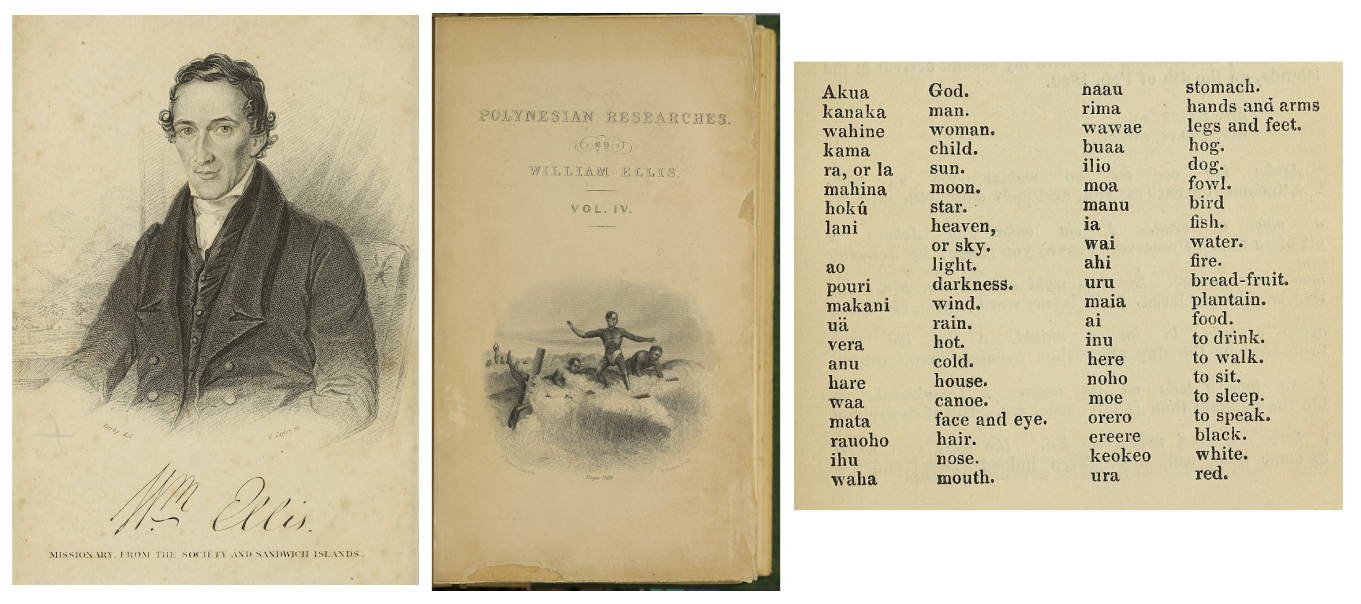
Эндрю Блохам (Andrew Bloxam), 1825 год
Английский священник и натуралист, в более позднем возрасте он проявлял особый интерес к ботанике. В его дневниках содержится много упоминаний о серфинге.
“… of sandalwood logs lay at the extremity of the room, and the walls were hung with surf boards and canoes placed against them. The end of the room on the right hand was separated from the other part by a low fence of canes.
This was probably their kitchen.
We were invited to enter and sit down, and as we conversed, every now and then a tobacco pipe was passed round for each to take a whiff and pass it to, his neighbor.
A native sat and fanned Madame Boki’s father, who appeared to be the principal person there, at the same time holding his. spitting box, which was neatly carved out of some hard and handsome wood.
In the middle of the hut was a hole about a foot deep which served as a fireplace, the smoke escaping through the low door and roof as it could.
Along the roof hung a machine something in the form of a sledge, we found that the natives use it for sliding down the hills, a very common but somewhat dangerous amusement.
It consists of two pieces of wood about twelve feet long, turned up at the end like a pair of skates, they are about two inches in depth and three-quarters of an inch in thickness; cross pieces join them toge!her at about a distance of four or five inches and upon these a kind of matting is fixed for the sup- port of the body, rising from the sledge part about six inches and of the same breadth.
The method of using it is this: they take it, and hold it perpendicularly before them with the turned up part uppermost, they then run and coming to the brow of the hill, suddenly throw themselves upon it head downward and are borne along to the bottom with the greatest rapidity.
But it requires much skill in the management and accidents frequently occur from its turning over and the possessor of it told me that the last time he used it he had much hurt himself and nearly broken his neck.”
Теодор Адольф Баррот (Theodore-Adolphe Barrot), 1836
Французский дипломат и журналист, выпустил целую книгу о своих приключениях на Гавайях: Unless Haste is Made: A French Skeptic’s Account of the Sandwich Islands.
“Towards noon, the entire female population of Kealakeakua assembled to bathe in a small bay surrounded by lava rocks; one rock served the bathers for a screen, and they plunged thence entirely naked, into the waves which were breaking upon the shore; a plank, six or eight feet in length, and pointed at one end, enabled them to sustain themselves on the crest of the waves.
It was indeed, a singular picture- a swarm of young women passing far out to sea, then returning with the swiftness of an arrow, borne upon the foaming crest of the surges which break with the noise of thunder on each side of the bay.
I expected every moment to see them dashed against the sharp points of the rocks, but they avoided the danger with surprising address; indeed, danger seemed to delight them, and they dared to defy it with a courage which astonished me.
The least movement of their body gave to the plank which sustained them, the desired direction, and disappearing for a moment in the midst of the breakers, they very soon arose from the foam and returned at their ease to run the same race again.
I saw a mother, who having placed her child, scarcely a year old, upon a plank two feet long, pushed it before her to a great distance, and then abandoning it to the fury of the waves, she followed, directing only now and then the plank which sustained it.
I had expected to see this population such as Capt. Cook found it, free and independent, and the contrast I avow, did not appear to me in favor of the present, when I afterwards saw these women covered with dirty rags.
The difficulties we had experienced in landing suggested the idea of returning on board the Bonite in a canoe.
We had been able to appreciate during the day the advantages possessed by these light and easily worked canoes in a rough sea over our heavy boats.
We entered a canoe of about fifteen feet in length and a foot or more in width.
This canoe, like all those of the Pacific islands, had an out-rigger made of a piece of light wood and fixed parallel to the canoe by means of two transverse bars four or five feet in length.
Our Indians waited for what is called a calm, that is the moment when the waves which usually succeed one another to the number of four or five, seem to cease for an instant, then they drew the canoe rapidly some distance from the shore, when springing upon their seats and paddling vigorously they were able before the next wave rolled in to gain such a distance that we experienced only two or three strong undulations.
We reached the Bonite safe and sound.
The next day I spoke to Mr. Forbes concerning the extraordinary dexterity in swimming which I had observed on the preceding day among the natives.
“You can have no adequate idea of it,” he replied, “they are more at their ease in the water than on the land.”
To confirm this assertion, he related an adventure which seemed too interesting to be omitted here.
The natives in their canoes frequently pass over the channels which separate the different islands of the archipelago.
One day, a native accompanied by his wife and two small children, put off in a canoe from the northern point of Lanai with the design of landing on the southern part of Molokai, a distance of seven. or eight leagues.
When he had put to sea the weather was… fine, but suddenly a dark cloud blackened the sky, a gale commenced and the sea became very rough.
For a long time the skill with which the islander guided his frail skiff in the midst of the waves preserved it from being wrecked; but at length a sea broke the out-rigger and the canoe capsized. The children were too young to be able to swim.
He seized them at the moment when the sea was about to swallow them up, and placed them upon the canoe, which being made of light wood floated, although bottom up.
Then he and his wife swimming at its side, undertook to urge it along to the nearest shore.
They were then near the middle of the channel.
After many hours of fatiguing exertion, and when they had almost reached the shore, they met a
very strong current which urged them back into the open sea.
To struggle against the force of the current would have been to expose themselves to certain death; they therefore decided to direct their canoe towards another part of the island.
Yet the night came on and they began to feel cold.
The woman was the first to complain of fatigue, but the desire so natural to escape death, and the sight of her children whose life depended upon the preservation of her own, gave her courage, and she continued to swim near her husband, pushing the canoe before them.
Soon the poor children became fatigued for they could not long cling to the round and polished surface of the canoe without a continued effort, and they were also chilled with cold.
Soon they relinquished their hold, and fell one after the other, into the sea.
Their parents seized them and placed… them again upon the canoe, striving at the same time to encourage them.
Alas! their strength was exhausted- their little hands could no longer retain their grasp, and the sea engulfed them for the third time.
It was no longer necessary to think of preserving the canoe; the parents therefore took the children upon their backs and swam towards the land which was sarcely visible in the darkness.
An hour later, the woman discovered that the child which she was carrying was dead, and she broke forth into bitter lamentations.
In vain did her husband persuade her to abandon the child and to take courage, pointing out to her the shore which now seemed near.
The unhappy mother would not separate from her lifeless child, and she continued to carry her precious burden until she felt her strength nearly exhausted, when she told her husband that she must die, for she could swim no further; yet, notwithstanding her husband’s earnest entreaties, she would not relinquish her burden.
He then endeavored to sustain her with one hand and to swim with the other, but nature could not prolong the struggle, and she disappeared beneath the waves.
The husband continued to swim on in sadness.
The desire to save his surviving child alone sustained him.
At length, after many hours of unspeakable hardship, and when almost dead, he reached the shore. His first care was to embrace the son he had saved, for he alone remained to him of his beloved family.
But on taking him into his arms, he perceived that he was dead, and he fell senseless upon the sand. He was discovered at day-break lying prostrate on the… shore by some fishermen.
He revived, but he died soon after in consequence of his sufferings, and perhaps also from grief.
He had been in the water eighteen hours.
We were at Kealakeakua six days, visiting the natives at their houses and collecting such information as seemed to posess any interest.
We were informed that Kapiolani together with Kaahumanu, wife of Kamehameha, was the first to embrace the Christian religion, but her conversion was not very sincere at first.
“For twelve years or more,” said Mr. Forbes, “she was a very bad woman. She was constantly drunk and she had four or five husbands. Even after having received baptism, she retained two; and it was only in consequence of our expostulations that she came to the conclusion to have but one.”
At present she is a virtuous woman, and she has become the firmest defender of the moral and religious innovations on Hawaii.”
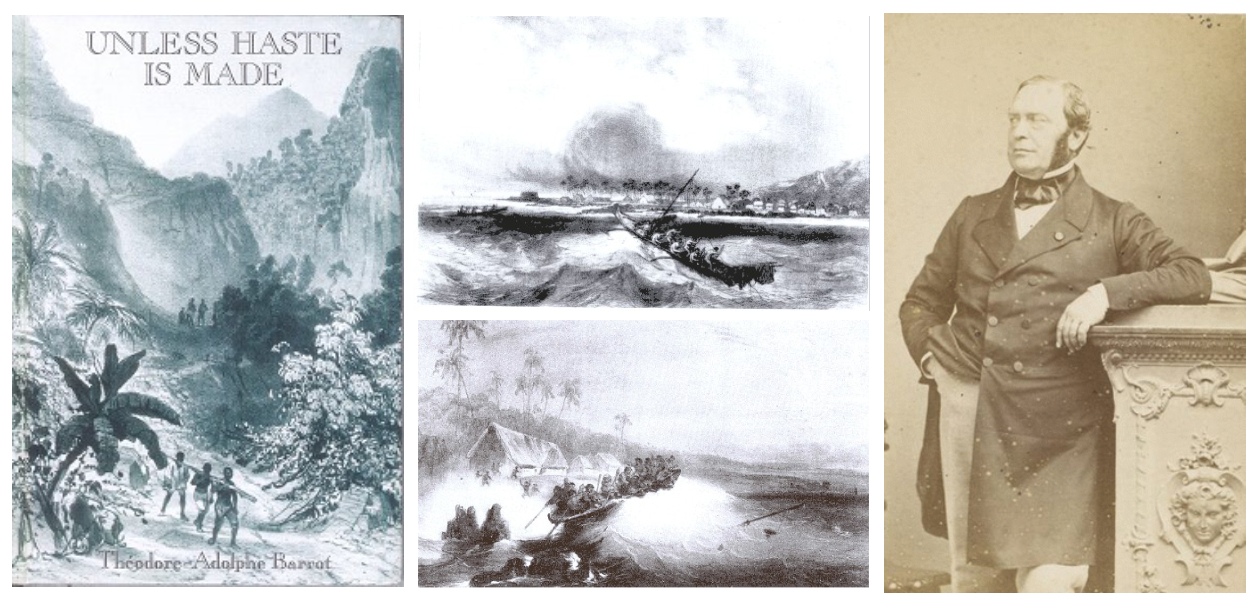
Ричард Дана Генри (Richard Dana Henry), 1840 год
Американский юрист и политик из Массачусетса, родом из колониальной семьи, получивший известность как защитник прав угнетенных и автор классических американских мемуаров «Два года до мачты» . Боролся за права угнетенных рабов и моряков и даже был прокурором и баллотировался в сенат. Благодаря ему был создан закон о защите прав моряков.
Известный город и одноименный популярный спот Дана поинт (Killer Dana), был назван в честь этого человека. Книга “Two Years Before the Mast” была опубликована в 1840 году, в ней содержится описание серфинга на лодке в Санта-Барбаре (всю книгу можно прочитать по ссылке тут).
“Two points ran out as the horns of the crescent, one of which – the one to the westward – was low and sandy, and is that to which vessels are obliged to give a wide berth when running out for a south-easter; the other is high, bold, and well wooded, and, we were told, has a mission upon it, called St. Buenaventura, from which the point is named.
In the middle of this crescent, directly opposite the anchoring ground, lie the mission and town of Santa Barbara, on a low, flat plain, but little above the level of sea, covered with grass, though entirely without trees, and surrounded on three sides by an amphitheatre of mountains, which slant off to the distance of fifteen or twenty miles.
Just before sundown the mate ordered a boat’s crew ashore, and I went as one of the number.
We passed under the stern of the English brig, and had a long pull ashore.
I shall never forget the impression which our first landing on the beach of California made upon me.
The sun had just gone down; it was getting dusky; the damp night-wind was beginning to blow, and the heavy swell of the Pacific was setting in, and breaking in loud and high “combers” upon the beach.
We lay on our oars in the swell, just outside of the surf, waiting for a good chance to run in, when a boat, which had put off from the Ayacucho just after us, came alongside of us, with a crew of dusky Sandwich Islanders, talking and hallooing in their outlandish tongue.
They knew that we were novices in this kind of boating and waited to see us go in.
The second mate, however, who steered our boat, determined to have the advantage of the experience, and would not go in first.
Finding at length how matters stood, they gave a shout, and taking advantage of a great comber which came swelling in, rearing its head, and lifting up the stern of our boat nearly perpendicular, and again dropping it in the trough, they gave three or four long and strong pulls, and went in on top of the great wave, throwing their oars overboard and as far from the boat as they could throw them, and jumping out the instant that the boat touched the beach, and then seizing hold of her, and running her up high and dry upon the sand.
We saw at once how it was to be done, and also the necessity of keeping the boat stern on to the sea; for the instant the sea should strike upon her broadside or quarter she would be driven up broadside on and capsized.
We pulled strongly in, and as soon as we felt that the sea had got hold of us, and was carrying us in with the speed of a racehorse, we threw the oars as far from the boat as we could, and took hold of the gunwale, ready to spring out and seize her when she struck, the officer using his utmost strength to keep her stern on.
We were shot up upon the beach like an arrow from a bow, and seizing the boat, ran her up high and dry, and soon picked up our oars, and stood by her, ready for the captain to come down. On one of these expeditions we saw a battle between two Sandwich Islanders and a shark.
“Johnny” had been playing about our boat for some time, driving away the fish, and showing his teeth at our bait, when we missed him, and in a few moments heard a great shouting between two Kanakas who were fishing on the rock opposite to us, and saw them pulling away on a stout line, and “Johnny Shark” floundering at the other end.
The line soon broke; but the Kanakas would not let him off so easily, and sprang directly into the water after him.
Now came the tug of war.
Before he could get into deep water one of them seized him by the tail, and ran up with him upon the beach; but Johnny twisted round, turning his head under his body, and showing his teeth in the vicinity of the Kanaka’s hand, made him let go and spring out of the way.
The shark now turned tail and made the best of his way, by flapping and floundering, towards deep water; but here again, before he was fairly off, the other Kanaka seized him by the tail, and made a spring towards the beach, his companion at the same time paying away upon him with stones and a large stick.
As soon, however, as the shark could turn he was obliged to let go his hold; but the instant he made toward deep water they were both behind him, watching their chance to seize him.
In this way the battle went on for some time, the, shark, in a rage, splashing and twisting about, and the Kanakas, in high excitement, yelling at the top of their voices; but the shark at last got off, carrying away a hook and line, and not a few severe bruises.”
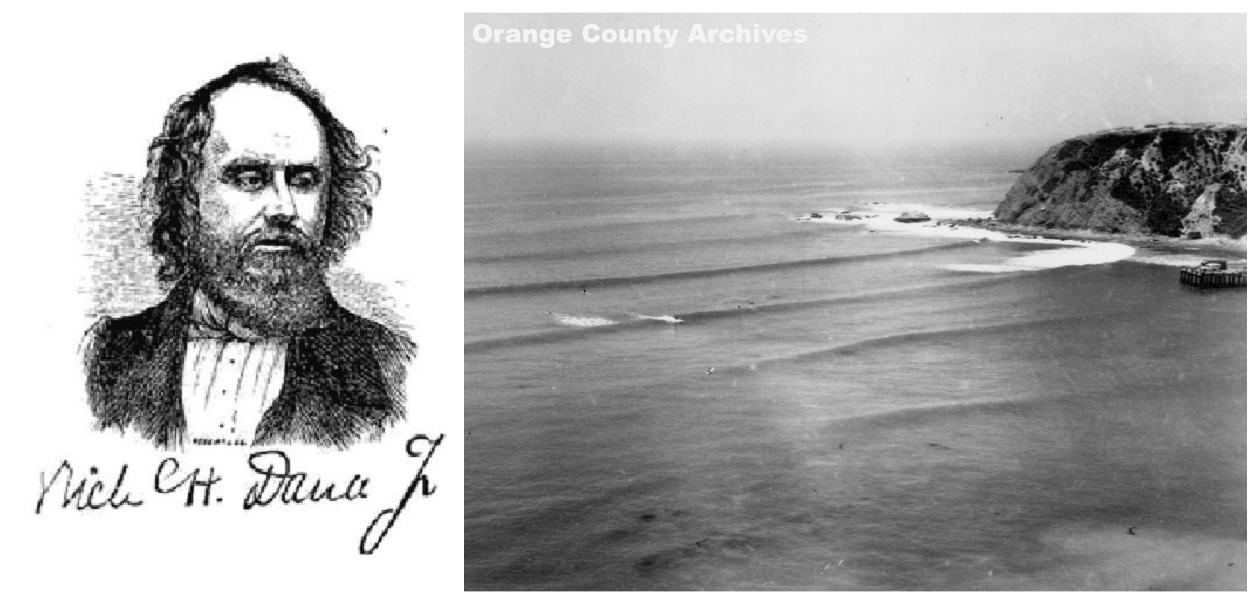
Олмстед Френсис Эллен (Olmsted, Francis Allyn), 1841 год
Олмстед посетил Кайлуа в конце июня и наблюдал, как несколько туземцев катались на серфинге, лежа или стоя на коленях. Их доски представляли собой гладкую плоскую доску от шести до восьми футов в длину и от двенадцати до пятнадцати дюймов в ширину. В книге “Incidents of a Whaling Voyage. To which are added observations on the scenery, manners and customs, and missionary stations, of the Sandwich and Society Islands.” есть первое изображение катания на серфинге, сделанное тем же автором и художником, иллюстрация основана на эскизе, составленном на месте автором.
“After witnessing this striking instance of the zeal of Governor Kuakini for scientific objects, I took a stroll down to the sea shore, where a party of natives were playing in the surf, which was thundering upon the beach.
Each of them had a surf boards a smooth, flat board from six to eight feet long, by twelve to fifteen inches broad.
Upon these, they plunged forward into the surf, diving under a roller as it broke in foam over them, until they arrived where the rollers were formed, a quarter of a mile from shore perhaps, when watching a favorable opportunity, they rose upon some huge breaker and balancing themselves, either by kneeling upon their boards or extending themselves full length, they dashed impetuously towards the shore, guiding themselves with admirable skill and apparent unconsciousness of danger, in their lightning-like courses, while the bursting combers broke upon each side of them, with a deafening noise.
In this way, they amuse themselves hour after hour, in sports which have too terrific an aspect for a foreigner to attempt, but which are admirably adapted to the almost amphibious character of the natives.”
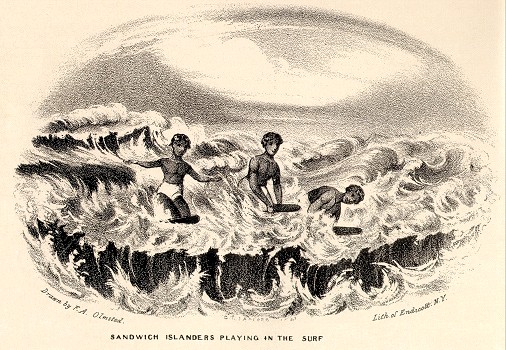
F. A. Olmsted: Sandwich Islanders Playing in the Surf, 1841.
First image of surf riding by the same author and artist.
Lithograph by Endicott, New York.
Эзекия Хантингтон (Hezekiah Huntington), 1847 год
Эзекия был проповедником, в его очерках описывается фридайвинг и серфинг, правда, через пуританскую призму. Полный текст книги тут.
Странички описания серфинга:
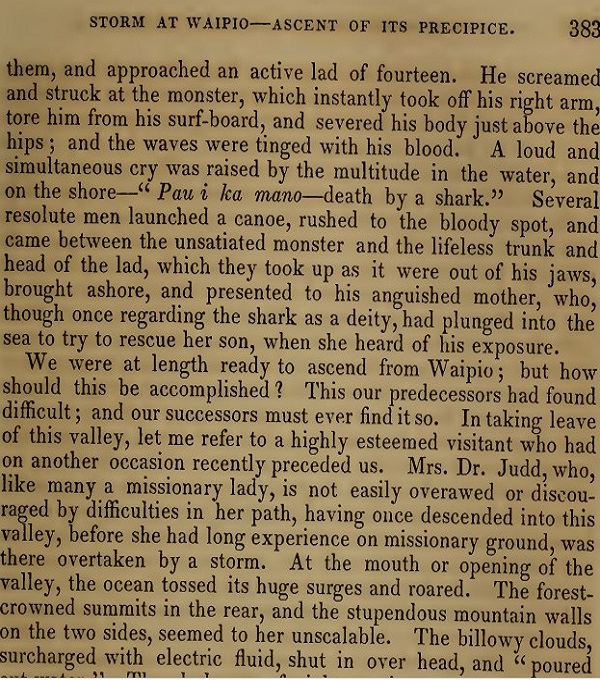
Генри Вайз (Lt. Henry Wise ), 1850 год
В книге “Los Gringos: or An inside view of Mexico and California with wanderings in Peru, Chile and Polynesia” простым и красивым языком описаны островитяне, их красота и красота природы:
“Becoming ennuied with these proceedingss, after much entreaty and a glass of wine, they consented to give me an idea of surf-swimming.
The moon was high and full, throwing a white, bright light athwart the rippling water, like a quivering sea of silver coins.
A Kanaka attendant speedily produced slabs of light cotton wood, aabut a foot longer than the person, and two and a half wide.
Each provided with one of these boards, they swam, or paddled out to the farthest roller.
It may be as well to remark here, that there is no reef, as at Hilo, within whose coral walls shipping can anchor; only a ledge near the shore, that serves to break the force of the waves upon the beach. Boats, however, land without inconvenience, through the agency of a small canal cut from the ledge to the heart of the town, in shape of a letter L.
The girls are at the outermost roller, when awaiting the moment before it breaks, they come flying in on the very crest of the wave, at the speed of a race-horse, the great art being to preserve as nice a poise on the back-bone, as it were, of the breaker, as not to be left behind, nor yet, as I found at the cost of several abrasions, launched too far ahead, and thus have the whole crash of the roller pitching you over and over in a series of hydropathic revolutions by no means safe or pleasant: but to understand the thing properly, it is excessively exciting sport.
One of the girls, daughter of a chief, possessed the knack in great perfectin, and while dashing in with astonishing velocity – at least the rate of twenty miles the hour – she would spring buoyantly upon the board, and then maintain a pose on one leg, either kneeling or standing, with an a plomb – like security of balance, that would have raised the reputation of Ducrow!
During the day every little idle imp and lounger about the town devote the time sporting in the surf; I have watched them for hours, a dozen of them perhaps in a group: their black heads set in a liquid frame of sparkling foam, half lost to view, as the wave subsides, then taken up by another, and borne on the unbroken ridge of a green roller, crossing and recrossing each other’s tracks, shouting and laughing, until the moment before striking the coral strand, the boards are turned aside, and off they paddle again for another ride.
I was not sucessful at the first lesson, although carefully instructed by my amiable companion in boards; and after an hour’s practice, finding I had swallowed as much salt water as I could conveniently, we returned to the house.
Never having witnessed a legitimate native dance, all our persuasive eloquence was exerted to induce the young ladies to delight us with a hevar, but they proved obdurate; and one assured me, with great indignity, that she was mikonaree all ovar; at the same time making a graceful manipulation with her hands, from hand to foot, to add strength to her assertion.
Thus finding myself associated with so pious and virtuous a coterie, who, however, did not deem it incompatible with their morality to sit down, with renewed zest, to cards, I desisted from further efforts, and betook myself to a cigar.
In this, as with all my later experience and intercourse with island beauties, I became convinced that I should never fall in love with them out of the water.
There is their native element for grace and witchery, whilst cleaving the yielding fluid with rounded limbs and streaming tresses, when one’s nice sense of perfume is not offended by rank odors of cocoanut oils, and other villanous cosmetics, which in themselves are enough to transform a Hebe into a Hecate.
Waterfalls and Diving.
All classes at Hilo evince an enthusiastic admiration for flowers, and the maidens particularly are never without natural wreaths, or neeklaces of woodbine and jessamine, prettily woven for the
occasion.
There is a yellow bud of the candle-nut, which is not so pleasant to eye or nose, though more generally worn.
But in all the tastes and diversions of the natives, there was not one that charmed us so much, and in which the natives indulged with such wild delight, as bathing in the river Wailuku.
Along the whole eastern face of the island of Hawaii there are numberless rills and streams that come bounding from the lofty sides of the giant mountains, in cataracts and cascades, until at last they jump from the green-clad shores into the salt foam of the ocean.
One of the largest of them is the Wailuku.
No farther than a league from the harbor inland is a miniature Niagara, of more than a hundred feet, which dashes a mass of broken water into a bowl-like basin, flashing upon either side brilliant rainbows, from which the fall takes its name.
Retracing our steps towards the village, the banks of the little river become less abrupt, and within a few hundred yards of the bay the water is diverted into a multitude of channels – here, a torrent boiling over scattered rocks, with a clear, sleeping pool beyond- there, the white cataract plunging swiftly through narrow straits, and leaping gaily down below, liko a liquid portcullis to some massive gateway—again, whirling eddies playing around rocky islets, until at last by one sparkling effort the waters re-unite, and go roaring and struggling down a steep chasm into the noisy surf of the bay.
It is here the young of both sexes pass most of their time.
Troops of boys and girls, and even little ones scarcely able to walk, are seen in all directions, perched on broad shelving crags and grassy mounds, or, still higher up, clinging from the steep
sides and peeping out from amid the foliage.
On every side they come leaping joyously into the rushing waters !
There on a bluff – thirty, forty – ay! seventy feet high- a score of native maidens are following each other in quick succession into the limpid pools beneath.
The moment before their flight through the air they are poised upon the rocky pedestals, like the Medicean Venus.
One buoyant bound – the right arm is thrown aloft, knees brought up, and at the instant of striking the water the head falls back, feet dashed straight out – when they enter the pools with the velocity
and clearness of a javelin, shooting far away, just beneath the surface, like a salmon.
Others, a”ain, arc diving in foaming torrents—splashing and skirling – laughing, always laughing – plunging – swimming, half- revealing their pretty forms before sinking again beneath the stream.
Others, still more daring and expert, go whirling through narrow passages, thrown from side to side in the white waters – now completely hidden in the cataracts – anon rising up in a recumbent attitude, when away they are hurled over a cataract of twenty feet, emerging far below, with long tresses streaming behind, and with graceful limbs cleaving the river, like naught else in nature more charming than themselves.
It is a sight to make a lover forget his mistress, or a parson his prayers.
I know it would have been my case, had I been so fortunate as to be either!
Here I passed all my leisure hours, never tired of beholding the beautiful panorama of life and water
moving before me; and there were others, on these occasions, who were wont to mingle bravely in the sport – portly post-captains – husbandly lieutenants – mad-cap reefers, of course – staid chaplains, too ! – but all declared it was pleasant, exceeding pleasant! although mingled with a few indifferent remarks as to what the good missionaries might think of it.
Many of the wyheenees have pretty faces, expressive black eyes, and long, jet-black hair; then there are others, who make good imitations of Blenheim spaniels in the visage; but nearly all have rounded, voluptuous forms, perfeetly natural and beautiful when young, with small hands and feet: but such larks they are for fun and laughter! with a certain air of sly demureness that renders them quite bewitching.
In the cool of the afternoons, a number of us in company with half a dozen of these attractive naiads, would amuse ourselves sliding over a gentle water-fall that poured into a secluded basin stretching calmly away below : hand in hand – and very soft, pretty hands they were ! – or, forming a long link, one after another, in a sitting posture, we threw ourselves upon the mercy of the lively foam above, and like lightning dashed over the brink of the falls, and were drawn with magical celerity for a great
depth beneath the surface; until our ears tingled and senses reeled with the rushing noise, when we would again be swept swiftly by a counter-current up to the air of heaven, and carefully stranded.”
Эдвард Т. Перкинс (Edward T. Perkins), 1851 год
В 1848 году Перкинс отправился на Гавайи в качестве члена экипажа американского китобойного корабля «Планета» и прибыл на острова 20 апреля 1849 года, прожив там 2 года.
Перкинс пытался заниматься серфингом лежа на четырехфутовой доске в местной одежде под руководством двух местных девочек.
Na Motu: or, Reef-rovings in the South Seas. A Narrative of Adventures at the Hawaiian, Georgian and Society Islands;
with Maps, Twelve Illustrations, and an Appendix. Relating to the Resources, Social and Political condition of Polynesia, and subjects of interest in the Pacific Ocean.
“EARLY in the morning the anchor was weighed, but the breeze being light, we did not reach Keauha before ten o’clock.
As we entered the harbor, the sight, was anything but tranquillizing to weak nerves.
We were steering for an iron-bound shore, where the surf was beating with a noise like thunder, and bursting upwards in sheets of foam.
Had the wind failed us, it would have been unpleasant to anticipate consequences.
Though the entrance was narrow, we had a commanding breeze that carried us safely in, where we anchored and moored the schooner by ropes made fast to cocoanut-trees.
From the sensation produced among the natives, I should judge that arrivals were unfrequent at Keauho, for the adjoining rocks were covered with curious idlers, and re-echoed theIr boisterous welcome.
The water, which does not exceed two fathoms in depth, is beautifully transparent; and over the white sandy bottom are scattered clusters of coral and shells.
Floating upon it were canoes filled with girls, who paddled around us, laughing and singing in high glee.
Frequently, when the outriggers came in collision with each other, the occupant of one canoe, by a dexterous movement, would capsize those of the other into the water; a joke that was taken in good part, and some of these amphibious damsels seemed to manifest a preference for the briny element.
Sometimes half a dozen heads were dotting the surface on one side of the schooner; then, by a simultaneous movement, all would disappear and presently be seen shooting upwards on the opposite side.
They swam about, plashing the brine in each other’s faces, and when fatigued rested themselves by clinging to the outriggers.
One of these girls, perhaps fourteen years of age, possessed an ornament that might excite the envy of our belles at home, and which so enhances female beauty.
This was the most exquisite (indulge the word) head of hair I ever beheld in Polynesia.
While swimming, it was either trailing behind her or hiding her face; but was only seen to advantage when its possessor was basking on shore, where she allowed it to float loosely upon her shoulders.
Black, wavy, and glossy, and unrivalled in fineness, its peculiar beauty was noticed by all on board, from the owner to the sailor.
The juvenile portion of the community seemed greatly to preponderate, and our deck was soon encumbered with them.
On the northern side of the harbor at Keauho, the black point of lava extends for a considerable distance into the sea, and in connection with a slight indentation in the shore, it forms a cove, where the surf rolls heavily.
At any hour of the day, children might be seen running out on this point with their surf-boards. Watching their opportunity, they would plunge into the sea between two rollers, with exceedingly nice judgment, reaching the wave at its culminating point, and just as it was “combing,” shoot in upon its crest, amid foam and spray, with the velocity of a race-horse, and shouting in wild delight.
What the sled is to the child at home, the papa, or surf-board, is to the juveniles of Hawaii.
I determined one morning to join them in their sport; and having signified my intention, about twenty girls, of various ages, and a dozen buys, promised to give me instruction.
I preferred confiding myself to the management of the two oldest girls, who were more experienced. A board, four feet in length, and rounded at both ends, was provided for me.
This, when used, is placed beneath the breast and held firmly between the extended arms, at an angle of about fifteen degrees with the level of the sea.
The boys wore malos, the girls, loose gowns; and not wishing to be encumbered with superfluous “gear,” I adopted the fashion of the former.
The shore receded quickly, so that at a distance of ten yards we were beyond our depth.
The surf rolled in heavily, and with my two instructresses on either side, I swam seaward.
The spent rollers we suffered to pass beneath us, but as our distance from the shore increased, they were not to be disregarded; and when we saw a wall of water rise up before us, and come rolling in like an avalanche, we dove beneath it, while it broke and foamed above us.
I should have said that I dove, for, like fishes, the girls could sink at will, and without any apparent effort.
This peculiarity I have also noticed among the pearl-divers of the Southern Ocean, who, by giving a slight spring upward, sink easily, and turn beneath the surface.
I have frequently attempted it, but without success, though by trial have remained under water as long as expert divers.
The breakers were frightful.
Though a good swimmer, and familiar with winds and waves, I would never think of buffeting voluntarily such a formidable array of cataracts without a host of guardians.
The roar was incessant, and almost deafening; still, we kept on.
It is a strange sight to see the horizon of vision contracting before you and rising rapiply towards the zenith, until you look upon an impending wall of liquid blue, imperceptibly melting to a delicate pea-green with a snowy crest.
There is a commingling of beauty and sublimity, of stern majesty and power.
It is the mighty bolt that shatters the groaning timbers of the ship, and scatters the fragments upon the froth of its rage.
But my fair guardians mocked its impotence.
With a laugh and a shout, saying, “Lu kakou,” (let us dive,) each clasped a hand, and in tranquil depths we hid from the billow that thundered above us.
Having obtained a suitable distance, we waited for a roller, and started upon its crest; but the art of surf-riding is not so simple as it would seem.
With my companions on either side, I flew rapidly along for a few seconds; but somehow or other the wave always receded and left me in the lurch, while they shot ahead in a sea of foam.
I sported in this way for fifteen minutes, until a roller caught me as it broke, and wrenching the board from my hands, whirled me along in every conceivable attitude; and on recovering from the shock, I was compelled to abandon my aquatic sports for the remainder of the day.
After bathing in the sea, the girls always pour fresh water over each other, carefully washing their dark tresses, for they say salt water impairs their beauty.
All who have visited Hilo concur in admiring its scenery.
The harbor, or bay, derives its name from the town, and is situate on the N. E. side of the island, forming a safe anchorage for vessels against all winds, except from the northeast.
Near the southeast shore there is a rocky islet covered with cocoanut-trees; and from this towards the N. E. extends a shoal for a long distance so that the entrance is on the western side, where the land is bold and the water deep.
During a strong northeast wind, the sea rolls in heavily; and the shore is lined with breakers.
On these occasions boats from vessels, instead of effecting a difficult landing on the western side, which is most thickly settled, usually resort to the southern shore, where a small stream affords them a secure retreat.
This is called Waiakea, and waters the district of that name, constituting the southern boundary of Hilo.
Not far from its mouth, and where it is intersected by the road passing through the town, the course of the stream is among rocks, frequently broken by miniature cascades and foaming rapids; in
one spot there is a broad, deep pool, bounded on the left by a precipitous cliff.
During the latter part of the afternoon, its banks are lined with boys and girls, who resort here to bathe.
We have often amused ourselves by tossing reals or medios into the water, and seeing the children leap from an elevation of twenty or thirty feet, and catch them before they reach the bottom.”
Генри Чивер (Henry Cheever), 1875 год
В книге преподобного Генри о гавайском серфинге мало технических подробностей. Но он один из первых людей предлагает, что в будущем серфингом можно было заниматься в других местах.
“The sport is so attractive and full of wild excitement to Hawaiians, and withal so healthful, that I cannot but hope it will be many years before civilization shall look it out of countenance, or make it disreputable to indudge in this manly, though it be dangerous, exercise.
Many a man from abroad who has witnessed this exhilarating play, has no doubt idly wished that he were free and able to share in it himself.
… part, I should like nothing better, if Icould do it, than to get balanced on a board just before a great rushing wave, and so be hurried in half or quarter of a mile landward with the speed of a race-horse, all the time enveloped in foam and spray, but without letting the roller break and tumble over my head.
In this consists the strength of muscle and sleight-of-hand, to keep the head and shoulders just ahead and clear of the great crested wall that is every moment impending over one, and threatening to bury the bold surf-rider in its warery ruin.
The natives do this with admirable intrepidity and skill, riding in, as it were, upon the neck and mane of their furious charger; and when you look to see them, their swift race run, dashed upon the rocks or sand, behold, they have slipped under the belly of the wave they rode, and are away outside, waiting for a cruise upon another.
Both men and women, girls and boys, have their times for this diversion.
Even the huge Premier (Auhea) has been kllown to commit her bulky person to a surf-board; and the chiefs generally, when they visit Lahaina, take a turn or two at this invigorating sport with billows and board.
For a more accurate idea of it than can be conveyed by any description, the reader is referred to the engraving.
I have no doubt it would num away with dyspesia from many a bather at Rockaway or Easthampton, if they would learn, and dare to use a surf-board on those great Atlantic rollers, as the Hawiians do on the waters of the Pacific.
But there is wanting on the Atlantic sea-board that delicious, bland temperature of the water, which within the tropics, while it makes sea-bathing equally a tonic, renders it always safe.
The missionaries at these Islands, and foreigners generally, are greatly at fault in that they do not avail themselves more of this easy and unequalled means of retaining health, or of restoring it when enfeebled.
Bathing in fresh water, in a close bath-house, is not to be compared to it as all invigorating and remedial agent; and it is unwise, not to say criminal, in such a climate, to neglect so natural a way of preserving health, as washing and swimming in the sea.”
Джеймс Гринвуд (1863 James Greenwood), 1863 год
Гринвуд был британским исследователем, писателем и журналистом, он написал две книги о путешествиях, в которых описывал быт дикарей и серфинг в том числе:
Книга называется “Curiosities of Savage Life и The wild man at home: or, Pictures of life in savage lands” (полный текст книги тут).

Чарльз Стидман (Charles Steedman), 1867
Самые ранние доски для серфинга, использовавшиеся в Австралии, были изготовлены из цельного куска дерева, и наиболее точное описание в австралийской публикации, вероятно, принадлежит Чарльзу Стидману в 1867 году:
“A small deal (pine of fir) board, about five feet long, one foot broad, and an inch thick, termed a surf board. This is a substantial board, similar to dimensions reported in Tahiti and Hawaii in the nineteenth century.”
Он так же описывал серфинг и боди серфинг в Австралии.
“…taneously in front of the head, and making the stroke outward in a nearly horizontal direction, thus causing a rather severe strain upon the chest, throws his body alternately upon the left and the right side, raising one arm entirely above the water, and reaching as far forward as he can to dip it, whilst his whole weight and force are spent upon the one that is passing under him; which, Iike a paddle, is propelling him along; whilst this arm is making a haIf-circle, and is being raised out of the water behind him, the opposite arm is describing a similar arc in the air over his head, to be dipped in the water as far as he can reach before him, the hand bent inwards so as to form a sort of cup, and thus act most effectively as it passes in its turn underneath him.
In tbis bold powerful mode of Swimming, which may certainly be defficient in the grace which many wish to see, there is little strain upon the breast and spine.
This mode enables the smimmer get through the water more speedily than the breast stroke does.
It is, however, less rapid than the side stroke and more fatiguing than either breast or side stroke.
Encouraged by white men, and accompanied by them, hand in hand, leaping and shouting, a party of aborigines will run to meet the breakers.
Extended in a line, they will stand to meet the incoming of the small seas, and will perform the most amusing feats, as the force of the breakers drives them back to the shore.
On the approach of a large wave the white man will usually dive and work their hands into the sand, so to obtain a firm hold as the sea bursts over them; while the blacks on the contrary, will rise on the crest, and continue to go through their eccentric and amusing evolutions as usual.
The swimmer will rise and fall with each wave, as it sweeps past, unless he should happen to be immediately inshore of one when it commences to break; then, the lifting power of the wave, or rather all that portion of it which is “curled,” is destroyed, and the pressure is downwards.
Anyone who has experienced this falling weight of water while bathing on a sea-coast where there is a long “fetch,” can testify to its crushing effects.
The falling curl of the wave first thumps, then presses him down into the sand, scouring out a
hole, as it were, for his reception.
Then the succeeding wave lifts him up in the opaque mixture of water, weeds, sand, and foam,
churning and grinding away at his body, till he may imagine that he, too, will soon be as intimately blended with the compound as any of its other
constituents.
At one moment, his legs and arms will be as violently twisted as if he were being spun into a rope; and then as suddendly, he will find himself as compactly coiled up into a ball as a hedgehog in an attitude of defence.
The way to avoid this rough usage is to wait and watch for the curling of the water overhead, then instantly, before it has time to break, to make a vigorous stroke right through the wave, when it wiII break harmlessly inshore.
The reason why swimmers rise and fall, without effort, with each wave, so long as it remains unbroken, without being carried along with it, is owing to the fact that the water forming the wave does not advance horizontally, but simply moves upwards and downwards; and that all bodies suspended in the water, and of nearly the same specific gravity, are affected in their on-ward motion solely by the movement of the medium in which they are immersed.
Surfboards
A small deal board, about five feet long, one foot broad, and an inch thick, termed a “surf board,” is of considerable help to a swimmer who is crossing water on which the foam is deep -for by its aid he can raise his head to breathe above the surface of the foam.
The following facts will convey some idea of the height, weight, and almost irresistible force.”
Джон Папа Ли (John Papa Ii ), 1870 год
Объемная хроника “Fragments of Hawaiian History” из первых рук с 1866 года до смерти автора вышла серией статей в газете на гавайском языке “Ka Nupepa Ku’oko’a”, а опубликованы статьи были в 1959 году как «Фрагменты гавайской истории». В них описывается жизнь через личный опыт Джона при короле Камехамехе.
“These were lands occupied by the chiefs because the surfing there was good, and the food abundant in ancient times.
There Kamehameha learned to surf and to glide with a canoe over the waves, guarded by the kaikunane of Keaka, in accordance with her commands.
Because he was well trained, Kamehameha excelled in these arts and in sailing canoes.
When Kalaniopuu next arrived from Kau, it was to take Kamehameha away with him, perhaps because Kamehameha’s mother had died.
This was in accordance with Keoua’s request before his death.
When they left, they were accompanied by Kalaimamahu, son of Keoua and Kamakaeheikuli and half brother of Kamehameha.
Upon their arrival in Kau, Kalaniopuu placed Kamehameha with his wife, the chiefess Kaneikapolei, who put Kamehameha in the hands of her kaikunane relatives, Inaina ma.
He was there for some time and was familiar with the life of the court by the time he became associated with his older cousin, Kiwalao, the son of Kalaniopuu and Kalola.
It was the custom of the chiefs to have sports such as racing, “maika” throwing, diving feet first, hiding the “no’a”, boxing, surfing, sledding, sham fighting, and many others.
These increased when the kingdom was at peace, as it was when Kalaniopuu first became king.
aahumanu’s circuits of the land were always by canoe, for she had learned all about canoeing and surfing from Kamehameha I, her cousin, lord, and husband.”
Джон Кольридж Паттисон ( J. C. Patteson), 1875 год
Паттесон дает краткий обзор жителей Норфолка, отмечая их энтузиазм в отношении катания на досках для серфинга, который первоначально был перенесен с Таити (преимущественно женщинами) на остров Питкэрн.
Важно отметить, что это подтверждает факт, что доски Питкэрна, которые использовали на острове Норфолк, имеют «маленький киль», что значительно предшествовало созданию плавника на доске для серфинга Томом Блейком в 1935 году:
“Both boys and girls learned to swim almost as soon as they could walk; consequently they could swim through the roughest surf, and play about in the broken water amongst rocks, without the slightest sense of danger.
One of their great amusements is to have a slide, as they term it; that is, to take a piece of wood about three feet long, shaped like a canoe, with a small keel, called a surf-board.
Holding this before them, they dive under the first heavy sea, and come up on the other side.
They then swim out a little way, until they see a rapid, heavy sea come rolling in, the higher the better; resting their breast upon the surf-board, they are carried along on the very apex of the surf at a prodigious rate right upon the rocks, where it would seem as if nothing could save them from being dashed in pieces.
It was a pretty sight indeed, in the brief twilight, the gay-looking fish lying on the stones in the water, where the great waves were not rolling furiously in, coloured by the glowing sky.
Some of my companions longed to jump in.
‘What! into those great breakers?’
‘That’s the fun,’ whispered a young girl at my side.
At Pitcairn, it seems, the’ fun’ was to swim out to sea, pushing a surf-board before you, and then to come quickly back with it on the top of a huge roller.
” ‘You can swim ?’ asked a delicate-looking young mother of me, as we stood together; and when I owned my ignorance, the compassionate, half-contemptuous tone of her reply was very funny.
Men, women, and children here take to the water like so many ducks.
The girls think it a great pity that I, who am ‘such a seafaring lady,’ do not know how, and offer to teach me.
‘You would soon learn from me,’ said a noble-looking creature, reported, I believe justly, to be the best swimmer of the party.
These fine days promote a great desire for bathing.
It would be pleasant before the sun was so hot as to blister them, which it seems it did dreadfully at Pitcairn in the Christmas holidays, and no wonder, as they were chiefly spent in the water. Fortunately they were short, as for six hours at a time would these mermaids remain in, with their surf-boards, swimming races.
The great piece of fun was for one to keep possession of a rock in the middle of Bounty Bay, whence the rest would try to pull her down, and whence she would fling them off into the water.
It sounded most cool and brilliant, and as if they ought all to have been named ‘Undine.’
A Christmas-tree would be rather poor after this sport.”
Томас Нокс (Thomas W. Knox), 1889 год
Его книга о путешествиях “The Boy Travellers in Australasia” была издана в 1889 году. В книге содержится описание быта и жизни дикарей Новой Зеландии, Фиджи, Маркизских островов, Тасмании, Австралии и Гавайев.
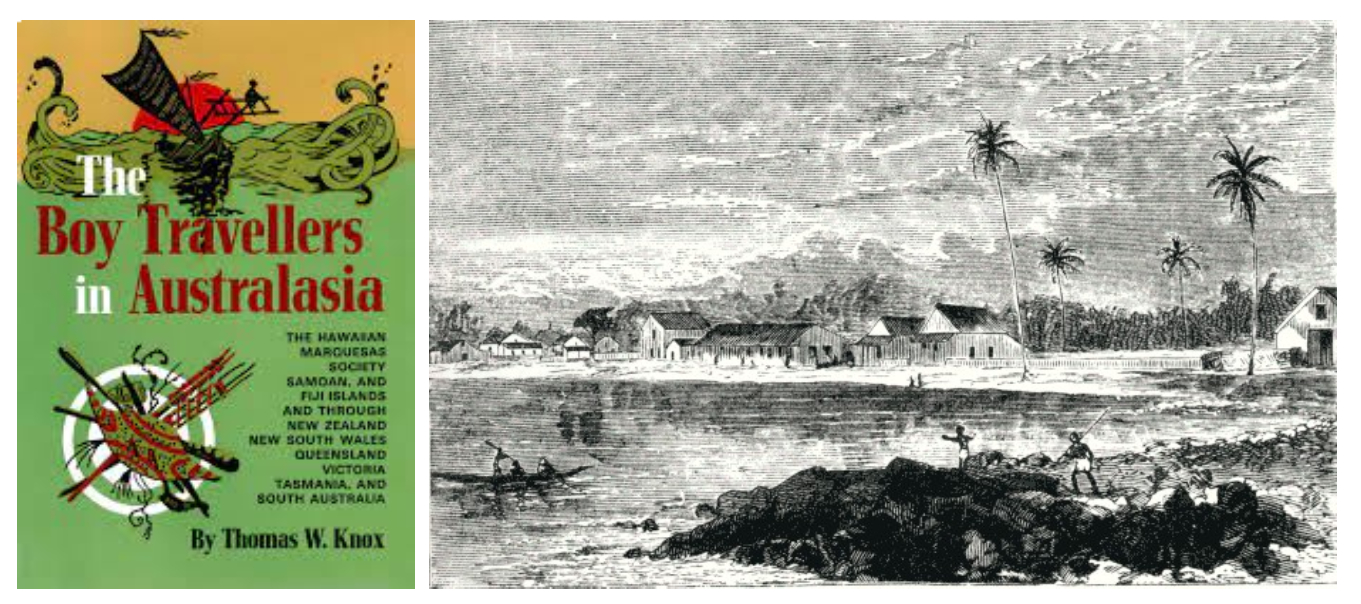
Марк Твен (Mark Twain), 1872 год
Марк Твен и его ассистент – Чарльз Стодарт, вместе путешествовали по Гавайям и они оба написали об этом свои истории.
Книга Марка Твена “Roughing It ” вышла в 1872 году. Это был полу автобиографический очерк, в котором Марк Твен писал о своем путешествии по Гавайям и о серфинге. Ознакомимся с этим известным очерком более детально:
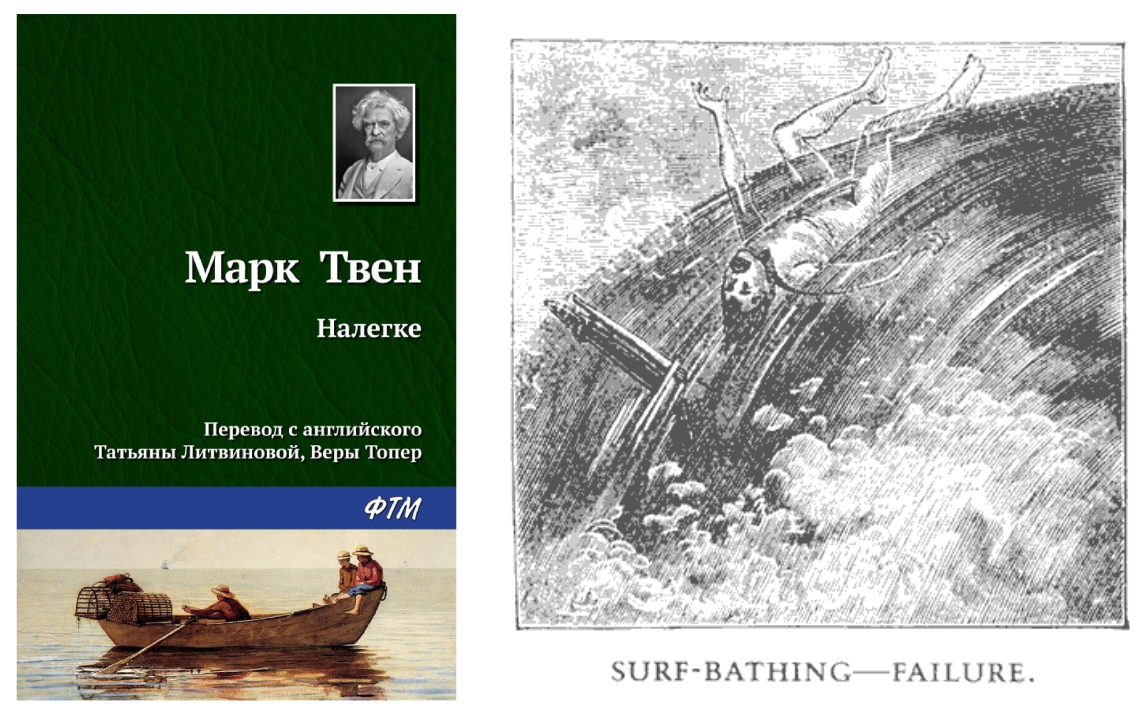
“Chapter LXXIII – Native Canoes – Surf Bathing”
«At noon, we hired a Kanaka to take us down to the ancient ruins at Honaunan in his canoe — price two dollars — reasonable enough, for a sea voyage of eight miles, counting both ways.
The native canoe is an irresponsible looking contrivance. I cannot think of anything to liken it to but a boy’s sled runner hollowed out, and that does not quite convey the correct idea. It is about fifteen feet long, high and pointed at both ends, is a foot and a half or two feet deep, and so narrow that if you wedged a fat man into it you might not get him out again. It sits on top of the water like a duck, but it has an outrigger and does not upset easily, if you keep still. This outrigger is formed of two long bent sticks like plow handles, which project from one side, and to their outer ends is bound a curved beam composed of an extremely light wood, which skims along the surface of the water and thus saves you from an upset on that side, while the outrigger’s weight is not so easily lifted as to make an upset on the other side a thing to be greatly feared. Still, until one gets used to sitting perched upon this knifeblade, he is apt to reason within himself that it would be more comfortable if there were just an outrigger or so on the other side also. I had the bow seat, and Billings sat amidships and faced the Kanaka, who occupied the stern of the craft and did the paddling. With the first stroke the trim shell of a thing shot out from the shore like an arrow. There was not much to see. While we were on the shallow water of the reef, it was pastime to look down into the limpid depths at the large bunches of branching coral — the unique shrubbery of the sea. We lost that, though, when we got out into the dead blue water of the deep. But we had the picture of the surf, then, dashing angrily against the crag- bound shore and sending a foaming spray high into the air.
There was interest in this beetling border, too, for it was honey-combed with quaint caves and arches and tunnels, and had a rude semblance of the dilapidated architecture of ruined keeps and castles rising out of the restless sea. When this novelty ceased to be a novelty, we turned our eyes shoreward and gazed at the long mountain with its rich green forests stretching up into the curtaining clouds, and at the specks of houses in the rearward distance and the diminished schooner riding sleepily at anchor. And when these grew tiresome we dashed boldly into the midst of a school of huge, beastly porpoises engaged at their eternal game of arching over a wave and disappearing, and then doing it over again and keeping it up — always circling over, in that way, like so many well- submerged wheels. But the porpoises wheeled themselves away, and then we were thrown upon our own resources. It did not take many minutes to discover that the sun was blazing like a bonfire, and that the weather was of a melting temperature. It had a drowsing effect, too.
In one place we came upon a large company of naked natives, of both sexes and all ages, amusing themselves with the national pastime of surf-bathing. Each heathen would paddle three or four hundred yards out to sea, (taking a short board with him), then face the shore and wait for a particularly prodigious billow to come along; at the right moment he would fling his board upon its foamy crest and himself upon the board, and here he would come whizzing by like a bombshell! It did not seem that a lightning express train could shoot along at a more hair-lifting speed. I tried surf-bathing once, subsequently, but made a failure of it. I got the board placed right, and at the right moment, too; but missed the connection myself. — The board struck the shore in three quarters of a second, without any cargo, and I struck the bottom about the same time, with a couple of barrels of water in me. None but natives ever master the art of surf-bathing thoroughly».
«В полдень мы наняли канака, чтобы тот отвез нас к древним руинам в Хонаунане на его каноэ — цена два доллара — вполне приемлемая для восьмимильного морского путешествия в обе стороны.
Местное каноэ выглядит пугающе ненадежным. Я не могу придумать ничего, с чем можно было бы его сравнить: оно около пятнадцати футов в длину, с высоким бортом и заостренное с обоих концов, имеет полтора или два фута в глубину и оно такое узкое, что если вы втиснете в него толстяка, то вы не сможете его оттуда вытащить. Оно всё же находится на поверхности воды и у него есть выносная опора, поэтому его нелегко опрокинуть. Эта опора – аутригер – состоит из двух длинных согнутых бревен, похожих на ручки плуга, которые выступают с одной стороны, а к их внешним концам привязано изогнутое бревно из очень легкого дерева, которое скользит по поверхности воды и таким образом спасает вас от опрокидывания. Нужно привыкнуть к этому снаряду и своему нестабильному положению в нем. Я сидел на носу, а Биллингс сидел посредине и лицом к канаке, который занимал корму лодки и греб. С первым же гребком каноэ вылетело с берега в океан, как стрела. Смотреть было особо не на что, пока мы были на мелководье рифа: были отлично видны кораллы – уникальный морской кустарник. Выйдя на глубину, мы уже ничего не могли видеть, кроме живописной картины прибоя, яростно бьющегося о скалистый берег и поднимающего высоко в воздух пенящиеся брызги.
Интерес вызвали подводные скалы в виде причудливых пещер, арками и туннелями в них, они имели грубое подобие ветхой архитектуры разрушенных крепостей и замков, возвышающихся над беспокойным морем. Налюбовавшись этим, мы обратили взоры к берегу и стали смотреть на горы с ее пышными зелеными лесами, уходящими в завесу облаков, на пятнышки домов в отдалении, на уменьшенную в размерах шхуну, сонно шедшую на якоре. . А когда и это наскучило, мы смело ринулись в гущу стайки огромных дельфинов, занятых своей вечной игрой: выгибаться дугой над волной и исчезать, а затем повторяя это снова и снова, постоянно кружась. Но они скоро укатились прочь и тогда мы были брошены на произвол судьбы. Не понадобилось много времени, чтобы осознать, что солнце пылает, как костер, и что жара оказывает усыпляющий эффект.
В одном месте мы наткнулись на большую компанию обнаженных туземцев обоего пола и всех возрастов, развлекавшихся национальным развлечением – купанием при серфинге. Каждый язычник отплывал в океан на триста или четыреста ярдов (взяв с собой короткую доску), затем поворачивался лицом к берегу и ждал, пока не придет особенно сильный вал; в нужный момент он швырял доску на ее пенный гребень, затем себя на доску и тут же укатывался стремительно вместе с волной! Казалось, молниеносный экспресс не может нестись с большей скоростью, от которой волосы встают дыбом. Позже я попробовал заняться серфингом, но потерпел неудачу. Я поставил доску правильно и в нужный момент, но борт ударился о берег за три четверти секунды, без груза, и я примерно в это же время ударился о дно, имея в себе пару бочек воды. Никто, кроме туземцев, никогда не овладевал искусством серфинга в совершенстве».
Книга его ассистента, Чарльза Стодарта, “Summer Cruising in the South Seas” вышла двумя годами позднее, она содержит много интересных описаний жизни туземцев и множество интересных рисунков художника Уэллиса Маккей. Одна из самых популярных изображений серфинга в интернете, принадлежит этой книге и ее художнику справа на фото).
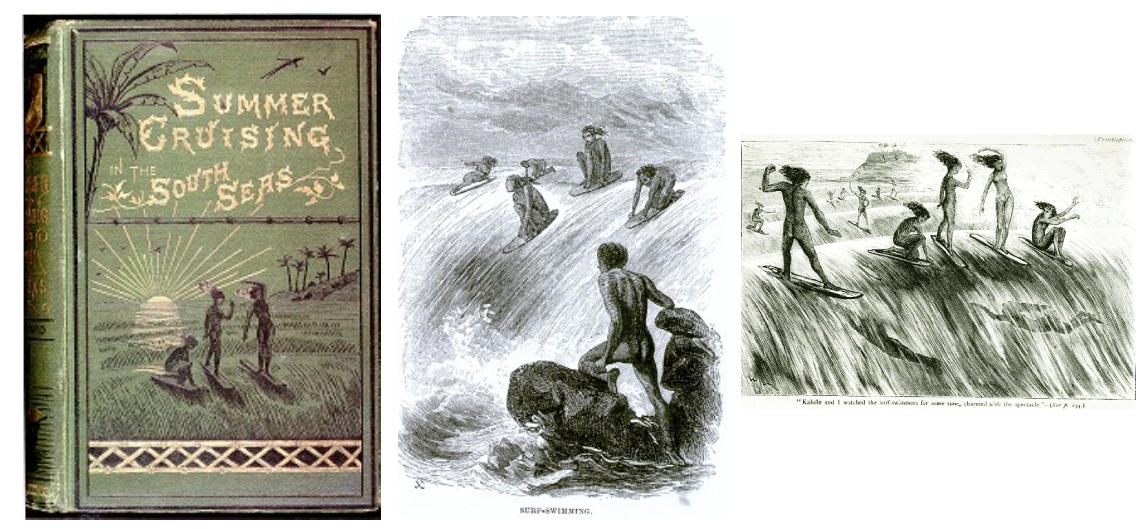
Упоминание о серфинге есть в нескольких частях его очерка, прилагаю копии этих страниц, а прочитать весь материал на языке оригинала можно по ссылке.
Изабелла Берд (Isabella L. Bird), 1875
Британская исследовательница XIX века, писательница и натуралистка, посетившая множество интересных диких мест. Прекрасно сконструированная книга “Six Months in the Sandwich Isles- Amoung Hawai’i’s Palm Groves, Coral Reefs and Volcanoes” из личных писем сестре и на своих и чужих заметках о жизни островитян в то время.
CANOE SURF-RIDING AT WAIKIKI
“We were just outside the reef, and near enough to hear that deep sound of the surf which, through the ever serene summer years girdles the Hawaiian Islands with perpetual thunder, before the pilot glided alongside, bringing the news which Mark Twain had prepared us to receive with interest, that “Prince Bill” had been unanimously elected to the throne.
The surf ran white and pure over the environing coral reef, and as we passed through the narrow channel, we almost saw the coral forests deep down under the Nevada’s keel; the coral fishers plied their graceful trade; canoes with outriggers rode the combers, and glided with inconceivable rapidity round our ship; amphibious brown beings sported in the transparent waves; and within the reef lay a calm surface of water of a wonderful blue, entered by a narrow, intricate passage of the deepest indigo.
DESCRIPTION AND ARRIVAL AT HILO BAY
Hilo, Hawaii.
This is the paradise of Hawaii.
What Honolulu attempts to be, Hilo is without effort.
Its crescent-shaped bay, said to be the most beautiful in the Pacific, is a semi-circle of about two miles, with its farther extremity formed by Cocoanut Island, a black lava islet on which this palm attains great perfection, and beyond it again a fringe of cocoanuts marks the deep indentations of the shore.
From this island to the north point of the bay there is a band of golden sand on which the roar of the surf sounded thunderous and drowsy as it mingled with the music of the living waters of the Waiakea and the Wailuku, which after lashing the sides of the mountains which give them birth, glide deep and fern-fringed into the ocean.
Canoes came off from the shore, dusky swimmers glided through the waters, youths, athletes, like the bronzes of the Naples Museum, rode the waves on their surf-boards, brilliantly dressed riders galloped along the sands, and came trooping down the bridle-paths from all the vicinity till a many-coloured, tropical crowd had assembled at the landing.
BOARD SURF-RIDING AT HILO
Hilo, Hawaii.
I had written thus far when Mr. Severance came in to say that a grand display of the national sport of surf-bathing was going on, and a large party of us went down to the beach for two hours to enjoy it.
It is really a most exciting pastime, and in a rough sea requires immense nerve.
The surf-board is a tough plank shaped like a coffin lid, about two feet broad, and from six to nine feet long, well oiled and cared for.
It is usually made of the erythrina, or the breadfruit tree.
The surf was very heavy and favourable, and legions of natives were swimming and splashing in the sea, though not more than forty had their Papa-he-nalu, or “wave sliding boards,” with them.
The men, dressed only in ‘malos’, carrying their boards under their arms, waded out from some rocks on which the sea was breaking, and, pushing their boards before them, swam out to the first line of breakers, and then diving down were seen no more till they re-appeared as a number of black heads bobbing about like corks in smooth water half a mile from shore.
What they seek is a very high roller, on the top of which they leap from behind, lying face downwards on their boards.
As the wave speeds on, and the bottom strikes the ground, the top breaks into a huge comber.
The swimmers appeared posing themselves on its highest edge by dexterous movements of their hands and feet, keeping just at the top of the curl, but always apparently coming down hill with a slanting motion.
So they rode in majestically, always just ahead of the breaker, carried shorewards by its mighty impulse at the rate of forty miles an hour, yet seeming to have a volition of their own, as the more daring riders knelt and even stood on their surf-boards, waving their arms and uttering exultant cries. They were always apparently on the verge of engulfment by the fierce breaker whose towering white crest was ever above and just behind them, but when one expected to see them dashed to pieces, they either waded quietly ashore, or sliding off their boards, dived under the surf, taking advantage of the undertow, and were next seen far out at sea preparing for fresh exploits.
The great art seems to be to mount the roller precisely at the right time, and to keep exactly on its curl just before it breaks.
Two or three athletes, who stood erect on their boards as they swept exultingly shorewards, were received with ringing cheers by the crowd.
Many of the less expert failed to throw themselves on the crest, and slid back into smooth water, or were caught in the combers, which were fully ten feet high, and after being rolled over and over, ignominiously disappeared amidst roars of laughter, and shouts from the shore.
At first I held my breath in terror, thinking the creatures were smothered or dashed to pieces, and then in a few seconds I saw the dark heads of the objects of my anxiety bobbing about behind the rollers waiting for another chance.
The shore was thronged with spectators, and the presence of the elite of Hilo stimulated the swimmers to wonderful exploits.
These people are truly amphibious.
Both sexes seem to swim by nature, and the children riot in the waves from their infancy.
They dive apparently by a mere effort of the will In the deep basin of the Wailuku River, a little below the Falls, the maidens swim, float, and dive with garlimds of flowers round their heads and throats. The more furious and agitated the water is, the greater the excitement, and the love of these watery exploits is not confined to the young.
I saw great fat men with their hair streaked with grey, balancing themselves on their narrow surf-boards, and riding the surges shorewards with as much enjoyment as if they were in their first youth.
I enjoyed the afternoon thoroughly.
BOARD SURF-RIDING ON KAUAI
Makaueli, Kauai.
The household here consists first and foremost of its head, Mrs. – , a lady of the old Scotch type
<…>
Then there are her eldest son, a bachelor, two widowed daughters with six children between them, three of whom are grown up young men, and a tutor, a young Prussian officer, who was on Maximilian’s staff up to the time of the Queretaro disaster, and is still suffering from Mexican barbarities.
The remaining daughter is married to a Norwegian gentleman, who owns and resides on the next property.
So the family is together, and the property is large enough to give scope to the grandchildren as they require it.
They are thoroughly Hawaiianised.
The young people all speak Hawaiian as easily as English, and the three young men, who are superb young fellows, about six feet high, not only emulate the natives in feats of horsemanship, such as throwing the lasso, and picking up a coin while going at full gallop, but are surf-board riders, an art which it has been said to be impossible for foreigners to acquire.
A CULTURAL ASSESSMENT
But the more I see of them the more impressed I am with their carelessness and love of pleasure, their lack of ambition and a sense of responsibility, and the time which they spend in doing nothing but talking and singing as they bask in the sun, though spasmodically and under excitement they are capable of tremendous exertions in canoeing, surfriding, and lassoing cattle.
MR. COAN’S REPORT OF A TIDAL WAVE AT HILO 1837
During this time, on November 7, 1837, one of the striking phenomena which make the islands remarkable occurred.
The crescent sand-beach, said to be the most beautiful in the Pacific, the fringe of palms, the far-reaching groves behind, and the great ocean, slept in summer calm, as they sleep to-day.
Four sermons, as usual, had been preached to audiences of 6000 people.
There had been a funeral, the natives say, though Mr, C. does not remember it, and his text had been “Be ye also ready,” and larger throngs than usual had followed the preachers to their homes.
The fatiguing day was over, the natives were singing hymns in the still evening air, and Mr. C. “had gathered his family for prayers” in the very room in which he told me this story, when they were startled by” a sound as if a heavy mountain had fallen on the beach.”
There was at once a fearful cry, wailing, and indescribable confusion.
The quiet ocean had risen in a moment in a gigantic wave, which, rushing in with the speed of a racehorse, and uplifting itself over the shore, swept everything Into promISCUOUS ruin; lllen, women, children, dogs, houses, food, canoes, clothing, floated wildly on the flood, and hundreds of people were struggling among the billows in the midst of their earthly all.
Some were dashed on the shore, some were saved by friends who hurried to their aid, some were carried out to sea by the retiring water, and some stout swimmers sank exhausted; yet the loss of life was not nearly so great as it would have been smong a less amphibious people.
Mr. C. described the roaring of the ocean, the cries of distress, the shrieks of the perishing, the frantic rush of hundreds to the shore, an’l the desolation of the whole neighbourhood of the beach, as forming a scene of the most thrilling and awful interest.”
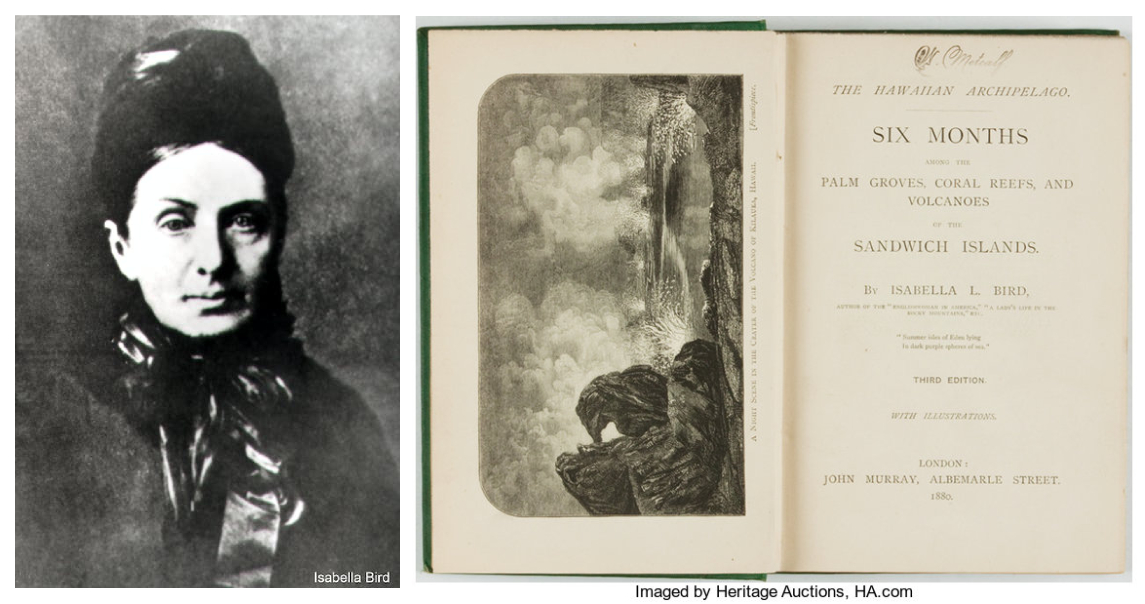
Джон Бодам-Уэтем (J.W. Boddam-Whetham), 1876 год
Джон Уэтэм Боддам-Уэтэм был английским натуралистом, путешественником и первоклассным игроком в крикет.
Surf Swimming.
“… sport of surf-swimming if he does not mind being drowned in the attempt. It is very amusing to watch the natives indulging in this favourite game, especially when the sea is rolling in heavily over the reef, and the breakers are large and wild.
It requires a good seat and a light hand to ride on the top of a wave with a saddle consisting only of a long piece of wood, a mere plank, about two feet wide, twelve feet long, and rather pointed at one end.
Armed with these the natives swim out from the beach for a mile or so, dive under the breakers, and finally reach the smooth water beyond the surf.
Here they wait for a very high rolling swell ; as it approaches they balance themselves on their boards, sometimes standing erect, but generally lying or kneeling on them, and away they go on the crest of the wave, always just a little ahead of the breaker, with the speed of race-horses, and all the time enveloped in foam and spray.
On approaching the shore one expects to see them dashed on the rocks, but instead of that they either slip off the board and fall behind the wave, or allow it to pass over them, and in a few moments are far away outside, waiting for another express roller.
The chief skill required for the successful performance of this feat is keeping the head and shoulders just ahead and clear of the great crested wave that rears itself high above and threatens every moment to bury the bold performer.
In fact, he may be said, figuratively, to ride on the neck of the white charger, while holding on by his mane.
I do not see why this attractive sport should not be introduced into England in suitable localities – Brighton, for instance.
It is very exciting to look at, and requires a good deal of nerve, I should think, but I never tried it.
Sharks are prevalent at Hilo, which must add to the hazard and excitement of the game, as I know of nothing more likely to hurry one through the water than a shark at one’s heels.
The surf-board does occasionally come back without its rider, one piercing shriek telling too plainly his sad fate.
Surf-swimming is one of the oldest of the ancient Hawaiian sports, but like all the others, it is fast dying out.
Old surf-riders will tell you that none of the present generation have the skill and courage displayed by their ancestors ; but who ever heard of the present generation approaching the past in anything ?”
Луис Беке (Louis Becke), 1898 год
Австралийский писатель и торговец, любивший путешествовать. Несколько раз он попадал в кораблекрушения и свои приключения с долей вымысла успешно продавал за вознаграждение в виде рассказов.
“Just as my wild-eyed, touzle-headed Gilbert Island cook brought me my early coffee and hard ship biscuit, Toria and Vailele- brown-skinned brother and sister- peeped in through the window, and in their curious bastard Samoan said ’twas a glorious morn to fahaheke.
Now I had learned to fahaheke (use a surf- board), having been instructed therein by the youths and maidens of the village individually and collectively.
And when you have once learned surf-swimming the game takes possession of your innermost soul like unto cycling and golf.
So I said I would come, and instantly my young friends handed me in a surfing costume, a highly indecorous looking girdle of thin strippings of the leaf of the pandanus palm.
This I blushingly declined, preferring a garment of my own design- a pair of dungaree pants razeed from the knees down.
Then, bidding me hurry up and meet the swimming party on the beach, Toria and his sister ran back to the village to attend early morning service, to which the wooden cylinder that did duty for a church bell was already summoning the people.
Now, in some of the Pacific Islands surf-swimming is one of the forbidden things, for many of the native teachers hold the sport to savour of the po uli – i.e., the heathen days- and the young folks can only indulge in the innocent diversion away from the watchful eye of the local Chadband and his alert myrmidons, the village police, among whom all fines are divided.
But in this particular little island we had for our resident missionary a young stalwart Samoan, who did not forbid his flock to dance or sing, nor prohibit the young girls from wearing flowers in their dark locks.
And he himself was a mighty fisherman and a great diver and swimmer, and smoked his pipe and laughed and sang with the people out of the fulness of his heart when they were merry, and prayed for and consoled them in their sorrow.
So we all loved Ioane, the teacher, and Eline, his pretty young wife, and his two jolly little muddy brown infants; for there was no other native missionary like him in all the wide Pacific.
The simple service was soon over, and then there was a great scurrying to and fro among the thatched houses, and presently in twos and threes the young people appeared, hurrying down to the beach and shouting loudly to the white man to follow.
A strong breeze had sprung up during the night, and the long rolling billows, which had sped waveringly along for, perhaps, a thousand miles from beyond the western sea-rim, were sweeping now in quick succession over the wide flat stretch of reef that stood out from the northern end of the island like a huge table.
Two hundred yards in width from the steep-to face it presented to the sea, it ceased, almost as abruptly as it began, in a bed of pure white sand, six feet below the surface of the water; and this sandy bottom continued all the way from the inner edge of the reef to the line of coco-palms fringing the island beach.
At low tide, when the ever-restless rollers dashed vainly against the sea-face of the reef, whose surface was then bared and shining in the sun, this long strip of sheltered water would lay quiet and undisturbed, as clear as crystal and as smooth as a sheet of glass; but as the tide rose the waves came sweeping over the coral barrier and poured noisily over its inner ledge till the lagoon again became as surf-swept and agitated as the sea beyond.
This was the favoured spot with the people for surf-swimming, for when the tide was full the surf broke heavily on the reef, and there was a clear run of half-a-mile from the starting-point on the inner face of the coral table to the soft, white beach.
Besides that, there was not a single rock or mound of coral between the reef and the shore upon which a swimmer might strike- with fatal effect if the danger were not perceived in time.
The north point was quite a mile from the village, and, the tide being very high, we had to follow a path through the coconut groves instead of walking along the beach, for the swirling waves, although well spent when they reached the shore, were washing the butts of the coco-palms, whose matted roots protruded from the sand at high-water mark.
In front of us raced some scores of young children ranging from six years of age to ten, pushing and jostling each other in their eagerness to be first on the scene.
Although the sun was hot already, the breeze was cool and blew strongly in our faces when we emerged from the narrow leafy track out upon the open strand.
Then with much shouting and laughing, and playful thumping of brown backs and shoulders, Timi, the master of ceremonies for the occasion, marshalled us all in line and then gave the word to go, and with a merry shout, mingled with quavering feminine squeaks, away we sprang into the sea, each one pushing his or her surf- board in front, or shooting it out ahead, and trying to reach the reef before anyone else.
And now the slight regard for the conventionalities that had been maintained during the walk from the village vanished, and the fun began- ducking and other aquatic horseplay, hair-pulling, seizing of surf-boards and throwing them back shorewards, and wrestling matches between the foremost swimmers.
The papalagi (white man), swimming between the boy Toria and a short, square-built native named Temana, had succeeded in keeping well in the van, when he was suddenly seized by the feet by two little imps, just as a sweeping roller lifted him high up.
And down the white man went, and away went his surf-board shoreward amid the shrieking laughs of the girls.
“Never mind,” shouted Temana, shaking his black curly head like a water-spaniel; and seizing a board from a girl near him, and pushing her under at the same time, he shot it over towards me; and then Toria, with a wrathful exclamation, caught one of the imps who had caused my disaster and, twining his left hand in her long, floating hair, pitched her board away behind him.
This little incident, however, lost us our places, and amid the merry gibes of some naked infants who were in the ruck, we swam on in face of the slapping seas, and at last gained the edge of the reef, which was now alive with nude, brown-skinned figures, trying to keep their position in the boiling surf for the first grand ” shoot ” shoreward.
Between the lulls of the freqnent seas the water was only about four feet deep, and presently some sort of order was formed, and we awaited the next big roller.
Over the outer reef it reared its greeny crest, curled and broke with thundering clamour, and roared its mile-line length towards us.
Struggling hard to keep our feet on the slippery coral against the swift back-wash, we waited till the white wall of hissing foam was five feet away, and then flung ourselves forward flat upon our boards. Oh, how can one describe the ecstatic feeling that follows as your feet go up and your head and shoulders down, and you seem to fly through the water with the spume and froth of the mighty roller pIa ying about your hair and hissing and singing in your ears?
Half a mile away lies the beach, but you cannot see it, only the plumed crowns of the palms swaying to and fro in the breeze; for your head is low down, and there is nothing visible but a wavering line of shaking green.
Perhaps, if you are adept enough to turn your head to right or left, you will see silhouetted against the snowy wall of foam scores and scores of black heads, and then before you can draw your breath from excitement the beach is before you, and you slip off your board as the wave that has carried you so gloriously in sweeps far up on the shore, amid the vines and creepers which enwrap the sea-laved roots of the coco-palms.
Then back again, up and down over the seas, diving beneath any that are too high and swift to withstand, till you reach the ledge of the reef again and wait another chance.
Not all together do we go this time, for now the swimmers are widely separated, and as we swim out we meet others coming back, flying before the rollers under which we have to dive.
Here and there are those who from long practice and skill disdain to use a board; for springing in front of a curling sea, by a curious trick of hollowing in the back and depressing the head and neck, they fly in before the rolling surge at an amazing speed, beating the water with one hand as they go, and uttering wild cries of triumph as they pass us, struggling seaward.
Others there are who with both hands held together before them, keep themselves well in position amid the boiling rush of waters by a movement of the legs and feet alone.
But, that day, to my mind the girls looked prettiest ot all when, instead of lying prone, they sat upon their boards, and held themselves in position by grasping the sides.
Twice, as we swam out, did we see some twenty or thirty of them mounted slopingly on the face of a curling sea, and with their long, dark locks trailing behind them, rush shoreward enveloped in mist and spray like goddesses of the waves.
Their shrill cries of encouragement to each other, the loud thunder of the surf as it broke upon its coral barrier, the seething hum and hiss of the roller as it impelled them to the beach, and the merry shrieks of laughter that ensued when some luckless girl over-balanced or misguided herself in the midst of the foam, lent a zest of enjoyment to the scene that made one feel himself a child again.
For two hours we swam out again and again to fly shoreward; and at last we met together on the beach, to rest under the shade of the palms, the girls to smoke their banana-leaf sului of strong negro-head tobacco, and the men their pipes, while the younger boys were sent to gather us young drinking-coconuts.
And then we heard a sudden cry of mingled laughter and astonishment; for, tottering along the path, surf-board under arm, came an old man of seventy, nude to his loins.
” Hu! hu!” he cried, and his wrinkled face twisted, and his toothless mouth quivered, “is old Pakia so blind and weak that he cannot fahaheke?
Ah, let but some of ye guide me out and set me before the surf-then will ye will see.”
Poor old fellow!
Like an old troop-horse who dozes in a field, and whose blood tingles to some distant bugle call, the ancient, from his little hut near by, had heard our cries, and his brave old heart had awakened to the call of lusty youth.
And so, earnestly begging the loan of a board from one of the swimmers, he had come to join us. And then two merry- hearted girls, taking him to the water’s edge, swam out with him to the reef amid our wild cheers and laughter.
They soon reached the starting-point, and then a roar of delight went up from us as we saw them place the ancient on his board, his knees to his chin, and his hands grasping the sides.
Then, as a bursting roller thundered along and swept down upon them, they gave him a shove and sprang before it themselves-one on each side.
And, old and half blind as he was, he came in like an arrow from the bow of a mighty archer, his scanty white locks trailing behind his poor old head like the frayed-out end of a manilla hawser, his face set, and his feeble old throat crowing a quavering, shaking note of triumph as he shot up to the very margin of the beach, amid a roar of applause from the naked and admiring spectators.
Poor old Pakia!
Well indeed art thou entitled to this stick of tobacco from the white man to console thy cheery and venerable old pagan soul in the watches of the night.”
Выводы: вопреки популярному мнению, о серфинге писали, о серфинге думали и популяризировали его не только известные всем Дюк Каханамоку, Джордж Фрит и Александр Хьюм, но и иные люди, благодаря которым серфинг остался на века в литературе, газетных архивах и теперь – в наших умах!
Материал получился объемный и содержательный! Надеюсь вам понравилось прочитанное, будем рады отзывам, делитесь с друзьями!
Автор: Настя Цейслер